We use Google Analytics to understand how visitors use this site. Analytics cookies are only activated with your consent. For details, read our Privacy Policy.
Profile lensThe same player, read from a different angle.
Athletic81
Acceleration
77
Pace
82
Agility
86
Strength
74
Balance
78
Jumping
78
Stamina
87
Fitness
85
Technical84
Dribbling
90
Short Passing
83
Long Passing
88
Finishing
81
Shot Accuracy
74
Shot Power
82
Shooting Technique
83
Heading
69
Tackling
72
Crossing
83
Free Kick
82
Penalties
77
First Touch
88
Mental78
Composure
76
Aggression
85
Consistency
80
Creativity
85
Leadership
74
Work Rate
80
Tactical84
Vision
84
Off the Ball
82
Defensive Positioning
69
Teamwork
92
Anticipation
82
Marking
62
Attacking78
Crossing
83
Finishing
81
Heading Accuracy
69
Shot Accuracy
74
Off the Ball
82
Technique86
Dribbling
90
Free Kick
82
Short Passing
83
Long Passing
88
First Touch
88
Shot Technique
83
Movement81
Acceleration
77
Pace
82
Agility
86
Balance
78
Physicality81
Shot Power
82
Jumping
78
Stamina
87
Strength
74
Fitness
85
Defending68
Marking
62
Tackling
72
Def. Positioning
69
Mentality & Game Reading82
Aggression
85
Composure
76
Penalties
77
Vision
84
Leadership
74
Work Rate
80
Teamwork
92
Anticipation
82
Consistency
80
Creativity
85
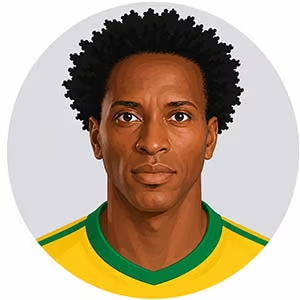
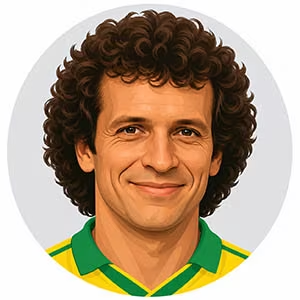
Brazil - Centre MidfielderZé Roberto
Zé Roberto’s career was defined by transformation. Initially a fast, technically gifted left-sided player, he could operate as a wing-back, wide midfielder or attacking midfielder, carrying possession through acceleration and combining naturally on his left foot. With age he moved increasingly toward central midfield, where stamina, balance, ball retention and tactical awareness became more important than pure speed. He pressed intelligently, offered short passing angles, carried the ball through midfield and recovered position repeatedly, allowing more attacking teammates greater freedom. Portuguesa launched his senior career before Real Madrid signed him in 1997. The move came too early for him to establish himself consistently, although he made 21 first-team appearances and belonged to squads that won La Liga and the Champions League. After returning briefly to Brazil, he rebuilt himself at Bayer Leverkusen, becoming a major component of the side that reached the 2002 Champions League final and narrowly missed both Bundesliga and German Cup success. Bayern Munich signed him that summer. Across two spells he won four Bundesliga-and-DFB-Pokal doubles and adapted from attacking wide player into increasingly complete midfielder. Later periods with Santos, Hamburg, Al-Gharafa and Grêmio preceded an extraordinary final chapter at Palmeiras, where he remained a major first-team contributor into his forties and won the 2015 Copa do Brasil and 2016 Brazilian championship. For Brazil he earned 84 caps, won two Copa América titles, finished runner-up at the 1998 World Cup and was selected in the tournament’s All-Star Team in 2006.
His versatility sometimes disguised the absence of a single dominant specialty. Zé Roberto could carry, pass, press, defend and support attacks, but he was neither an elite final-third creator nor a specialist defensive midfielder capable of controlling central space alone. His best performances depended on movement around him and tactical freedom to connect phases. When positioned too high against compact opponents he could struggle to create decisive actions from static situations; when used too defensively, his relatively modest size limited his influence in sustained aerial and physical battles. At Real Madrid, the problem was partly self-created. Zé Roberto has admitted that as a young player he slept badly, ate poorly, arrived at training tired and allowed distractions away from football to damage his preparation. His later longevity should not erase that failure. Nor could physical preparation remove ageing entirely: once acceleration declined, his game required increasing tactical economy and more careful management of recovery.
Psychologically, Zé Roberto is most valuable as evidence that conscientiousness can change dramatically across a career. He has described his Real Madrid period without protecting his younger self, explicitly blaming his own habits rather than the club for failing to establish himself. Years later he identified Fernando Hierro and Fernando Redondo as examples who had shown him what professional preparation actually looked like: senior players who remained after training and treated routine as part of performance. He gradually copied that behaviour. By his thirties, and particularly after noticing slower recovery at Grêmio in 2012, he began organising diet, rest, recovery work and additional physical maintenance with extraordinary precision, eventually playing professionally until 43. That transformation also affected his leadership. At Palmeiras he increasingly became a reference for younger players, framing preparation and competitive standards through daily behaviour rather than demanding authority through status. Failure remained emotionally meaningful. His exclusion from Brazil’s 2002 World Cup squad came during what he regarded as one of the best seasons of his career, and he later described it as one of his deepest professional frustrations; in a 2026 interview he admitted that he initially refused even to watch the tournament. Yet he did not build a public feud with Luiz Felipe Scolari or withdraw from international ambition. He returned, continued competing for selection and produced arguably his strongest World Cup four years later. That pattern separates emotional hurt from retaliatory behaviour. Criticism and exclusion could penetrate deeply, but the mature Zé Roberto generally converted them into preparation rather than confrontation. There is similarly little evidence of habitual escalation toward referees or opponents. His competitive aggression was expressed through running, pressing and availability more than intimidation. Major occasions did not appear to narrow him once his professional habits had stabilised: the 2002 Champions League run, Bayern’s title campaigns and the 2006 World Cup all found him tactically dependable. The central contradiction therefore remains essential. Zé Roberto did not possess immutable discipline. He learned it after experiencing what happened without it, then turned that lesson into the organising principle of the second half of his career.