We use Google Analytics to understand how visitors use this site. Analytics cookies are only activated with your consent. For details, read our Privacy Policy.
Profile lensThe same player, read from a different angle.
Athletic81
Acceleration
76
Pace
84
Agility
75
Strength
90
Balance
77
Jumping
83
Stamina
78
Fitness
82
Technical82
Dribbling
79
Short Passing
71
Long Passing
68
Finishing
92
Shot Accuracy
88
Shot Power
84
Shooting Technique
90
Heading
85
Tackling
33
Crossing
61
Free Kick
65
Penalties
73
First Touch
79
Mental80
Composure
85
Aggression
76
Consistency
82
Creativity
69
Leadership
75
Work Rate
74
Tactical85
Vision
72
Off the Ball
92
Defensive Positioning
33
Teamwork
81
Anticipation
93
Marking
30
Player Traits
Attacking84
Crossing
61
Finishing
92
Heading Accuracy
85
Shot Accuracy
88
Off the Ball
92
Technique75
Dribbling
79
Free Kick
65
Short Passing
71
Long Passing
68
First Touch
79
Shot Technique
90
Movement78
Acceleration
76
Pace
84
Agility
75
Balance
77
Physicality83
Shot Power
84
Jumping
83
Stamina
78
Strength
90
Fitness
82
Defending32
Marking
30
Tackling
33
Def. Positioning
33
Mentality & Game Reading78
Aggression
76
Composure
85
Penalties
73
Vision
72
Leadership
75
Work Rate
74
Teamwork
81
Anticipation
93
Consistency
82
Creativity
69
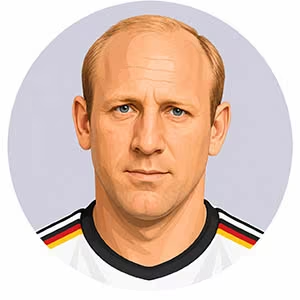
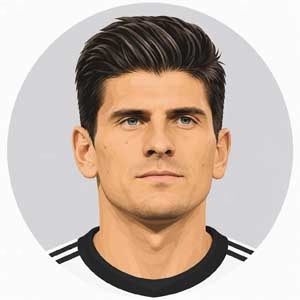
Germany - StrikerGómez, Mario
Mario Gómez scored the only goal of Germany's opening match at Euro 2012, expected relief and support to follow, and instead found the criticism just as sharp as before — a striker with two prolific Bundesliga seasons behind him still carrying the label of a player who disappeared at major tournaments, having gone scoreless at Euro 2008 and the 2010 World Cup. Two games later, after a brace against the Netherlands, he ran toward the away end in celebration, then simply turned around without celebrating at all. He said afterward it felt more like relief than joy.
Born in Riedlingen, in southwest Germany, in 1985 to a Spanish father and German mother, Gómez was a classical penalty-box striker in an era when the position was increasingly falling out of tactical fashion — tall, physically strong, an exceptional finisher with either foot and in the air, whose value depended on precise positioning inside the box rather than dropping deep or drifting wide to combine. He idolized flair players as a boy, watching Bundesliga highlights with his father and admiring Jay-Jay Okocha's trickery, and wanted to play like Romário, but his frame and instincts pointed him toward a more direct, predatory game instead, and he never fought that fact. He came through Stuttgart's academy, becoming German Footballer of the Year in his second full season, before a club-record move to Bayern Munich in 2009 turned him into one of the Bundesliga's most productive forwards — 28 league goals to win the Golden Boot in 2010–11, and 41 in all competitions the following season, five hat-tricks in a single campaign, one shy of Gerd Müller's record. He won two Bundesliga titles, two DFB-Pokals and the 2013 Champions League with Bayern, though a difficult two-year spell at Fiorentina, hampered by injuries, followed almost immediately after the treble. Later stints at Beşiktaş, Wolfsburg and a return to Stuttgart closed out his career in 2020. For Germany he won 78 caps and 31 goals across three European Championships and two World Cups, reaching the 2010 semi-final and lifting the trophy in 2014 — though injury and lost form kept him out of that winning squad, a title he watched rather than played for.
His limitations were tied specifically to the gap between his club form and his tournament form, a pattern discussed so often in German football that it became its own storyline. Gómez missed four clear chances against Real Madrid in a Champions League semi-final before scrambling in an ugly winner, and his profligacy in the 2012 Champions League final at his own home stadium was widely cited as the single biggest reason Bayern lost it. He offered almost nothing outside the penalty area — no pressing, minimal link play, little defensive contribution — making him entirely dependent on service from teammates capable of delivering it, and coaches who favored interchange and possession-based systems over a fixed target man periodically left him out in favor of more mobile forwards like Miroslav Klose.
Temperamentally he was sensitive to public criticism in a way he discussed unusually openly for an elite striker, without ever letting it curdle into resentment toward the game itself. He described the pressure before that Euro 2012 match against the Netherlands as enormous, said it left him unable to play with the freedom he wanted, and credited a private word from coach Joachim Löw — reassurance rather than tactics — with settling him before he delivered. He was explicit that his priority was the team's result over his own scoring tally, repeating at Euro 2012 that he wanted to win the tournament rather than the Golden Boot, and at the 2018 World Cup he publicly and directly criticized German media for turning personal after a group-stage loss to Mexico, drawing a clear line between fair criticism of performance and what he considered unfair attacks on individuals — a rare instance of a player pushing back on press treatment of teammates rather than only himself. He described his approach to missed chances with dry self-awareness rather than denial: a striker's job, he said, is mostly to forget. He spoke warmly of Kevin Kurányi and Klose mentoring him as a young player and, as he aged into the senior role himself, made a deliberate effort to be the same figure for younger internationals. Away from the pitch he was known almost as much for his personal style and fashion sense as for his football, a detail that made him a distinctive public figure in German sport without ever becoming a source of controversy. Resilient under sustained scrutiny, quietly team-oriented beneath a game built on individual finishing, and willing to defend teammates publicly when he felt the press had crossed a line, Gómez spent his biggest moments proving a specific, narrow doubt wrong rather than chasing acclaim for its own sake.


 All Time Bayern MunichClub