We use Google Analytics to understand how visitors use this site. Analytics cookies are only activated with your consent. For details, read our Privacy Policy.
Profile lensThe same player, read from a different angle.
Athletic80
Acceleration
84
Pace
82
Agility
85
Strength
68
Balance
75
Jumping
70
Stamina
86
Fitness
86
Technical82
Dribbling
85
Short Passing
77
Long Passing
82
Finishing
82
Shot Accuracy
77
Shot Power
83
Shooting Technique
85
Heading
65
Tackling
54
Crossing
78
Free Kick
71
Penalties
70
First Touch
88
Mental83
Composure
84
Aggression
74
Consistency
80
Creativity
83
Leadership
84
Work Rate
82
Tactical79
Vision
80
Off the Ball
82
Defensive Positioning
55
Teamwork
87
Anticipation
77
Marking
48
Attacking77
Crossing
78
Finishing
82
Heading Accuracy
65
Shot Accuracy
77
Off the Ball
82
Technique81
Dribbling
85
Free Kick
71
Short Passing
77
Long Passing
82
First Touch
88
Shot Technique
85
Movement82
Acceleration
84
Pace
82
Agility
85
Balance
75
Physicality79
Shot Power
83
Jumping
70
Stamina
86
Strength
68
Fitness
86
Defending52
Marking
48
Tackling
54
Def. Positioning
55
Mentality & Game Reading80
Aggression
74
Composure
84
Penalties
70
Vision
80
Leadership
84
Work Rate
82
Teamwork
87
Anticipation
77
Consistency
80
Creativity
83
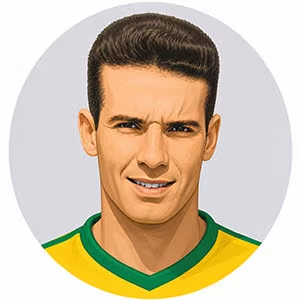
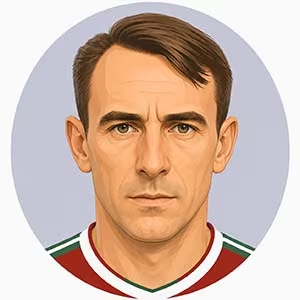
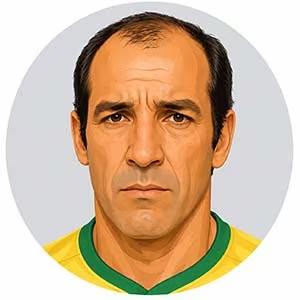
Brazil - Left WingerZagallo, Mário
The first man in history to conquer the FIFA World Cup as both a player and a manager spent his playing days fundamentally reinventing the tactical parameters of the wide attacker. Mário Jorge Lobo Zagallo—immortalized across Brazil as O Velhinho or Formiguinha (The Little Ant)—was the tireless, tactically revolutionary outside-left who provided the defensive cover, positional balance, and transition running that allowed Pelé, Garrincha, and Vavá the freedom to destroy opponents in 1958 and 1962.
Stationed nominally on the left wing, Zagallo was decades ahead of his time: dropping back thirty yards to act as an auxiliary fourth midfielder without possession, cutting off passing lanes, and instantly springing forward on the counter to deliver pinpoint crosses into the box. At club level, he was the tactical fulcrum of legendary sides at Flamengo (winning three consecutive Campeonato Carioca titles between 1953 and 1955) and Botafogo, collecting two state titles and two Torneio Rio-São Paulo trophies alongside Garrincha and Nilton Santos. For Brazil, across 33 caps and five goals, he started every match in both the 1958 and 1962 World Cup triumphs, scoring in the 1958 final against Sweden.
Zagallo’s specialized game was built strictly around collective equilibrium rather than individual flamboyance. He lacked the hypnotic, individual dribbling wizardry of a Garrincha or the sheer athletic power of contemporary European wide men, and his goal tally was modest because he spent so much energy running the length of the pitch to track opposition full-backs. If a tactical setup demanded a selfish, high-volume dribbler to take on triple-teams in the corner, his methodical, team-first approach was not built for that role.
Disciplined, intensely superstitious, and possessing an unyielding tactical brain, Zagallo approached football as a grand strategic puzzle. He had zero interest in personal vanity, taking immense pride in the exhausting running that kept the Seleção defensively sound. On the pitch, his presence was constant and communicative: barking tactical cues, shifting defensive lines, and leading by relentless physical example. Inside the dressing rooms of Botafogo, Flamengo, and the national team, he commanded immense authority—a respected tactical pioneer whose intellect, patriotism, and record four World Cup trophies (two as player, one as head coach in 1970, one as assistant in 1994) make him one of the most towering and decorated figures in the history of the sport.