We use Google Analytics to understand how visitors use this site. Analytics cookies are only activated with your consent. For details, read our Privacy Policy.
Profile lensThe same player, read from a different angle.
Athletic83
Acceleration
75
Pace
77
Agility
74
Strength
83
Balance
86
Jumping
83
Stamina
92
Fitness
91
Technical81
Dribbling
79
Short Passing
83
Long Passing
80
Finishing
65
Shot Accuracy
72
Shot Power
85
Shooting Technique
76
Heading
85
Tackling
86
Crossing
76
Free Kick
68
Penalties
82
First Touch
81
Mental82
Composure
82
Aggression
88
Consistency
80
Creativity
70
Leadership
84
Work Rate
88
Tactical83
Vision
81
Off the Ball
69
Defensive Positioning
83
Teamwork
89
Anticipation
84
Marking
84
Player Traits
Attacking73
Crossing
76
Finishing
65
Heading Accuracy
85
Shot Accuracy
72
Off the Ball
69
Technique78
Dribbling
79
Free Kick
68
Short Passing
83
Long Passing
80
First Touch
81
Shot Technique
76
Movement78
Acceleration
75
Pace
77
Agility
74
Balance
86
Physicality87
Shot Power
85
Jumping
83
Stamina
92
Strength
83
Fitness
91
Defending84
Marking
84
Tackling
86
Def. Positioning
83
Mentality & Game Reading83
Aggression
88
Composure
82
Penalties
82
Vision
81
Leadership
84
Work Rate
88
Teamwork
89
Anticipation
84
Consistency
80
Creativity
70
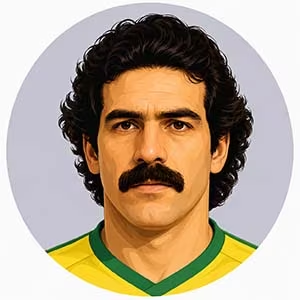
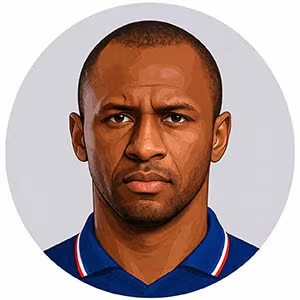
Brazil - Defensive MidfielderSilva, Gilberto
Born in Lagoa da Prata, Minas Gerais, in 1976, Gilberto was a defensive midfielder built on positioning, timing and clean interception rather than physical aggression. At 1.83m he was solid without being imposing, and his defining quality was reading the game a step ahead — cutting out passing lanes before the ball arrived, screening the back four, and recycling possession simply and effectively rather than attempting to dictate play himself. He emerged at Atlético Mineiro and moved to Europe via Grêmio, but his defining club chapter came at Arsenal, which he joined in 2002 having just won the World Cup and where he stayed for six seasons, making 253 appearances and forming the defensive foundation of the Invincibles alongside Patrick Vieira. He won two Premier League titles and three FA Cups, and later closed his career at Panathinaikos. His international peak came earlier and higher: a starting defensive midfielder in Brazil's 2002 World Cup-winning side, playing behind an attacking line of Ronaldo, Rivaldo and Ronaldinho, and scoring in the opening match of that tournament against Turkey. He won 93 caps for Brazil across a decade.
His limitations were the direct inverse of his strengths. Gilberto offered almost nothing going forward beyond a simple, reliable pass, rarely arrived in the box, and scored infrequently even by the modest standards of his position. He was not a dominant physical presence and depended on positioning rather than power to win individual duels, which made him less effective against powerful, direct central midfielders who could simply outmuscle him in congested areas. His game contained no individual moment capable of deciding a match alone, which meant his value was consistently underestimated by anyone judging him on isolated highlights rather than on what did not happen around him.
Temperamentally he was as understated as his football. Gilberto was calm to the point of near-invisibility in press coverage across two decades of top-level football, rarely quoted, rarely controversial, and entirely without the demonstrative expressiveness that Brazilian football usually produces in its attacking players. He defended cleanly rather than aggressively, accumulating one of the lowest disciplinary records of any defensive midfielder of his generation despite a role that invites contact constantly — a testament to anticipation over confrontation. He rarely argued with referees, did not simulate, and responded to physical treatment by repositioning rather than retaliating. Inside the Arsenal dressing room he was respected as a stabilising, low-maintenance professional, trusted by Vieira and later by the younger midfielders who followed him without ever seeking the captaincy or the spotlight himself. He integrated into English football with minimal friction, adapting to the league's physical demands without the adjustment period some technical players require, and his conduct across two decades in three countries produced no incident of note. Away from football he was private and family-oriented, and he later worked in Brazilian football administration in a similarly understated capacity. Composed, thorough and deliberately unremarkable, Gilberto Silva built two decades of elite football on the premise that the best possible outcome is the one nobody has to talk about.



 All Time ArsenalClub