We use Google Analytics to understand how visitors use this site. Analytics cookies are only activated with your consent. For details, read our Privacy Policy.
Profile lensThe same player, read from a different angle.
Athletic78
Acceleration
75
Pace
70
Agility
80
Strength
85
Balance
82
Jumping
83
Stamina
67
Fitness
82
Technical44
Dribbling
51
Short Passing
56
Long Passing
59
Shot Accuracy
44
Shot Power
74
Shooting Technique
42
Heading
52
Free Kick
48
Penalties
44
First Touch
55
Mental78
Composure
81
Consistency
74
Leadership
70
Goalkeeping87
Reflexes
93
Positioning
85
Handling
85
Kicking
86
Goalkeeping87
Reflexes
93
Positioning
85
Handling
85
Kicking
86
Attacking48
Heading Accuracy
52
Shot Accuracy
44
Technique52
Dribbling
51
Free Kick
48
Short Passing
56
Long Passing
59
First Touch
55
Shot Technique
42
Physicality78
Shot Power
74
Jumping
83
Stamina
67
Strength
85
Fitness
82
Movement77
Acceleration
75
Pace
70
Agility
80
Balance
82
Mentality & Game Reading67
Composure
81
Penalties
44
Leadership
70
Consistency
74
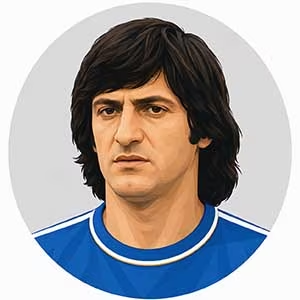
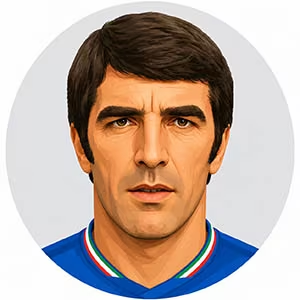
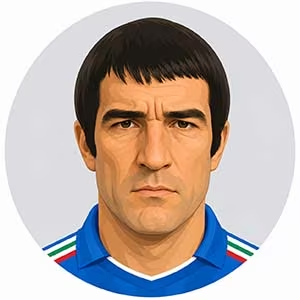
Italy - GoalkeeperGarella, Claudio
The legendary Gianni Brera once famously quipped that he was "the best goalkeeper in the world, without hands," yet an unorthodox shot-stopper from Rome became the ultimate lucky charm and defensive rock behind two of the most romantic, historic Scudetti in Italian football history. Claudio Garella—immortalized across Italy simply as Garellik—completely rewrote the textbook of goalkeeping aesthetics by turning body-blocking with his feet, shins, thighs, and chest into a lethal art form. Standing six-foot-two with an awkward, heavy build and deceptive flexibility, Garella was the undisputed foundation of Osvaldo Bagnoli’s mythic Hellas Verona (lifting the impossible 1984–85 Scudetto) before moving south to anchor Diego Maradona’s SSC Napoli, capturing the historic 1986–87 league and Coppa Italia double. He possessed uncanny positional intuition and rapid ground-level reflexes: kicking away goal-bound strikes on the line, smothering point-blank chances with sprawling hockey-style saves, and using his physical bulk to shut down one-on-one isolations.
Yet Garella’s unorthodox, chaotic technique naturally came with glaring aesthetic and mechanical liabilities. His handling on routine, catching saves was notoriously erratic, frequently leading to dropped balls or awkward parries that produced frantic goalmouth scrambles. When forced to play high balls outside his six-yard box, his aerial command lacked elegance, and his distribution with his feet under back-pass pressure was rudimentary and risk-laden, occasionally resulting in comic, high-profile blunders (garellate).
Unpretentious, cheerful, and possessing an ironic, self-deprecating humor, Garella was completely indifferent to critics who mocked his awkward style. He cared only about whether the ball crossed the white line, laughing off media ridicule and letting his championship medals do the talking. On the pitch, his presence was relaxed and reassuring: picking himself up casually after making a bizarre foot save and resetting his defense with a wry smile. Inside the Verona and Napoli locker rooms, he was an immensely popular, beloved figure—adored by Maradona, trusted implicitly by Bagnoli and Ottavio Bianchi, and cherished by supporters for his blue-collar authenticity. Strikers found his sprawling, unconventional blocking nearly impossible to read in one-on-one situations, cementing an eternal legacy as the most original, successful, and unforgettable cult hero in the history of Italian goalkeeping.