We use Google Analytics to understand how visitors use this site. Analytics cookies are only activated with your consent. For details, read our Privacy Policy.
Profile lensThe same player, read from a different angle.
Athletic79
Acceleration
71
Pace
74
Agility
73
Strength
82
Balance
87
Jumping
80
Stamina
88
Fitness
77
Technical82
Dribbling
80
Short Passing
85
Long Passing
82
Finishing
73
Shot Accuracy
71
Shot Power
84
Shooting Technique
76
Heading
84
Tackling
84
Crossing
75
Free Kick
72
Penalties
70
First Touch
83
Mental83
Composure
81
Aggression
88
Consistency
85
Creativity
73
Leadership
82
Work Rate
88
Tactical83
Vision
82
Off the Ball
73
Defensive Positioning
83
Teamwork
92
Anticipation
83
Marking
80
Player Traits
Attacking75
Crossing
75
Finishing
73
Heading Accuracy
84
Shot Accuracy
71
Off the Ball
73
Technique80
Dribbling
80
Free Kick
72
Short Passing
85
Long Passing
82
First Touch
83
Shot Technique
76
Movement76
Acceleration
71
Pace
74
Agility
73
Balance
87
Physicality82
Shot Power
84
Jumping
80
Stamina
88
Strength
82
Fitness
77
Defending82
Marking
80
Tackling
84
Def. Positioning
83
Mentality & Game Reading82
Aggression
88
Composure
81
Penalties
70
Vision
82
Leadership
82
Work Rate
88
Teamwork
92
Anticipation
83
Consistency
85
Creativity
73
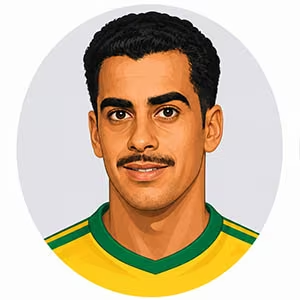
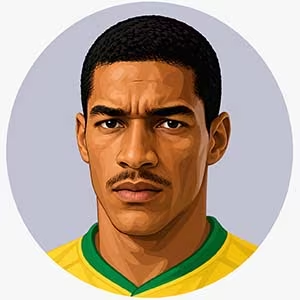
Brazil - Defensive MidfielderEmerson, da Rosa
Technically and tactically, Emerson was a holding midfielder with considerably more ball-playing ability than the stereotype attached to his physical profile suggested. Strong, mobile and positionally disciplined, he protected central space, recovered possession and provided the first secure connection after turnovers. He could carry the ball forward, play through pressure and arrive around the box, but his primary value came from allowing more adventurous teammates to operate ahead of him without destabilising the team. At Bayer Leverkusen, Roma and Juventus he developed into one of the most trusted midfielders in Europe, and Fabio Capello repeatedly used him as a structural reference because Emerson understood spacing, second-ball control and defensive transition. His period at Roma produced a Serie A title in 2001; at Juventus he became a central figure in Capello’s midfield before following him to Real Madrid in 2006. Emerson himself later explained that he had absorbed Capello’s football ideas over several years and praised the coach’s insistence on collective discipline: common travel, equal rules and the reduction of individual privilege. That compatibility is important. Emerson was not simply obedient; he functioned best in environments where hierarchy was strict but the principles were legible.
His limitations became clearer when the physical and contextual conditions changed. Emerson’s game depended on mobility across short and medium distances, body strength in contact and the ability to arrive early enough that duels remained controllable rather than desperate. At Real Madrid, already thirty, he struggled initially with the tempo and spatial demands of Spanish football and later admitted that his first six months had been poor before he adapted more effectively during the second half of the season. He was never a pure tempo controller who could dominate possession through constant progressive passing, nor a highly creative midfielder capable of solving compact defensive structures by himself. As his acceleration declined, the same aggressive positional habits could make him look slower because he reached contests later and had less margin to recover. The Bernabéu period therefore exposed a genuine performance degradation rather than merely hostile perception: Capello himself acknowledged at one point that Emerson was moving slowly. But the criticism surrounding him also exceeded purely technical evaluation, in part because he had arrived as one of Capello’s trusted players. Emerson later said that poor reactions to the coach were often redirected toward him, Cannavaro and Roberto Carlos. Physical decline and reputational pressure must therefore remain separate explanations.
Psychologically, Emerson is best defined by high burden tolerance combined with strong sensitivity to perceived disrespect. He accepted heavy tactical responsibility, strict coaching and low-glamour work without needing symbolic centrality. His praise for Capello’s discipline at Real Madrid is explicit: Emerson admired a system in which stars travelled together, followed common rules and were treated as members of one team rather than protected brands. Yet his response to the Bernabéu crowd shows that this tolerance did not extend to indiscriminate public humiliation. In December 2006 he said that criticism itself did not offend him, but that the treatment he was receiving lacked respect and could “ruin” a twenty-year-old player. That distinction is unusually useful: he did not deny poor form, but objected to the transformation of performance criticism into personal delegitimisation. His departure from Roma reveals the same mechanism in another direction. Years later he explained that he had been a leader in the dressing room and understood the supporters’ anger when he chose Juventus, but insisted that the president had previously promised to sell him and then reversed that promise; Emerson pushed for the agreement to be honoured even though the decision damaged his standing with Roma supporters. This was not simple status defensiveness. He could sacrifice popularity when he believed an explicit commitment had been broken. Conversely, he did not automatically rebel against authority: Capello remained one of the coaches he trusted most. Evidence for habitual referee conflict, retaliatory aggression or teammate-directed blame is insufficient and should remain unknown. The stronger pattern is contractual respect sensitivity: Emerson could absorb workload, criticism and subordination when the rules felt coherent, but reacted much more sharply when he believed respect, promises or attribution of responsibility had become unfair.



 All Time RomaClub