We use Google Analytics to understand how visitors use this site. Analytics cookies are only activated with your consent. For details, read our Privacy Policy.
Profile lensThe same player, read from a different angle.
Athletic82
Acceleration
92
Pace
85
Agility
87
Strength
73
Balance
77
Jumping
77
Stamina
82
Fitness
80
Technical83
Dribbling
91
Short Passing
77
Long Passing
79
Finishing
85
Shot Accuracy
85
Shot Power
81
Shooting Technique
80
Heading
71
Tackling
36
Crossing
76
Free Kick
71
Penalties
72
First Touch
87
Mental78
Composure
79
Aggression
80
Consistency
78
Creativity
88
Leadership
79
Work Rate
74
Tactical76
Vision
78
Off the Ball
85
Defensive Positioning
40
Teamwork
74
Anticipation
77
Marking
38
Player Traits
Attacking80
Crossing
76
Finishing
85
Heading Accuracy
71
Shot Accuracy
85
Off the Ball
85
Technique81
Dribbling
91
Free Kick
71
Short Passing
77
Long Passing
79
First Touch
87
Shot Technique
80
Movement85
Acceleration
92
Pace
85
Agility
87
Balance
77
Physicality79
Shot Power
81
Jumping
77
Stamina
82
Strength
73
Fitness
80
Defending38
Marking
38
Tackling
36
Def. Positioning
40
Mentality & Game Reading78
Aggression
80
Composure
79
Penalties
72
Vision
78
Leadership
79
Work Rate
74
Teamwork
74
Anticipation
77
Consistency
78
Creativity
88
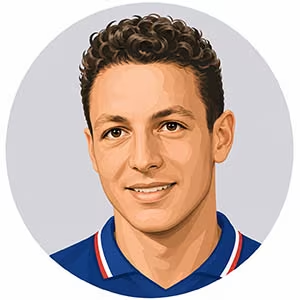
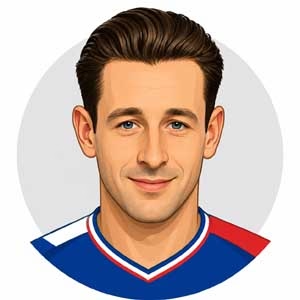
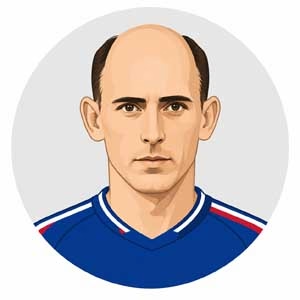
France - Left WingerVincent, Jean
At the Parc des Princes on 6 July 1960, France were 4–2 ahead of Yugoslavia with fifteen minutes remaining in the inaugural European Championship semi-final. Jean Vincent, wearing the captain’s armband, had already cancelled out Yugoslavia’s opening goal almost immediately and later created France’s third. Then the match disintegrated. Yugoslavia scored three times in a few minutes and won 5–4, turning what seemed a controlled passage to the final into one of France’s most abrupt international collapses. Vincent completed the match and three days later again captained the side in the third-place game against Czechoslovakia, another defeat. It was a useful test of a player whose career had usually placed him inside successful collective structures. Two years earlier he had played every match of France’s run to third place at the 1958 World Cup; with Lille and Reims he accumulated championships, cups and two European Cup finals. What distinguishes the 1960 episode is not that Vincent somehow prevented collapse—he clearly did not—but that neither the sudden reversal nor the increased responsibility of captaincy changed his willingness to remain involved in the attacking work.
Vincent was primarily a left winger, but considerably less restricted than the label suggests. At his best he combined direct running, a strong left foot and considerable scoring instinct with enough tactical adaptability to move inside when the structure demanded it. His 22 goals in 46 internationals are unusually productive numbers for a wide attacker of his period. During the 1958 World Cup Albert Batteux repeatedly altered his position: against Scotland Vincent was moved into a deeper half-back role so Roger Piantoni could advance, the adjustment was retained against Northern Ireland, and after Robert Jonquet’s injury against Brazil he was asked to operate centrally and help mark Didi. Four days later he returned to the wing as France defeated West Germany 6–3. That flexibility fits his club career. He won the league and two French Cups with Lille, then moved to Reims in 1956 and added three more championships, another cup and the 1959 European Cup final. He was therefore not merely a touchline supplier: he could score, combine, cross and temporarily absorb responsibilities normally assigned to midfielders.
The breadth of those assignments should not obscure his limitations. Vincent’s most valuable actions still depended on forward-facing situations in which he could move onto the ball rather than spend long periods controlling possession under static pressure. He was technically secure and tactically educated, but not the primary manipulator of rhythm in teams containing players whose game depended much more heavily on possession. Reims could ask him to adapt around those players because his own contribution survived without monopolising the ball. That same property could make him less influential when the match denied running lanes and demanded repeated creation from a standing start. His later international use also demonstrates adaptation rather than timeless athletic superiority. In his final France appearance in 1961 he was assigned to mark Paul Van Himst and effectively played as a defender for the first time. The capacity to perform such work speaks well for his tactical understanding, but it also reflects a player whose role was being reconstructed as his career advanced. There is insufficient evidence to attribute France’s defensive collapses in 1960 to Vincent’s psychological degradation; they are better treated as collective tactical failures occurring while he continued to contribute.
Psychologically, Vincent’s most useful documented characteristic is **status permeability**: seniority and authority did not appear to require social distance from players below him in the hierarchy. Bernard Hiegel, who arrived at Reims as a young player in 1960, remembered entering a tiny squad dominated by established internationals where opportunities for newcomers were extremely limited. Within that environment Vincent was, in Hiegel’s recollection, probably the senior player closest to the younger members: he took them fishing and, together with Just Fontaine, became an important social presence whose long exchanges animated team meals. That evidence matters because Vincent simultaneously occupied genuine competitive status. He captained France during the 1960 European Championship and continued wearing the armband through a sequence that included the Yugoslavia collapse, the subsequent defeat to Czechoslovakia and later internationals. His leadership therefore did not require maintaining interpersonal distance or protecting symbolic rank. Nor does the surviving material justify turning conviviality into low competitiveness: he remained a scoring international, accepted positional reassignment during major tournaments and continued to perform functional work even when moved away from his preferred flank. Evidence is too weak to score reactions to referees, individual provocation, teammates’ mistakes or hostile crowds, and no distinctive retaliatory aggression should be invented. What can be defended is narrower: **Vincent could occupy senior status without socially hardening the hierarchy around him**, while tactically accepting assignments that reduced his individual visibility. That combination suggests leadership through integration rather than authority through distance.