We use Google Analytics to understand how visitors use this site. Analytics cookies are only activated with your consent. For details, read our Privacy Policy.
Profile lensThe same player, read from a different angle.
Athletic81
Acceleration
83
Pace
81
Agility
82
Strength
84
Balance
83
Jumping
77
Stamina
79
Fitness
77
Technical87
Dribbling
94
Short Passing
83
Long Passing
85
Finishing
85
Shot Accuracy
84
Shot Power
83
Shooting Technique
91
Heading
78
Tackling
44
Crossing
86
Free Kick
84
Penalties
81
First Touch
94
Mental80
Composure
84
Aggression
85
Consistency
78
Creativity
92
Leadership
80
Work Rate
74
Tactical78
Vision
84
Off the Ball
85
Defensive Positioning
40
Teamwork
77
Anticipation
76
Marking
38
Player Traits
Attacking84
Crossing
86
Finishing
85
Heading Accuracy
78
Shot Accuracy
84
Off the Ball
85
Technique89
Dribbling
94
Free Kick
84
Short Passing
83
Long Passing
85
First Touch
94
Shot Technique
91
Movement82
Acceleration
83
Pace
81
Agility
82
Balance
83
Physicality80
Shot Power
83
Jumping
77
Stamina
79
Strength
84
Fitness
77
Defending41
Marking
38
Tackling
44
Def. Positioning
40
Mentality & Game Reading81
Aggression
85
Composure
84
Penalties
81
Vision
84
Leadership
80
Work Rate
74
Teamwork
77
Anticipation
76
Consistency
78
Creativity
92
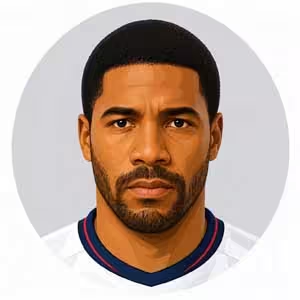
England - Left WingerBarnes, John
A devastating blend of upper-body power, balance, and velvet close control allowed John Charles Bryan Barnes to redefine wide attacking play in English football throughout the late 1980s. Emerging at Watford under Graham Taylor before completing a high-profile move to Kenny Dalglish’s Liverpool in 1987, Barnes broke away from the traditional English template of the linear, chalk-on-the-boots winger. Standing six feet tall with broad shoulders, he could shrug off challenges at full tilt, cut inside onto his lethal left foot, or glide past two markers in congested channels using subtle hip shifts and sudden changes of tempo. In Dalglish's fluent 1987–88 side—alongside Peter Beardsley and John Aldridge—he was unplayable, claiming both the PFA Players' Player of the Year and FWA Footballer of the Year awards. After a ruptured Achilles tendon curtailed his explosive acceleration in the early 1990s, his tactical intellect engineered a successful second act: transitioning into a deep-lying central midfielder who dictated tempo through vision and crisp distribution. Over 400 matches for Liverpool, he won two First Division titles, two FA Cups, and a League Cup. His international trajectory across 79 caps for England—punctuated by his immortal solo goal against Brazil at the Maracanã in 1984—often drew unfair criticism, as England managers struggled to replicate Liverpool’s fluid attacking structure to maximize his talents.
Facing sustained, overt racial hostility across English terraces during the height of the hooligan era, Barnes maintained an extraordinary level of dignity and mental fortitude. The iconic 1988 image of him casually backheeling a banana off the Goodison Park turf captured his refusal to let external hatred disrupt his focus or alter his craft. On the pitch, he carried himself with an effortless, almost languid swagger; he never engaged in petulant outbursts or theatrical simulation, responding to cynical tackles by simply getting up and destroying the full-back on the next sequence. Inside the dressing room, he was an articulate, charismatic, and cultured figure—popular across squad divides and unbothered by tabloid hysteria. When the trauma of the 1989 Hillsborough disaster shook the entire Liverpool community, Barnes became a vital emotional anchor, attending countless funerals and supporting grieving families with quiet, selfless empathy. Toward referees and physical stoppers who used every cynical tactic to slow him down, he maintained an immaculate, dignified posture: letting his technical superiority and physical balance dismantle opponents, leaving an enduring legacy as one of the most gifted and culturally resilient wingers in British football history.