We use Google Analytics to understand how visitors use this site. Analytics cookies are only activated with your consent. For details, read our Privacy Policy.
Profile lensThe same player, read from a different angle.
Athletic82
Acceleration
83
Pace
86
Agility
79
Strength
77
Balance
76
Jumping
82
Stamina
87
Fitness
84
Technical77
Dribbling
78
Short Passing
77
Long Passing
79
Finishing
68
Shot Accuracy
71
Shot Power
78
Shooting Technique
69
Heading
77
Tackling
76
Crossing
78
Free Kick
63
Penalties
64
First Touch
75
Mental77
Composure
76
Aggression
85
Consistency
75
Creativity
68
Leadership
82
Work Rate
78
Tactical76
Vision
74
Off the Ball
77
Defensive Positioning
74
Teamwork
81
Anticipation
76
Marking
70
Attacking74
Crossing
78
Finishing
68
Heading Accuracy
77
Shot Accuracy
71
Off the Ball
77
Technique74
Dribbling
78
Free Kick
63
Short Passing
77
Long Passing
79
First Touch
75
Shot Technique
69
Movement81
Acceleration
83
Pace
86
Agility
79
Balance
76
Physicality82
Shot Power
78
Jumping
82
Stamina
87
Strength
77
Fitness
84
Defending73
Marking
70
Tackling
76
Def. Positioning
74
Mentality & Game Reading76
Aggression
85
Composure
76
Penalties
64
Vision
74
Leadership
82
Work Rate
78
Teamwork
81
Anticipation
76
Consistency
75
Creativity
68
Argentina - Left BackTarantini, Alberto
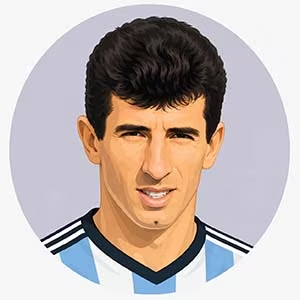
He won the World Cup while unemployed. In the spring of 1978 Alberto Tarantini walked out of Boca Juniors after a contract dispute and refused to sign anywhere, which meant that when César Luis Menotti named him at left-back for the tournament Argentina were hosting, the player wearing the number three shirt in front of seventy thousand people at the Monumental had no club, no wage and no professional obligations of any kind. He played all seven matches. By the time he lifted the trophy on 25 June he was still, technically, a free agent — and entirely unbothered by it.
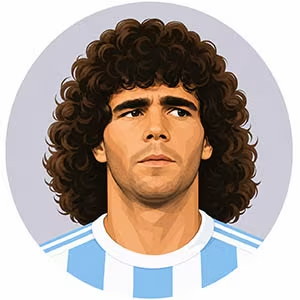
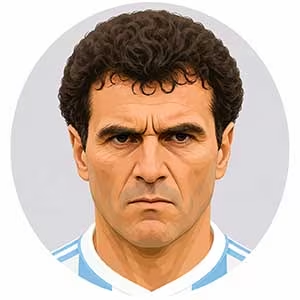
Born in Buenos Aires in 1955 and known as El Conejo, Tarantini was a left-back of the aggressive Argentine school: not tall at 1.75m, physically fearless, and instantly recognisable by a mane of dark curls that made him one of the most visible players of the era. He defended by contact and anticipation rather than positioning, arriving in the tackle hard and early, and he attacked with genuine appetite, overlapping into the final third at a time when full-backs were still expected to stay home. Technically he was solid rather than refined — a functional passer, a good crosser off the run, and a strong header for his size. He came through Boca Juniors, where he won the 1976 Metropolitano and Nacional championships and formed part of the squad that took the club to continental success, before the rupture that left him clubless on the eve of the World Cup. After the tournament he became one of the first Argentine World Cup winners to move to England, spending a season at Birmingham City in a relegation side where his commitment made him a cult figure, then returning to South America with River Plate and Talleres de Córdoba, and later playing in France with Bastia and Toulouse. He won 60 caps for Argentina and appeared at both the 1978 and 1982 World Cups.
His weaknesses were the standard cost of that style. Tarantini defended by stepping in, which left space behind him for wingers who ran in behind rather than at him, and his eagerness to join attacks could leave his side structurally exposed on the counter. His foul count was high, his card record worse, and in matches where his team was already under pressure his instinct to escalate physically rather than settle was a genuine liability that coaches had to weigh against everything else he offered.
Because the physical confrontation was not incidental to his game — it was the game. Tarantini was a deliberate, calculating provocateur who worked on opponents from the first minute, using words, off-the-ball contact and pure nuisance to drag a forward into an argument he could not win and did not need. It was cold rather than hot-tempered: he initiated, he did not react, and he was visibly amused when it worked. That same appetite for conflict occasionally escaped the pitch entirely, most notoriously at Birmingham City, where he climbed into the crowd to confront home supporters who had abused him, an incident that horrified England and slightly improved his standing in Argentina. He was fearless in a way that had no obvious limit — indifferent to reputation, to hostile stadiums, to the size of the opponent — and he thrived in exactly the matches where intimidation was being applied to his teammates. Away from football he was the most conspicuously flamboyant member of that Argentina squad: long-haired, fashionable, permanently photographed, drawn to nightlife and the social circuit of Buenos Aires and later of England and France, a bon vivant who made no attempt to disguise how much he enjoyed being famous. Charming off the pitch and genuinely unpleasant on it, Tarantini remains the only man to have become a world champion without an employer.