We use Google Analytics to understand how visitors use this site. Analytics cookies are only activated with your consent. For details, read our Privacy Policy.
Profile lensThe same player, read from a different angle.
Athletic83
Acceleration
90
Pace
91
Agility
84
Strength
73
Balance
76
Jumping
72
Stamina
94
Fitness
85
Technical79
Dribbling
81
Short Passing
80
Long Passing
81
Finishing
73
Shot Accuracy
72
Shot Power
77
Shooting Technique
76
Heading
71
Tackling
71
Crossing
79
Free Kick
66
Penalties
68
First Touch
81
Mental79
Composure
77
Aggression
85
Consistency
85
Creativity
73
Leadership
76
Work Rate
79
Tactical77
Vision
80
Off the Ball
79
Defensive Positioning
68
Teamwork
86
Anticipation
82
Marking
66
Player Traits
Attacking75
Crossing
79
Finishing
73
Heading Accuracy
71
Shot Accuracy
72
Off the Ball
79
Technique78
Dribbling
81
Free Kick
66
Short Passing
80
Long Passing
81
First Touch
81
Shot Technique
76
Movement85
Acceleration
90
Pace
91
Agility
84
Balance
76
Physicality80
Shot Power
77
Jumping
72
Stamina
94
Strength
73
Fitness
85
Defending68
Marking
66
Tackling
71
Def. Positioning
68
Mentality & Game Reading79
Aggression
85
Composure
77
Penalties
68
Vision
80
Leadership
76
Work Rate
79
Teamwork
86
Anticipation
82
Consistency
85
Creativity
73
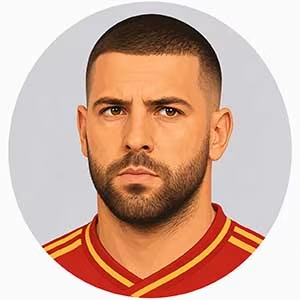
Spain - Left BackJordi Alba
On 1 July 2012, Spain were leading Italy 1–0 in the European Championship final in Kyiv when Jordi Alba received the ball near halfway, exchanged possession with Xavi and continued running. There was no obvious reason for a left-back to be sprinting fifty metres beyond Spain’s nominal forward line, but Xavi saw him and released the pass. Alba controlled, entered the penalty area and finished past Gianluigi Buffon for 2–0. He later admitted that he had not really thought about the run at all. The instinct was pure Alba: recognise empty space, attack it immediately and trust that the structure behind him would survive. Spain eventually won 4–0.
Alba was an attacking left-back whose greatest weapon was repeated acceleration into space. Small, light and exceptionally quick, he could advance outside the winger, dart inside behind a full-back or arrive beyond the defensive line through blind-side runs. His combination play was fast rather than decorative: short exchanges, immediate give-and-go movements and early low passes across the box. At Barcelona, his understanding with Lionel Messi became one of the side’s most reliable attacking mechanisms, with Alba repeatedly recognising when Messi had drawn defenders inward and exploding into the space behind them. He had begun higher up the pitch and retained the instincts of a winger, but Valencia converted him into a full-back and gave him the platform from which Spain selected him for Euro 2012. Barcelona brought him back that summer after releasing him from their academy as a teenager. He went on to make 459 competitive appearances for the club and win 19 trophies, including five league titles, five Copas del Rey and the 2015 Champions League. Alba’s attacking reputation should not obscure the volume of defensive work he performed: at Euro 2012 he led the tournament with 45 ball recoveries. For Spain he became first-choice left-back across three World Cups and three European Championships, eventually captaining the national team late in his international career. He left Barcelona in 2023, joined Inter Miami and retired from professional football at the end of the 2025 season.
His game had obvious structural risks. Alba’s instinct was to advance, and teams capable of attacking the space behind him immediately after turnovers could force him into long recovery runs. His lack of height also made him vulnerable when opponents deliberately targeted the far post with aerial deliveries. In possession he was most dangerous through movement rather than stationary creation; if opponents denied the space for overlaps and forced him to receive facing a compact defensive block, his influence could become much more ordinary. His extraordinary relationship with Messi sometimes also made his attacking decisions predictable, because opponents knew the return pass toward Alba’s run was always available. Emotionally, he was not naturally detached. Changes of role could affect him strongly. When Luis Enrique altered Barcelona’s shape after the heavy defeat to Paris Saint-Germain in 2017 and Alba lost minutes, contemporary accounts describe him as taking the situation badly. The tactical decision itself reduced both his role and his sense of importance, and the relationship with the coach deteriorated.
Psychologically, Alba is best understood as a player whose competitive activation was high before any external provocation arrived. He played quickly, argued quickly and reacted quickly. That emotional speed could produce friction, but it also powered the repeated runs that defined his game. The conflict with Luis Enrique is especially revealing because it evolved. When Luis Enrique first omitted him from Spain squads in 2018, Alba publicly admitted surprise and disappointment but refused to accuse the coach of personal retaliation. He said he had no reason to call him, accepted that selection belonged to the manager and focused on playing well enough for Barcelona to force a recall. When he was eventually recalled, Alba did not demand an apology; he explicitly said neither man owed the other one and acknowledged that both had strong characters. By 2022 he was describing Luis Enrique as the best coach he had worked with and praising his directness and trust. That progression matters more than simply labelling Alba confrontational: he could feel marginalisation intensely, but direct recognition and restored trust allowed the grievance to dissolve rather than become permanent. Criticism itself did not make him withdraw. Alba said that criticism was unavoidable at Barcelona and that players had to focus on performing rather than attempting to eliminate it. On the field, however, he was capable of visible disputes with opponents and officials; emotional regulation was therefore less absolute than for more austere defenders. The important distinction is that physical hostility rarely made him stop playing his natural game. His response was more often greater speed and involvement than inhibition. Major occasions similarly raised activation without shrinking decision-making: the spontaneous run in the Euro 2012 final is the clearest example, but his sustained importance across Barcelona’s Champions League campaigns and Spain tournaments points in the same direction. Alba’s leadership later in his career remained emotional and affiliative rather than authoritarian. He spoke directly, defended teammates, valued trust strongly and could become visibly irritated when he felt ignored. His competitive identity therefore rested on connection: with teammates, coach, crowd and the role he was expected to perform. When that connection existed, high emotion became fuel. When it disappeared, frustration rose rapidly.


 All Time BarcelonaClub