We use Google Analytics to understand how visitors use this site. Analytics cookies are only activated with your consent. For details, read our Privacy Policy.
Profile lensThe same player, read from a different angle.
Athletic83
Acceleration
91
Pace
85
Agility
85
Strength
77
Balance
77
Jumping
77
Stamina
91
Fitness
77
Technical80
Dribbling
82
Short Passing
78
Long Passing
84
Finishing
72
Shot Accuracy
71
Shot Power
85
Shooting Technique
82
Heading
68
Tackling
66
Crossing
82
Free Kick
77
Penalties
71
First Touch
87
Mental74
Composure
76
Aggression
78
Consistency
73
Creativity
84
Leadership
74
Work Rate
72
Tactical74
Vision
78
Off the Ball
80
Defensive Positioning
65
Teamwork
79
Anticipation
74
Marking
68
Player Traits
Attacking75
Crossing
82
Finishing
72
Heading Accuracy
68
Shot Accuracy
71
Off the Ball
80
Technique82
Dribbling
82
Free Kick
77
Short Passing
78
Long Passing
84
First Touch
87
Shot Technique
82
Movement85
Acceleration
91
Pace
85
Agility
85
Balance
77
Physicality81
Shot Power
85
Jumping
77
Stamina
91
Strength
77
Fitness
77
Defending66
Marking
68
Tackling
66
Def. Positioning
65
Mentality & Game Reading76
Aggression
78
Composure
76
Penalties
71
Vision
78
Leadership
74
Work Rate
72
Teamwork
79
Anticipation
74
Consistency
73
Creativity
84
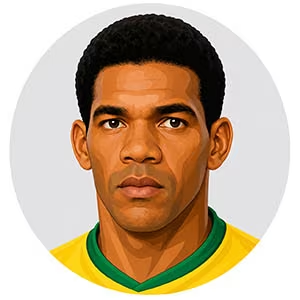
Brazil - Left BackMarinho Chagas
Flowing golden hair whipping in the wind, white boots blazing, and a complete disregard for traditional defensive duties turned a dazzling native of Natal into one of the most entertaining and radical full-backs in South American lore. Francisco das Chagas Marinho—celebrated worldwide simply as Marinho Chagas or A Bruxa (The Witch)—was a visionary attacking force who treated the left flank as a personal runway, pioneering the ultra-offensive modern wing-back role long before it was tactically normalized.
Blessed with explosive linear sprint speed, audacious close-range dribbling, and a sledgehammer of a long-range shot off his right foot when cutting infield, Chagas made his name at Botafogo during the early 1970s. He later starred for Fluminense (winning the 1976 Campeonato Carioca), São Paulo (lifting the 1981 Campeonato Paulista and winning the Bola de Prata three times), and took his bohemian talents to the North American Soccer League with the New York Cosmos and Fort Lauderdale Strikers. For Brazil, across 36 caps and four goals, his international zenith arrived at the 1974 World Cup in West Germany, where his daring forward runs earned him the tournament's Best Left-Back award despite heavy domestic tactical scrutiny.
That breathtaking attacking ambition, however, came at a staggering structural cost. Chagas was essentially an auxiliary left winger who regularly abandoned his defensive post, leaving vast expanses of open grass behind him that opposing sides exploited on fast counters—most painfully illustrated in Brazil’s 1974 World Cup defeat to Poland, which triggered a bitter, on-pitch screaming match with goalkeeper Émerson Leão. Orthodox man-marking, backward tracking, and collective defensive cohesion were never his priorities.
Bohemian, unapologetically rebellious, and carrying the vibrant soul of the Brazilian counter-culture, Chagas played the game solely for freedom and spectacle. He had zero interest in rigid tactical dogmas, laughing off managerial fury and thrilling terraces with audacious long-range screamers from 35 yards out. On the pitch, his body language was all kinetic swagger: galloping past flat-footed full-backs, waving his arms to demand the ball, and striking thunderous drives with wild abandon. Inside the dressing rooms of Rio and São Paulo, he was a colorful, free-spirited character whose tragic later life battle with alcoholism never dimmed the memory of his electrifying talent, leaving behind an immortal legacy as the most daring, explosive, and romantic left-back in Brazilian history.