We use Google Analytics to understand how visitors use this site. Analytics cookies are only activated with your consent. For details, read our Privacy Policy.
Profile lensThe same player, read from a different angle.
Athletic79
Acceleration
83
Pace
81
Agility
85
Strength
76
Balance
77
Jumping
66
Stamina
82
Fitness
79
Technical80
Dribbling
86
Short Passing
76
Long Passing
80
Finishing
75
Shot Accuracy
74
Shot Power
85
Shooting Technique
80
Heading
65
Tackling
52
Crossing
74
Free Kick
77
Penalties
71
First Touch
85
Mental76
Composure
74
Aggression
75
Consistency
76
Creativity
84
Leadership
74
Work Rate
80
Tactical77
Vision
79
Off the Ball
79
Defensive Positioning
52
Teamwork
80
Anticipation
77
Marking
41
Attacking73
Crossing
74
Finishing
75
Heading Accuracy
65
Shot Accuracy
74
Off the Ball
79
Technique81
Dribbling
86
Free Kick
77
Short Passing
76
Long Passing
80
First Touch
85
Shot Technique
80
Movement82
Acceleration
83
Pace
81
Agility
85
Balance
77
Physicality78
Shot Power
85
Jumping
66
Stamina
82
Strength
76
Fitness
79
Defending48
Marking
41
Tackling
52
Def. Positioning
52
Mentality & Game Reading77
Aggression
75
Composure
74
Penalties
71
Vision
79
Leadership
74
Work Rate
80
Teamwork
80
Anticipation
77
Consistency
76
Creativity
84
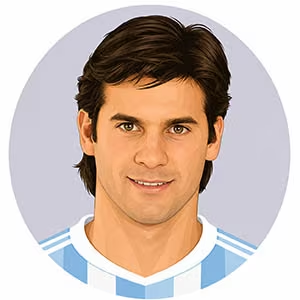
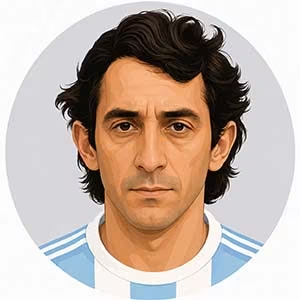
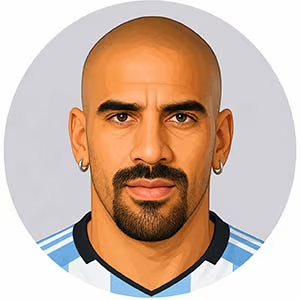
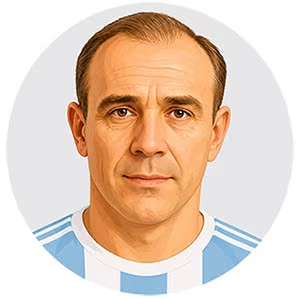
Argentina - Left MidfielderSolari, Santiago
Santiago Solari spent most of his playing career being the reliable, tactically obedient wide midfielder inserted into Real Madrid's Galácticos era to do the defensive running the more decorated names around him weren't going to do, and then, entirely unexpectedly, became a Champions League-winning head coach at the same club less than a decade after retiring — a second act considerably more consequential than most observers of his playing days would have predicted.
Born in Rosario in 1976 into a family with a strong intellectual and political tradition — his grandfather was a well-known writer and his father an activist during Argentina's military dictatorship — Solari was a versatile attacking or wide midfielder known more for tactical discipline, work rate and reliability than for individual flair, a profile that made him useful without ever making him a focal point. He emerged at River Plate before moving to Spain, playing for Atlético Madrid during the club's relegation and subsequent promotion, then Real Madrid from 2000, where he spent five seasons in a squad containing Zidane, Figo, Ronaldo and Raúl, contributing defensive solidity and tactical flexibility on the flanks rather than individual moments of brilliance. He won two La Liga titles and the 2002 Champions League with Real Madrid, a modest personal contribution to a period defined by considerably more celebrated teammates, before later spells at Internazionale and a return to Spanish football closed his playing career. For Argentina his senior international recognition remained limited relative to his club-level consistency, reflecting a generation with considerable depth in his positions.
His limitations as a player were exactly what his role implied. Solari offered little in the way of individual technical brilliance or goal output, and his value was almost entirely functional — tactical discipline, defensive work rate on the flank, and reliability in systems built around considerably more gifted attacking players. He was rarely a starter in the biggest matches of his Real Madrid years when fully fit alternatives were available, and his career is largely undocumented by the kind of individual moments that generate lasting reputation, a pattern consistent with a player whose contribution was structural rather than memorable.
Temperamentally he displayed a composed, intellectually engaged personality that set him apart from many teammates, evident both during his playing career and afterward. Solari accepted a subordinate tactical role within a squad of enormous individual talent without apparent friction, working diligently in a system that offered him little personal glory relative to the players around him — a pattern of quiet professional acceptance the corpus has seen before, though rarely from a player who would later occupy such different professional territory. He was known within Real Madrid's dressing room as thoughtful and well-read, maintaining interests in literature and writing that few of his teammates shared, a genuine intellectual curiosity that extended well beyond typical footballer media training. His transition into coaching, first with Real Madrid's youth and reserve sides and then unexpectedly into the first team as a caretaker in 2018, revealed a calm, methodical decision-maker capable of managing enormous individual egos — including a Cristiano Ronaldo-less squad still containing Ramos, Modrić and Bale — without visible panic, guiding the club to the 2018 Club World Cup title in his brief interim tenure. He handled that abrupt promotion, and an equally abrupt departure months later when Zinedine Zidane returned, with the same measured equanimity that had characterized his acceptance of a subordinate playing role over a decade earlier. Away from football he maintained a public profile as a published writer, an unusual second identity for a professional footballer that suggests an inner life considerably more developed than his playing career alone would indicate. Composed, intellectually curious and consistently unflustered by sudden shifts in professional status, Solari's career illustrates how a player defined by quiet functional acceptance can, given the opportunity, reveal a far more substantial personality underneath.