We use Google Analytics to understand how visitors use this site. Analytics cookies are only activated with your consent. For details, read our Privacy Policy.
Profile lensThe same player, read from a different angle.
Athletic80
Acceleration
81
Pace
84
Agility
80
Strength
83
Balance
80
Jumping
71
Stamina
80
Fitness
77
Technical83
Dribbling
86
Short Passing
83
Long Passing
85
Finishing
82
Shot Accuracy
77
Shot Power
92
Shooting Technique
80
Heading
68
Tackling
52
Crossing
81
Free Kick
84
Penalties
83
First Touch
84
Mental76
Composure
84
Aggression
76
Consistency
71
Creativity
82
Leadership
70
Work Rate
77
Tactical79
Vision
82
Off the Ball
82
Defensive Positioning
47
Teamwork
79
Anticipation
80
Marking
44
Player Traits
Attacking78
Crossing
81
Finishing
82
Heading Accuracy
68
Shot Accuracy
77
Off the Ball
82
Technique84
Dribbling
86
Free Kick
84
Short Passing
83
Long Passing
85
First Touch
84
Shot Technique
80
Movement81
Acceleration
81
Pace
84
Agility
80
Balance
80
Physicality81
Shot Power
92
Jumping
71
Stamina
80
Strength
83
Fitness
77
Defending48
Marking
44
Tackling
52
Def. Positioning
47
Mentality & Game Reading78
Aggression
76
Composure
84
Penalties
83
Vision
82
Leadership
70
Work Rate
77
Teamwork
79
Anticipation
80
Consistency
71
Creativity
82
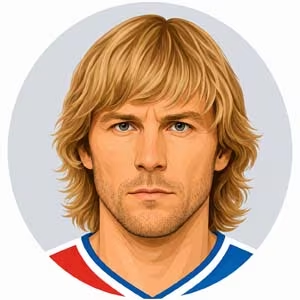
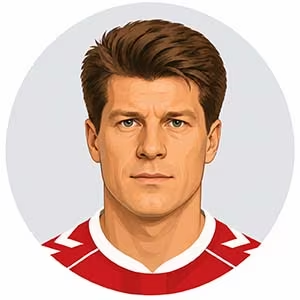
Czech Republic - Left MidfielderBerger, Patrik
Berger was a left-footed attacking midfielder who could play wide on the left, centrally behind the forwards or as an advanced midfielder arriving from deeper positions. His most distinctive weapon was the violence and accuracy of his shooting. Given space outside the penalty area, he could strike with minimal preparation and generate exceptional pace, while his delivery from dead balls added another source of threat. He carried possession elegantly, shifted the ball onto his left foot quickly and combined technical quality with enough athleticism to travel through midfield rather than remaining fixed near the touchline. At Liverpool, Roy Evans initially used him in advanced roles before later managers gave him greater freedom between midfield and attack. Berger developed at Slavia Prague before moving to Borussia Dortmund in 1995, where he struggled for regular starts despite being part of a Bundesliga-winning squad. His performances at Euro 1996 prompted Liverpool to sign him that summer. He began explosively, scoring twice against Leicester and twice against Chelsea, and eventually spent seven seasons at Anfield, making 196 appearances and scoring 35 goals in all competitions according to the club. Injuries reduced his role during the 2000–01 treble season, but he returned in time to contribute in both the FA Cup and UEFA Cup finals, supplying the long pass from which Michael Owen scored the winning goal against Arsenal at Cardiff. Later spells followed at Portsmouth, Aston Villa, Stoke City and finally Sparta Prague. For the Czech Republic he scored 18 goals in 44 appearances and played at Euro 1996 and Euro 2000.
His effectiveness declined sharply when matches denied him the time and angle to move onto his left foot. Berger was not a natural controller who could dominate possession from deep, nor an elite one-against-one winger capable of repeatedly beating defenders from a standing start. His game required some freedom to move toward shooting or combination zones, and rigid positional assignments could reduce him to peripheral circulation. He was also more dangerous arriving into actions than continuously dictating them. Injuries became a major structural limitation. A serious knee problem in 2000 required specialist treatment and interrupted what should have been one of his peak seasons, while recurring knee, hamstring and back problems repeatedly damaged continuity later in his career; after multiple operations, another recurrence eventually forced his retirement. His temperament could create an additional cost: when he believed his role had become unacceptable, he was capable of making the disagreement public rather than simply adapting.
That last point is essential to understanding Berger. In March 1998, frustrated by his position under Roy Evans, he refused to sit on the bench against Bolton and subsequently sought a move away from Liverpool. The episode was not merely private disappointment: Evans publicly questioned his commitment to the collective and Berger returned to Prague while his representatives explored an exit. Gérard Houllier’s arrival changed the relationship between player and club. Berger stayed, played regularly again and produced some of his most consistent football, suggesting that his resistance was not to discipline itself but to a role he no longer believed offered him a meaningful place. This distinction appears again later. At Aston Villa, when regular football disappeared, he openly acknowledged that teammates were playing well enough to justify the manager keeping the same side; he could therefore accept exclusion when he considered the sporting logic convincing. His final rupture there came from another source. In 2008 he publicly advised Gareth Barry to accept Liverpool’s interest, calling such an opportunity exceptional. Martin O’Neill considered the intervention unacceptable and removed Berger from the squad. Berger apologised and said he had not intended harm, but the incident shows a willingness to speak according to personal conviction even when institutional loyalty required silence. Berger’s relationship with pressure was otherwise relatively stable. His penalty in the Euro 1996 final, significant cup performances for Liverpool and successful return from knee surgery before the 2001 finals indicate that big occasions did not routinely narrow his technique or ambition. Injuries frustrated him more persistently than hostile crowds or physical provocation. There is little evidence of habitual retaliation against opponents or referees, and his risk-taking remained primarily technical: shooting from ambitious distances, carrying possession and seeking decisive actions. Berger later said that goals themselves had never mattered to him as much as helping the team win, while former teammates remembered him as socially integrated and deeply attached to Liverpool. His personality therefore combined genuine team identification with a strong personal threshold: he could subordinate himself when he accepted the reason, but not indefinitely when he believed his role or judgement had been devalued.