We use Google Analytics to understand how visitors use this site. Analytics cookies are only activated with your consent. For details, read our Privacy Policy.
Profile lensThe same player, read from a different angle.
Athletic82
Acceleration
87
Pace
92
Agility
79
Strength
82
Balance
75
Jumping
77
Stamina
88
Fitness
78
Technical76
Dribbling
75
Short Passing
78
Long Passing
78
Finishing
63
Shot Accuracy
62
Shot Power
80
Shooting Technique
70
Heading
69
Tackling
74
Crossing
76
Free Kick
63
Penalties
60
First Touch
76
Mental76
Composure
75
Aggression
82
Consistency
74
Creativity
68
Leadership
78
Work Rate
82
Tactical77
Vision
77
Off the Ball
76
Defensive Positioning
75
Teamwork
82
Anticipation
77
Marking
73
Attacking69
Crossing
76
Finishing
63
Heading Accuracy
69
Shot Accuracy
62
Off the Ball
76
Technique73
Dribbling
75
Free Kick
63
Short Passing
78
Long Passing
78
First Touch
76
Shot Technique
70
Movement83
Acceleration
87
Pace
92
Agility
79
Balance
75
Physicality81
Shot Power
80
Jumping
77
Stamina
88
Strength
82
Fitness
78
Defending74
Marking
73
Tackling
74
Def. Positioning
75
Mentality & Game Reading76
Aggression
82
Composure
75
Penalties
60
Vision
77
Leadership
78
Work Rate
82
Teamwork
82
Anticipation
77
Consistency
74
Creativity
68
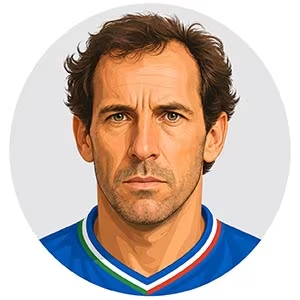
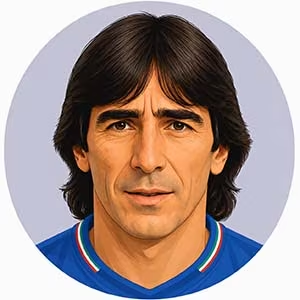
Italy - Left BackRocca, Francesco
At the Tre Fontane training ground in October 1976, Francesco Rocca moved to anticipate an ordinary ball and his left knee finally gave way. The collapse looked sudden, but the sequence had begun days earlier. He had suffered a heavy knock during Roma’s league match, finished the game, travelled to the Italian national team with the knee swollen and then played the full World Cup qualifier against Luxembourg despite being unable to train normally beforehand. Rocca later insisted that he had not forced the national-team trip against medical advice: he had been examined and cleared to go. After returning to Rome, the joint failed in training. Five operations, repeated attempted comebacks and chronic pain followed. The episode is revealing because Rocca’s response to physical warning was not avoidance. He repeatedly tried to remain available until the body removed the decision from him. That behaviour helped create the legend around “Kawasaki”; it also eventually made the distinction between courage and self-protection brutally important.
Rocca was one of the most physically dynamic Italian full-backs of the mid-1970s. Primarily used on the left, he defended with directness but transformed the role through the volume and speed of his forward running. Roma’s own historical account describes exceptional acceleration, changes of direction and long progressive runs; teammates sometimes had to tell him to moderate his pace because he reached the end line before the rest of the attack could arrive. His football therefore depended on repeated transition between defensive and attacking phases rather than static occupation of the flank. He could recover, immediately accelerate beyond midfield and cross with either foot, while his physical confidence allowed him to attack contact rather than avoid it. Fulvio Bernardini brought him into the Italian team during the post-1974 rebuild, and Rocca accumulated 18 caps between 1974 and 1976 before injury effectively ended his international career. His peak was extremely short but tactically important: he offered the width and running volume of a modern attacking full-back before that interpretation had become normal in Italian football.
The qualities that made Rocca exceptional also produced a specific degradation mechanism. His game consumed his body. Repeated high-speed running, aggressive changes of direction and a willingness to continue through discomfort placed enormous load on the knees, and once the first major damage occurred the physical basis of his football could never be fully restored. He nevertheless attempted repeated returns, playing 37 league matches across 1978–79 and 1979–80 before related problems again reduced him to only six appearances in 1980–81. Even during rehabilitation, witnesses remembered him rising at five in the morning to run despite a knee already damaged by multiple operations. That should not be scored simply as admirable work rate. In performance terms, Rocca’s limitation was an inability—or unwillingness—to use discomfort itself as a reliable stopping signal. The eventual retirement decision demonstrates that he could change that calculation, but only after years of repeated attempts. At twenty-seven he finally said that continuing risked leaving him permanently disabled and admitted that he could no longer become the player he had been. His degradation was therefore overwhelmingly physical, but behaviour affected how long he continued to expose himself to it.
Psychologically, Rocca is best defined by **duty persistence beyond prudent limits**. The evidence is behavioural rather than mythological. He finished the match in which the knee was initially damaged, travelled with Italy while still symptomatic, played the qualifier, underwent five operations and repeatedly reconstructed his preparation around returning to the field. Even after those operations, teammates and supporters saw him adding voluntary running before normal training. This does not prove low fear or unusual pain tolerance in a medical sense; it proves that pain and uncertainty were repeatedly insufficient to make him relinquish the football obligation. The contradiction appears clearly in his retirement. Rocca described the decision as emotionally worse than the operations themselves, yet he finally stopped because continuing threatened his future mobility. That was not surrender but a late recalibration of responsibility. His later coaching philosophy also suggests that he did not romanticise what had happened: he studied preparation and injury prevention intensely and described helping younger players avoid the mistakes and consequences that had shaped his own career. Evidence for persistent referee conflict, retaliatory fouling, teammate blame, individual provocation or hostile-crowd degradation is too weak to score. The stronger and more unusual signal is this: **Rocca’s immediate response to adversity was to continue acting, sometimes beyond the point at which continuing remained functionally rational**.