We use Google Analytics to understand how visitors use this site. Analytics cookies are only activated with your consent. For details, read our Privacy Policy.
Profile lensThe same player, read from a different angle.
Athletic81
Acceleration
76
Pace
78
Agility
74
Strength
83
Balance
82
Jumping
85
Stamina
86
Fitness
82
Technical77
Dribbling
75
Short Passing
75
Long Passing
80
Finishing
68
Shot Accuracy
66
Shot Power
74
Shooting Technique
69
Heading
87
Tackling
83
Crossing
78
Free Kick
68
Penalties
66
First Touch
75
Mental83
Composure
84
Aggression
85
Consistency
82
Creativity
66
Leadership
85
Work Rate
83
Tactical80
Vision
73
Off the Ball
68
Defensive Positioning
85
Teamwork
85
Anticipation
83
Marking
84
Player Traits
Attacking73
Crossing
78
Finishing
68
Heading Accuracy
87
Shot Accuracy
66
Off the Ball
68
Technique74
Dribbling
75
Free Kick
68
Short Passing
75
Long Passing
80
First Touch
75
Shot Technique
69
Movement78
Acceleration
76
Pace
78
Agility
74
Balance
82
Physicality82
Shot Power
74
Jumping
85
Stamina
86
Strength
83
Fitness
82
Defending84
Marking
84
Tackling
83
Def. Positioning
85
Mentality & Game Reading79
Aggression
85
Composure
84
Penalties
66
Vision
73
Leadership
85
Work Rate
83
Teamwork
85
Anticipation
83
Consistency
82
Creativity
66
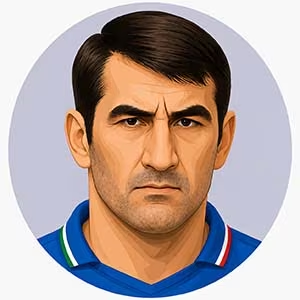
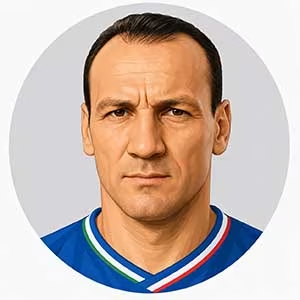
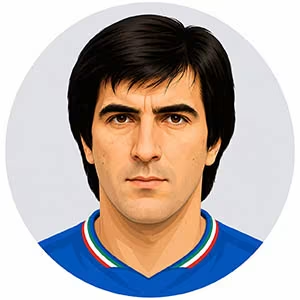
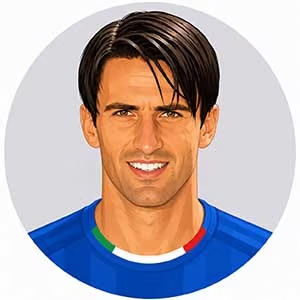
Italy - Right BackPanucci, Christian
In Basel on 13 June 2008, Italy were trailing Romania 1–0 and facing the possibility of effective elimination from the European Championship when Christian Panucci moved towards the near post for a corner. Only minutes earlier he had been involved in the defensive misunderstanding that allowed Adrian Mutu to score. This time he attacked the delivery, reached it ahead of his marker and headed Italy level. The match finished 1–1, keeping the holders alive. At thirty-five, Panucci had become the oldest Italian to score at a European Championship. The sequence condensed much of his competitive personality: participation in a damaging error did not make him retreat from the next high-responsibility action. He remained willing to attack the ball, expose himself and intervene. That response should not be confused with emotional serenity. Panucci’s career contains too many confrontations for that description to survive. What remained unusually stable was his willingness to put himself back into the action after something had gone wrong.
Panucci was a powerful, tactically versatile defender whose original position was right-back but whose career eventually covered left-back and centre-back as well. Real Madrid’s official history emphasises that versatility and his aerial strength: five of his six goals for the club were headers. His attacking contribution was direct rather than elaborate. He overlapped when required, crossed competently and became especially dangerous arriving at the far post, while defensively he combined physical engagement with strong positional experience. He won the Champions League with Milan while still twenty-one and again with Real Madrid in 1998, becoming the first Italian to represent the Spanish club. Fabio Capello trusted him repeatedly—at Milan, Madrid and Roma—and Panucci later explained why the relationship worked: Capello demanded professionalism and gave nothing away, but their confrontations were direct and loyal. He could therefore function extremely well under demanding authority when he regarded that authority as legitimate. His longevity at Roma eventually transformed a widely travelled defender into a structural senior player, and his 34 Serie A goals demonstrate how much value his timing and heading added beyond conventional defensive work.
His limitations were partly athletic and partly behavioural. Panucci was never dependent on exceptional acceleration, and as he aged he increasingly relied on positioning, physical judgement and anticipation; attackers capable of repeatedly forcing him into open-field recovery could therefore expose him more effectively than opponents who allowed direct contact. His versatility also had boundaries: he could perform centrally but lacked the dimensions of a dominant specialist centre-back, while his attacking value came more from runs and aerial arrival than from sustained creative possession. More unusually, conflict itself could become a genuine performance-availability problem. At Inter, his relationship with Marcello Lippi deteriorated sufficiently for him to be excluded from the squad; at Roma in January 2009, after Luciano Spalletti chose Marco Cassetti ahead of him against Napoli, Panucci refused to sit on the bench. He was subsequently omitted for five matches and excluded from the Champions League list before apologising. This cannot be softened into “strong personality”. Unlike emotional reactions that remain internal while performance continues, Panucci’s reaction directly removed his availability to the team. His competitive resilience after mistakes could therefore coexist with substantial degradation when the threat was hierarchical rather than purely competitive.
Psychologically, Panucci is best defined by **reciprocal authority sensitivity**. He did not object to powerful coaches as such. Capello was perhaps the most demanding authority of his career, yet Panucci repeatedly followed him and later described their relationship as unusually honest: they argued, but the exchanges remained loyal and Capello never granted him privileges merely because he trusted him. The contrast with Lippi is stark. Excluded from the 2006 World Cup picture, Panucci publicly argued that personal dislike rather than footballing merit explained the decision; when asked whether competitor Cristian Zaccardo was better than him, he answered no while refusing to attack Zaccardo personally. His response therefore targeted the legitimacy of the authority making the judgement rather than the teammate benefiting from it. Spalletti exposed the less controlled side of the same mechanism: being relegated to the bench provoked an actual refusal, followed by sanction and only later apology. Even his Milan departure fits more cautiously: Panucci later described suffering when Arrigo Sacchi returned and he sensed that the coach did not value him, yet he left for Capello’s Real Madrid rather than forcing prolonged coexistence. This was not generic intolerance of criticism, competition or discipline. Panucci could accept all three from authority he considered honest and reciprocal. What he struggled to absorb was **unilateral devaluation**—the feeling that another person possessed the power to redefine his worth without granting him equivalent legitimacy to contest that judgement. Evidence for systematic referee obsession, provocation-driven retaliation or teammate-directed blame is insufficient and should remain unknown. The contradiction is cleaner: Panucci could recover immediately from a football error, while a perceived relational injustice could provoke behaviour far more damaging than the original sporting setback.


 All Time RomaClub