We use Google Analytics to understand how visitors use this site. Analytics cookies are only activated with your consent. For details, read our Privacy Policy.
Profile lensThe same player, read from a different angle.
Athletic79
Acceleration
75
Pace
76
Agility
77
Strength
74
Balance
85
Jumping
74
Stamina
85
Fitness
82
Technical83
Dribbling
82
Short Passing
86
Long Passing
84
Finishing
82
Shot Accuracy
78
Shot Power
85
Shooting Technique
82
Heading
71
Tackling
48
Crossing
81
Free Kick
76
Penalties
75
First Touch
85
Mental77
Composure
85
Aggression
74
Consistency
74
Creativity
85
Leadership
70
Work Rate
74
Tactical81
Vision
86
Off the Ball
80
Defensive Positioning
51
Teamwork
82
Anticipation
75
Marking
41
Attacking78
Crossing
81
Finishing
82
Heading Accuracy
71
Shot Accuracy
78
Off the Ball
80
Technique83
Dribbling
82
Free Kick
76
Short Passing
86
Long Passing
84
First Touch
85
Shot Technique
82
Movement78
Acceleration
75
Pace
76
Agility
77
Balance
85
Physicality80
Shot Power
85
Jumping
74
Stamina
85
Strength
74
Fitness
82
Defending47
Marking
41
Tackling
48
Def. Positioning
51
Mentality & Game Reading78
Aggression
74
Composure
85
Penalties
75
Vision
86
Leadership
70
Work Rate
74
Teamwork
82
Anticipation
75
Consistency
74
Creativity
85
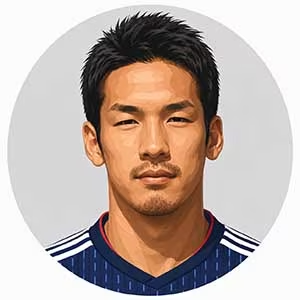
Japan - Attacking MidfielderNakata, Hidetoshi
Hidetoshi Nakata
Walking away from professional football at just twenty-nine years of age after lying on the pitch in Dortmund at the 2006 World Cup captured the uncompromising, fiercely independent soul of a trailblazer from Kofu who treated the sport on his own terms. Hidetoshi Nakata was an imposing, modern attacking midfielder who shattered Asian football's stylistic tropes, combining a remarkably robust upper body and low-center-of-gravity balance with panoramic vision, sharp vertical surges, and a venomous right-footed strike from distance.
Operating as a classic central playmaker, dynamic mezzala, or second-line orchestrator, Nakata possessed the physical power to absorb heavy contact from European stoppers without losing his stride. He excelled at receiving the ball on the half-turn under intense pressure, shielding possession with his back, and releasing laser-guided, angled passes into the path of surging forwards. After exploding at Bellmare Hiratsuka, his arrival at Perugia in 1998 sparked an immediate sensation—scoring a debut brace against Juventus—before moving to Fabio Capello’s AS Roma in January 2000 for €21 million. His defining moment in giallorosso remains the title-deciding clash against Juventus in Turin in May 2001, where he came off the bench to score a sensational 25-yard rocket and trigger Montella's equalizer, cementing the 2000–01 Scudetto. He later won the 2001–02 Coppa Italia with Parma, followed by spells at Bologna, Fiorentina, and Bolton Wanderers. For Japan, across 77 caps and 11 goals, he was a two-time Asian Footballer of the Year (1997, 1998), the beating heart of their 2002 World Cup campaign on home soil, and featured across three World Cups (1998, 2002, 2006) and the 2000 Sydney Olympics.
His high-friction, vertical game, however, carried distinct tactical boundaries. Nakata was not an elusive, light-footed trickster who unpicked packed low blocks through repetitive lateral dribbles in telephone booths; his effectiveness depended on open vertical lanes and dynamic runners capable of reading his early, demanding through-balls. When isolated in slower, static possession systems where teammates failed to attack vacated space behind the defense, his distribution could occasionally appear impatient or forced.
Introspective, intellectual, and carrying an aloof, avant-garde aura that fascinated global fashion houses as much as football tacticians, Nakata refused to conform to traditional corporate or sporting hierarchies. He had zero interest in media posturing, clashing with conservative football officials over training standards and commercial demands while expecting uncompromising tactical professionalism from his national teammates. On the pitch, his body language was upright, focused, and physically defiant: brushing off lunging challenges without going to ground, gesturing teammates into position with crisp hand signals, and celebrating crucial goals with quiet, stoic satisfaction. Inside the locker rooms of Rome, Parma, and Japan, he was an enigmatic, highly respected lone wolf whose physical resilience, vision, and trailblazing European impact elevated Asian football to global credibility.