We use Google Analytics to understand how visitors use this site. Analytics cookies are only activated with your consent. For details, read our Privacy Policy.
Profile lensThe same player, read from a different angle.
Athletic75
Acceleration
74
Pace
76
Agility
81
Strength
73
Balance
76
Jumping
66
Stamina
81
Fitness
75
Technical84
Dribbling
84
Short Passing
82
Long Passing
87
Finishing
77
Shot Accuracy
75
Shot Power
85
Shooting Technique
81
Heading
66
Tackling
48
Crossing
86
Free Kick
95
Penalties
84
First Touch
87
Mental77
Composure
85
Aggression
71
Consistency
74
Creativity
85
Leadership
70
Work Rate
72
Tactical81
Vision
85
Off the Ball
82
Defensive Positioning
49
Teamwork
80
Anticipation
74
Marking
44
Player Traits
Attacking77
Crossing
86
Finishing
77
Heading Accuracy
66
Shot Accuracy
75
Off the Ball
82
Technique86
Dribbling
84
Free Kick
95
Short Passing
82
Long Passing
87
First Touch
87
Shot Technique
81
Movement77
Acceleration
74
Pace
76
Agility
81
Balance
76
Physicality76
Shot Power
85
Jumping
66
Stamina
81
Strength
73
Fitness
75
Defending47
Marking
44
Tackling
48
Def. Positioning
49
Mentality & Game Reading78
Aggression
71
Composure
85
Penalties
84
Vision
85
Leadership
70
Work Rate
72
Teamwork
80
Anticipation
74
Consistency
74
Creativity
85
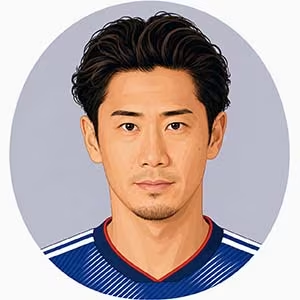
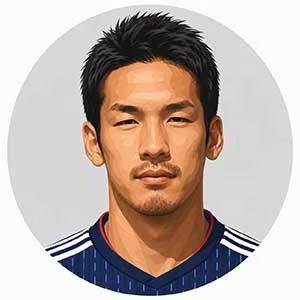
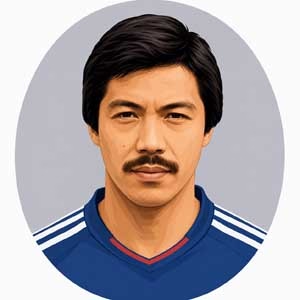
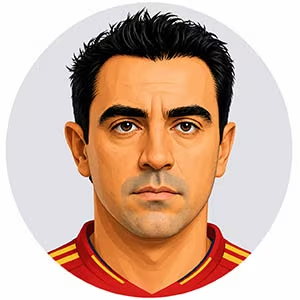
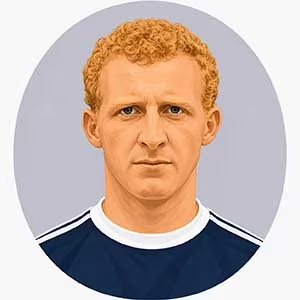
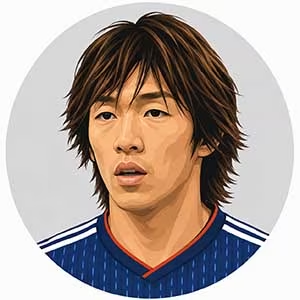
Japan - Attacking MidfielderNakamura, Shunsuke
hunsuke Nakamura was the visionary creative architect of Celtic’s modern European era and the aesthetic crown jewel of Japanese football throughout the 2000s, redefining the art of the dead-ball across continents.
Operating as an inverted wide playmaker, traditional number ten, or deep orchestrator, Nakamura manipulated tempo through pristine first touches, deceptive body swerves, and panoramic vision that opened defensive locks with a single diagonal ball. After dominating the J.League with Yokohama F. Marinos (winning J.League MVP in 2000 and 2013) and proving his quality in Serie A with Reggina, he joined Gordon Strachan’s Celtic in 2005. Across four glorious seasons in Glasgow spanning 166 appearances and 34 goals, he swept three consecutive Scottish Premier League championships, the 2007 Scottish Cup, two Scottish League Cups, and became the first Japanese player to be voted SPFA Players' Player of the Year and SFWA Footballer of the Year in 2007. For Japan, across 98 caps and 24 goals, he was the talisman of the Samurai Blue, capturing two AFC Asian Cups (2000, 2004—winning MVP in 2004) and featuring across two World Cups (2006, 2010).
That breathtaking technical elegance, however, operated within clear athletic parameters. Nakamura lacked linear sprint speed and physical power; when matched against hyper-aggressive, physical midfield enforcers who pressed him relentlessly and turned matches into chaotic, muddy wrestling matches, his influence could be subdued if denied time on the half-turn. Furthermore, his defensive contributions were strictly limited to positional containment, offering minimal ball-winning resistance in his own defensive third.
Monastic, intensely humble, and dedicated to obsessive technical perfection, Nakamura approached the sport with the focused discipline of a master craftsman. He spent hours after training practicing set pieces, striking thousands of balls until the trajectory became pure muscle memory. On the pitch, his body language was serene and upright: gliding between challenges with effortless balance and celebrating clutch goals with understated smiles. Inside the Celtic, Reggina, and Japanese dressing rooms, he was an adored cultural ambassador and revered artist whose flawless free-kicks and creative vision left an indelible, immortal mark on European and Asian football history.


 All-Time AsiaAsia