We use Google Analytics to understand how visitors use this site. Analytics cookies are only activated with your consent. For details, read our Privacy Policy.
Profile lensThe same player, read from a different angle.
Athletic80
Acceleration
75
Pace
76
Agility
75
Strength
82
Balance
79
Jumping
82
Stamina
84
Fitness
84
Technical74
Dribbling
74
Short Passing
75
Long Passing
75
Finishing
57
Shot Accuracy
55
Shot Power
75
Shooting Technique
58
Heading
80
Tackling
80
Crossing
62
Free Kick
65
Penalties
66
First Touch
75
Mental80
Composure
78
Aggression
83
Consistency
76
Creativity
71
Leadership
85
Work Rate
87
Tactical78
Vision
76
Off the Ball
62
Defensive Positioning
78
Teamwork
85
Anticipation
82
Marking
76
Attacking63
Crossing
62
Finishing
57
Heading Accuracy
80
Shot Accuracy
55
Off the Ball
62
Technique70
Dribbling
74
Free Kick
65
Short Passing
75
Long Passing
75
First Touch
75
Shot Technique
58
Movement76
Acceleration
75
Pace
76
Agility
75
Balance
79
Physicality81
Shot Power
75
Jumping
82
Stamina
84
Strength
82
Fitness
84
Defending78
Marking
76
Tackling
80
Def. Positioning
78
Mentality & Game Reading79
Aggression
83
Composure
78
Penalties
66
Vision
76
Leadership
85
Work Rate
87
Teamwork
85
Anticipation
82
Consistency
76
Creativity
71
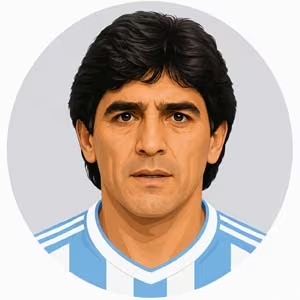
Argentina - Defensive MidfielderMerlo, Reinaldo
For fifteen seasons at River Plate, Reinaldo Merlo occupied a part of midfield where success was often measured by what happened somewhere else. When Norberto Alonso or Juan José López advanced, Merlo adjusted behind them; when possession was lost, he moved towards the space their ambition had exposed. Ángel Labruna famously described him through the image of a windscreen wiper, sweeping from side to side behind River’s more creative midfielders. The metaphor can make the role sound mechanical, but former teammates remembered something more intelligent: Daniel Onega later emphasised how quickly Merlo understood what River required from him and how effectively he covered the attacking midfielders around him. That interpretation became remarkably durable. Coaches repeatedly brought competitors for his position, yet Merlo remained. He did not preserve his place by demanding more visible responsibility. He preserved it by making an apparently subordinate function structurally indispensable.
Merlo was a defensive midfielder built around anticipation, coverage, stamina and direct ball-winning. He followed opposing creators closely when required, contested second balls and shifted laterally to protect teammates who had moved beyond the ball. His nickname “Mostaza” eventually became inseparable from River’s number five shirt, but he was more technically competent than the destroyer stereotype suggests. On his first-team debut against Estudiantes in 1969, contemporary coverage praised both his personality and his football, and Merlo himself later remembered the match as one in which he had both marked and played. His distribution remained functional rather than expansive: after recovery he generally returned possession to teammates better equipped to create rather than attempting to become the attack’s principal organiser. That division of labour helped balance River sides containing substantial technical freedom ahead of him. Between 1969 and 1984 he played his entire senior career for River, winning seven Argentine championships and becoming one of the club’s longest-serving players. River’s official history credits him with 563 appearances, the highest total in the club’s history.
The limitations followed directly from that specialisation. Merlo was not a progressive playmaker and could not replace the creative volume of the midfielders he protected. Teams forcing him to become the primary constructor could therefore reduce River’s attacking quality without necessarily defeating Merlo individually. His aggressive defensive orientation also worked best when distances remained compact enough for anticipation and lateral coverage to matter; large open spaces placed greater demands on acceleration and one-against-one recovery. He could mark intensely, but reducing him to permanent pursuit of one opponent also risked removing the broader screening function that made him valuable. His extremely low scoring output reflected role rather than merely technical deficiency: forward arrival was rarely the priority assigned to him. Age eventually reduced the mobility required for constant midfield adjustment, making the same territory harder to protect. Merlo’s usefulness was therefore highly relational: he became most valuable when the team contained players whose attacking freedom created precisely the defensive problems he specialised in solving.
Psychologically, Merlo is best defined by **ego-neutralized functional subordination**. His own retrospective description of professionalism is unusually revealing: when asked about an old statement that a professional should not complain publicly if sent to the bench, Merlo reaffirmed the principle that selection decisions were to be accepted rather than argued outside the pitch. This should not be mistaken for low competitiveness or weak personality. His debut was already described as imposing, and his recollections of Superclásicos emphasised total investment: those matches were occasions in which, as he put it, players gave everything and prepared specifically to win. The distinction lies in where that competitiveness was directed. Merlo could accept that Alonso and López possessed greater creative visibility, that his own role existed partly to compensate for them, and even that coaches could formally challenge his place, without needing to convert those asymmetries into public status conflict. Evidence for referee confrontation, retaliation, teammate blame or provocation-driven loss of control is insufficient and should remain unknown. Nor should the highly controlling personality later visible in Merlo the coach be projected backwards without evidence. The defensible playing pattern is narrower: **Merlo could invest intensely in competition while accepting a hierarchy in which his importance came from enabling more visible teammates rather than requiring the structure to advertise his own importance**.