We use Google Analytics to understand how visitors use this site. Analytics cookies are only activated with your consent. For details, read our Privacy Policy.
Profile lensThe same player, read from a different angle.
Athletic81
Acceleration
74
Pace
74
Agility
75
Strength
82
Balance
86
Jumping
81
Stamina
93
Fitness
85
Technical81
Dribbling
78
Short Passing
82
Long Passing
83
Finishing
77
Shot Accuracy
73
Shot Power
87
Shooting Technique
72
Heading
83
Tackling
86
Crossing
77
Free Kick
67
Penalties
66
First Touch
78
Mental88
Composure
82
Aggression
96
Consistency
85
Creativity
73
Leadership
95
Work Rate
98
Tactical85
Vision
83
Off the Ball
75
Defensive Positioning
84
Teamwork
94
Anticipation
85
Marking
86
Player Traits
Attacking77
Crossing
77
Finishing
77
Heading Accuracy
83
Shot Accuracy
73
Off the Ball
75
Technique77
Dribbling
78
Free Kick
67
Short Passing
82
Long Passing
83
First Touch
78
Shot Technique
72
Movement77
Acceleration
74
Pace
74
Agility
75
Balance
86
Physicality86
Shot Power
87
Jumping
81
Stamina
93
Strength
82
Fitness
85
Defending85
Marking
86
Tackling
86
Def. Positioning
84
Mentality & Game Reading86
Aggression
96
Composure
82
Penalties
66
Vision
83
Leadership
95
Work Rate
98
Teamwork
94
Anticipation
85
Consistency
85
Creativity
73
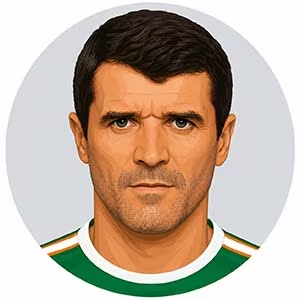
Ireland - Defensive MidfielderKeane, Roy
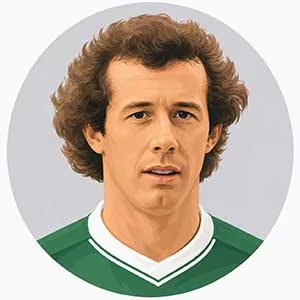
The tunnel at Highbury on February 1, 2005, provided the definitive prologue to a clash of titans when an Irish captain pointed his finger into Patrick Vieira’s face, warning him that intimidation tactics would not work against Manchester United. Roy Maurice Keane was the ferocious beating heart, tactical general, and uncompromising moral standard-bearer of Sir Alex Ferguson’s most dominant European era. Stationed in the center of the park as the definitive box-to-box enforcer and midfield driver, Keane combined an engine of limitless stamina with aggressive ball-winning, razor-sharp short passing, and exceptional spatial leadership. His magnum opus arrived on April 21, 1999, at the Stadio Delle Alpi against Juventus: receiving a yellow card that ruled him out of the Champions League final, he delivered a legendary, heroic display to haul United back from 2–0 down to a 3–2 victory, paving the way for the historic continental treble. Across 480 matches for United following his British-record transfer from Nottingham Forest in 1993, he won seven Premier League championships, four FA Cups, the 1999 Champions League, and the 1999 Intercontinental Cup. For the Republic of Ireland, across 67 caps and nine goals, he was the talismanic driving force behind their run to the 1994 World Cup and 2002 qualification, before the infamous Saipan incident ended his tournament participation.
Nevertheless, Keane’s maximalist, combative fury constantly bordered on total destructive ruin. His volcanic temper resulted in frequent high-profile dismissals and severe disciplinary bans—most notoriously his premeditated, career-ending knee-high tackle on Manchester City’s Alf-Inge Håland in 2001. Tactically, he was not a delicate, long-range free-kick specialist or an intricate dribbler in tight spaces; his offensive game was built entirely on direct, vertical distribution and forceful late surges, while his refusal to compromise his high-intensity physical output eventually accelerated the physical wear-and-tear on his hips and knees.
Ruthless, perfectionist, and intolerant of mediocrity, Keane led not by offering gentle encouragement, but by demanding absolute excellence on pain of verbal devastation. He held his teammates, managers, and directors to an unforgiving standard, viewing anything less than total victory as a catastrophic failure of character. On the pitch, his body language was pure, radiating menace: chest puffed out, eyes burning with competitive fire, barking tactical orders and tracking back forty yards to wipe out opposition counters with brutal efficiency. Inside the Old Trafford dressing room, his word was terrifying law; his presence kept huge egos completely grounded and focused on silverware, until his explosive departure in late 2005 following an unfiltered critique of teammates on MUTV. Opponents feared stepping into his midfield domain, while match officials faced an intense, relentless interrogator on every whistle, cementing an eternal legacy as the most fearsome, driven, and influential captain in Premier League history.


 All Time Manchester UnitedClub