We use Google Analytics to understand how visitors use this site. Analytics cookies are only activated with your consent. For details, read our Privacy Policy.
Profile lensThe same player, read from a different angle.
Athletic78
Acceleration
79
Pace
77
Agility
82
Strength
74
Balance
78
Jumping
68
Stamina
83
Fitness
82
Technical88
Dribbling
87
Short Passing
91
Long Passing
91
Finishing
84
Shot Accuracy
81
Shot Power
84
Shooting Technique
84
Heading
72
Tackling
57
Crossing
92
Free Kick
78
Penalties
87
First Touch
90
Mental78
Composure
88
Aggression
73
Consistency
75
Creativity
87
Leadership
70
Work Rate
74
Tactical84
Vision
87
Off the Ball
84
Defensive Positioning
52
Teamwork
87
Anticipation
78
Marking
44
Player Traits
Attacking83
Crossing
92
Finishing
84
Heading Accuracy
72
Shot Accuracy
81
Off the Ball
84
Technique87
Dribbling
87
Free Kick
78
Short Passing
91
Long Passing
91
First Touch
90
Shot Technique
84
Movement79
Acceleration
79
Pace
77
Agility
82
Balance
78
Physicality78
Shot Power
84
Jumping
68
Stamina
83
Strength
74
Fitness
82
Defending51
Marking
44
Tackling
57
Def. Positioning
52
Mentality & Game Reading81
Aggression
73
Composure
88
Penalties
87
Vision
87
Leadership
70
Work Rate
74
Teamwork
87
Anticipation
78
Consistency
75
Creativity
87
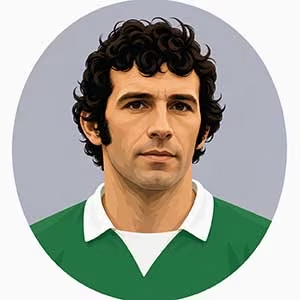
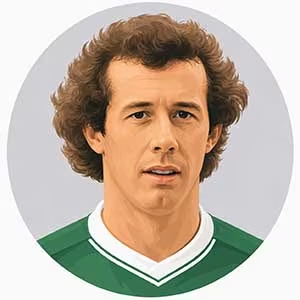
Ireland - Attacking MidfielderBrady, Liam
Highbury, May 1980, the final home match of a contract Liam Brady had already decided not to renew. Arsenal had just lost the FA Cup final to West Ham, their third major final defeat in fourteen months, and their best player — twenty-four years old, adored by the crowd, offered more money to stay than any English club could match — walked out to a guard of honour from his own supporters, who understood before most journalists did that he was leaving anyway, and that money had nothing to do with it. He wanted to test himself in Italy. That was the entire explanation, then and for the rest of his life.
Born in Dublin in 1956, Brady joined Arsenal's academy at fifteen and became the club's most gifted attacking midfielder of the post-war era. He was a rare combination for English football of that decade: genuinely two-footed, with a left foot of exceptional range capable of the long diagonal switch as easily as the defence-splitting through ball, and a dribbling style built on close control and change of pace rather than power. He read matches slowly and precisely, dictating tempo from deep positions in a league that mostly demanded directness. Across seven seasons in the Arsenal first team he made 306 appearances, won the 1979 FA Cup with the winning assist in the final, and was voted PFA Players' Player of the Year in 1979. His move to Juventus in 1980 made him one of the first British players to succeed at the highest level in Italy: two Serie A titles in his two seasons there, before transfers to Sampdoria, Inter and Ascoli extended an Italian career of seven years in total. He won 72 caps for the Republic of Ireland across seventeen years, captaining the side through a generation that narrowly missed the tournament qualifications that would define the next one.
His limitations were physical and, at times, self-inflicted by the same idealism that defined him. Brady was not quick and offered limited defensive work, depending on midfield partners to cover ground he would not cover himself, which made him vulnerable in matches that turned into transitional, high-tempo contests. His decision-making, while generally excellent, occasionally erred toward the elaborate pass when a simpler one was available. And his insistence on leaving Arsenal at their lowest ebb rather than at their peak — a point critics raised for years — meant he departed a struggling side for a stronger one, a sequencing some considered a lack of loyalty precisely when the club needed him most.
Temperamentally he was calm, articulate and guided by conviction rather than by grievance or ambition for wealth. Brady rarely argued with referees, fouled infrequently, and built his authority through consistent excellence rather than volume or confrontation — teammates at every club described a quietly respected figure rather than an emotional leader. His departure from Arsenal is the clearest window into him: it was not a falling-out, produced no bitterness on either side, and he returned to the club decades later to work in youth development, suggesting the relationship had never actually broken. He adapted to Italian football, and to the intense man-marking and tactical discipline it demanded, without complaint, treating the challenge as the entire point of having left. He was even-tempered under provocation, rarely retaliated against the close physical attention Italian defenders gave him, and criticism did not appear to wound him in any lasting way — he discussed his own career, including its disappointments, with a measured honesty rather than defensiveness. Away from the pitch he was private, intelligent and low-key, building a respected second career in football journalism and administration after retiring, entirely free of controversy across five decades in the public eye. Principled, unhurried and immune to both flattery and provocation, Brady made the single most consequential decision of his career for reasons that had nothing to do with money, results, or anyone else's opinion of him.


 All Time ArsenalClub