We use Google Analytics to understand how visitors use this site. Analytics cookies are only activated with your consent. For details, read our Privacy Policy.
Profile lensThe same player, read from a different angle.
Athletic82
Acceleration
86
Pace
82
Agility
84
Strength
77
Balance
76
Jumping
91
Stamina
82
Fitness
74
Technical83
Dribbling
86
Short Passing
78
Long Passing
78
Finishing
84
Shot Accuracy
85
Shot Power
82
Shooting Technique
77
Heading
92
Tackling
51
Crossing
74
Free Kick
76
Penalties
77
First Touch
84
Mental74
Composure
84
Aggression
76
Consistency
73
Creativity
82
Leadership
66
Work Rate
66
Tactical83
Vision
86
Off the Ball
85
Defensive Positioning
48
Teamwork
77
Anticipation
86
Marking
44
Player Traits
Attacking84
Crossing
74
Finishing
84
Heading Accuracy
92
Shot Accuracy
85
Off the Ball
85
Technique80
Dribbling
86
Free Kick
76
Short Passing
78
Long Passing
78
First Touch
84
Shot Technique
77
Movement82
Acceleration
86
Pace
82
Agility
84
Balance
76
Physicality81
Shot Power
82
Jumping
91
Stamina
82
Strength
77
Fitness
74
Defending48
Marking
44
Tackling
51
Def. Positioning
48
Mentality & Game Reading77
Aggression
76
Composure
84
Penalties
77
Vision
86
Leadership
66
Work Rate
66
Teamwork
77
Anticipation
86
Consistency
73
Creativity
82
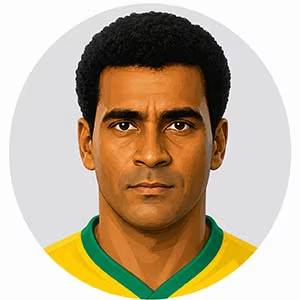
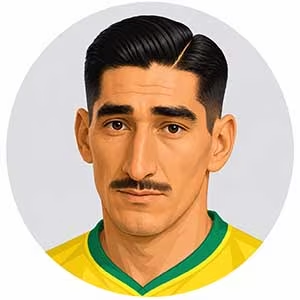
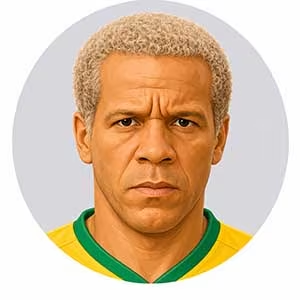
Brazil - ForwardLeivinha
Brazil's football federation still had time, on the eve of the 1974 World Cup, to celebrate a milestone nobody had planned around: the national team's one-thousandth official goal, scored the year before against Bolivia at the Maracanã, a header rising above the Bolivian defense off a Valdomiro cross. The scorer was a slight, unassuming forward from the interior of São Paulo state who was never the tallest or most physically imposing player on any pitch he occupied — and who scored disproportionately with his head anyway, timing and opportunism compensating for whatever his frame lacked.
Born in Novo Horizonte, São Paulo, in 1949 into a family where, as he put it years later, the game was in the blood — his twin brothers Dadá and Didi also became professionals — João Leiva Campos Filho broke through at Linense before a stroke of good fortune got him a trial at Portuguesa: the coach, short-handed with two regular attackers injured, needed a body and gave the sixteen-year-old a chance he never gave back. He became part of an exciting young Portuguesa attack nicknamed after the era's pop music movement, then moved to Palmeiras in 1971, where he spent five seasons as one of the central figures of the club's celebrated Segunda Academia — a technically gifted generation, alongside Ademir da Guia, that captivated Brazilian football in the early 1970s. He scored 108 goals in 267 appearances for Palmeiras, won two Brazilian championships, and was called up to the 1974 World Cup squad, where he started until an ankle sprain suffered against Zaire cost him his place for the remainder of the tournament. In 1975 he moved to Atlético Madrid, scoring a hat-trick on his debut against Salamanca and finishing with 43 goals in 93 official matches across four seasons, winning the Spanish league and continental honors, before injuries forced his retirement at São Paulo around thirty. For Brazil he won 27 caps and 7 goals across a decade of involvement with the national side.
His limitations were tied directly to his physical frame and to the fragility that eventually shortened his career. Leivinha depended on quick, close-range movement in tight spaces and opportunistic finishing rather than power or aerial dominance in the conventional sense, which made him vulnerable against physically dominant defenders who could deny him the half-yard he needed to operate. Injuries, particularly to his ankle, recurred across his career and ultimately ended it earlier than his talent alone would have dictated, costing him a longer run at the top level in Europe and, arguably, further international recognition.
Temperamentally the available record describes a player of instinctive, opportunistic quality rather than one defined by conflict or controversy — an attacking midfielder whose value lay in reading the exact moment a chance would open rather than in physical confrontation or vocal leadership. He built his early career on a fortunate break he immediately made the most of, and his signature moment for Brazil arrived not through a spectacular individual run but through anticipation and timing in the six-yard box, patterns that recurred throughout his career. Away from the pitch he moved into football broadcasting and analysis after retiring, remaining visibly connected to the game for the rest of his life. He died in 2026 in Santos, São Paulo, at seventy-six, after several years living with Alzheimer's disease, remembered by Palmeiras, by Atlético Madrid, and by the Brazilian federation as one of the most technically gifted forwards of his generation — a player, as his own club put it, who scored with both his feet and his head. Skilled, opportunistic and shaped by a career-long collision between remarkable technical gifts and a body that could not always sustain them, Leivinha remains best remembered for two things separated by twenty months: a milestone goal for his country, and the ankle injury that quietly ended his chance to finish the tournament that should have been his greatest stage.