We use Google Analytics to understand how visitors use this site. Analytics cookies are only activated with your consent. For details, read our Privacy Policy.
Profile lensThe same player, read from a different angle.
Athletic80
Acceleration
87
Pace
82
Agility
85
Strength
77
Balance
76
Jumping
78
Stamina
79
Fitness
78
Technical81
Dribbling
90
Short Passing
79
Long Passing
75
Finishing
77
Shot Accuracy
76
Shot Power
81
Shooting Technique
83
Heading
77
Tackling
45
Crossing
72
Free Kick
73
Penalties
77
First Touch
86
Mental77
Composure
78
Aggression
74
Consistency
76
Creativity
85
Leadership
76
Work Rate
74
Tactical80
Vision
82
Off the Ball
82
Defensive Positioning
44
Teamwork
73
Anticipation
83
Marking
38
Attacking77
Crossing
72
Finishing
77
Heading Accuracy
77
Shot Accuracy
76
Off the Ball
82
Technique81
Dribbling
90
Free Kick
73
Short Passing
79
Long Passing
75
First Touch
86
Shot Technique
83
Movement83
Acceleration
87
Pace
82
Agility
85
Balance
76
Physicality79
Shot Power
81
Jumping
78
Stamina
79
Strength
77
Fitness
78
Defending42
Marking
38
Tackling
45
Def. Positioning
44
Mentality & Game Reading78
Aggression
74
Composure
78
Penalties
77
Vision
82
Leadership
76
Work Rate
74
Teamwork
73
Anticipation
83
Consistency
76
Creativity
85
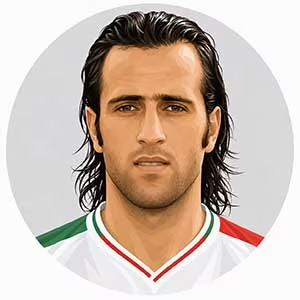
Iran - Attacking MidfielderKarimi, Ali
Slaloming past entire defensive blocks on the hard, packed dirt of Tehran before recreating those exact solo runs in the Bundesliga earned an eccentric Persian virtuoso the global title of The Asian Maradona. Ali Karimi was an anarchic dribbling wizard whose game belonged to the romantic traditions of pure street football, possessing balance and ankle elasticity that made him virtually dispossessable in one-on-one isolations.
Operating as a classic attacking playmaker, second striker, or free-roaming winger, Karimi manipulated defenders through hesitation moves, sudden hip swerves, and a lightning-fast sole-of-the-boot drag. After dominating Asian football with Persepolis and Al-Ahli—winning the 2004 Asian Footballer of the Year award following a sensational Asian Cup campaign where he scored a historic hat-trick against South Korea—he was hand-picked by Felix Magath for Bayern Munich in 2005. In Bavaria, he silenced European skeptics by claiming the 2005–06 Bundesliga and DFB-Pokal double, before later winning the 2011 DFB-Pokal with Schalke 04. Across 127 caps and 38 goals for Iran, he served as the creative heartbeat of Team Melli, featuring at the 2006 World Cup in Germany.
The paradox of Karimi’s genius, however, was a lifelong allergy to tactical systems and defensive tracking. He openly resented defensive duties, refused to press without the ball, and approached physical conditioning with erratic enthusiasm. When confronted by compact European low blocks that doubled him on the touchline and denied him space to turn, his influence could vanish for long stretches if his individual dribbling lanes were closed off.
Moody, uncompromising, and governed by an unbending personal integrity, Karimi walked through his career on his own terms. He was entirely immune to administrative pressure, famously wearing green wristbands during a 2009 World Cup qualifier in Seoul to support Iranian democratic protesters despite immense political risk. On the pitch, his posture was languid and unhurried until the ball arrived, at which point he exploded into electric sequences of feints that brought crowds to their feet. Inside the dressing rooms of Tehran, Dubai, and Munich, he was an enigmatic, revered figure who played purely for aesthetic joy, cementing an immortal legacy as one of the most naturally gifted and mesmerizing dribblers Asia ever produced.


 All-Time AsiaAsia