We use Google Analytics to understand how visitors use this site. Analytics cookies are only activated with your consent. For details, read our Privacy Policy.
Profile lensThe same player, read from a different angle.
Athletic85
Acceleration
91
Pace
90
Agility
85
Strength
81
Balance
78
Jumping
81
Stamina
89
Fitness
85
Technical85
Dribbling
86
Short Passing
85
Long Passing
86
Finishing
86
Shot Accuracy
82
Shot Power
85
Shooting Technique
80
Heading
78
Tackling
57
Crossing
83
Free Kick
77
Penalties
85
First Touch
85
Mental82
Composure
78
Aggression
84
Consistency
82
Creativity
78
Leadership
84
Work Rate
87
Tactical85
Vision
86
Off the Ball
85
Defensive Positioning
60
Teamwork
86
Anticipation
84
Marking
47
Player Traits
Attacking83
Crossing
83
Finishing
86
Heading Accuracy
78
Shot Accuracy
82
Off the Ball
85
Technique83
Dribbling
86
Free Kick
77
Short Passing
85
Long Passing
86
First Touch
85
Shot Technique
80
Movement86
Acceleration
91
Pace
90
Agility
85
Balance
78
Physicality84
Shot Power
85
Jumping
81
Stamina
89
Strength
81
Fitness
85
Defending55
Marking
47
Tackling
57
Def. Positioning
60
Mentality & Game Reading83
Aggression
84
Composure
78
Penalties
85
Vision
86
Leadership
84
Work Rate
87
Teamwork
86
Anticipation
84
Consistency
82
Creativity
78
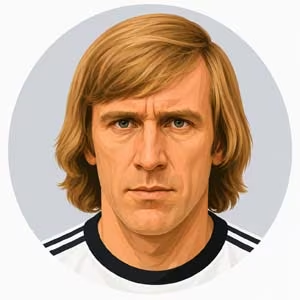
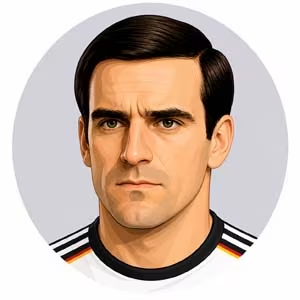
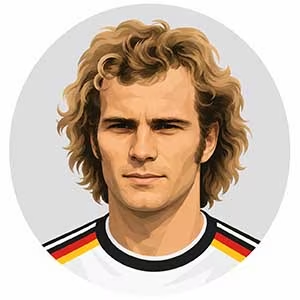
Germany - Attacking MidfielderHoeness, Uli
An explosive sprint clocked at 11.0 seconds over 100 meters made Ulrich Hoeneß the sharpest counter-attacking knife in Udo Lattek’s dominant Bayern Munich side of the early 1970s. Emerging alongside Paul Breitner from the amateur ranks directly into the starting eleven, the Ulm-born forward redefined the role of the fast wide attacker and direct second striker. He combined a long, powerful stride with lethal finishing off his right boot, famously tearing through Atlético Madrid’s backline with a devastating brace in the 1974 European Cup final replay in Brussels. Between 1970 and 1979, Hoeneß collected three consecutive Bundesliga titles, three straight European Cups, and the 1976 Intercontinental Cup. For West Germany, across 35 caps and five goals, he was a key protagonist in their international golden double, starting every match in the Euro 1972 triumph and lifting the 1974 World Cup on home soil at Munich's Olympiastadion.
Cruelly, his peak was cut drastically short by structural physical trauma. A horrific meniscus and cartilage tear sustained during the 1975 European Cup final against Leeds United stripped him of his foundational asset—his terrifying linear acceleration—reducing him to a compromised role before forcing his definitive retirement at just 27 years old. Tactically, his game had always leaned heavily on open transitions: when trapped against deep, static low blocks that denied him sprint channels, his tight-space combination play was utilitarian, his left foot was limited, and his aerial output was minimal.
Combative, hyper-ambitious, and possessing an early executive intellect that foreshadowed his decades as Bayern’s master builder, Hoeneß played with intense, aggressive directness. He did not seek aesthetic beauty; he attacked space to win at all costs, demanding total tactical efficiency from himself and his teammates. On the pitch, his body language was urgent and determined: he drove directly at defenders, threw his body into hard challenges, and refused to be intimidated by violent markers. Inside the Bayern and West German dressing rooms, he was an energetic, outspoken figure who stood toe-to-toe with dominant personalities like Franz Beckenbauer and Sepp Maier. His mental resilience was tested in the harshest spotlight when he blazed his penalty over the crossbar in the Euro 1976 final shootout against Czechoslovakia, yet he absorbed the failure with dignity and continued to lead on the pitch. Match officials found him a sharp, highly demanding competitor, leaving an immortal legacy as one of the most dynamic, fast, and tragically short-lived attacking forces in European football history.


 All Time Bayern MunichClub