We use Google Analytics to understand how visitors use this site. Analytics cookies are only activated with your consent. For details, read our Privacy Policy.
Profile lensThe same player, read from a different angle.
Athletic78
Acceleration
74
Pace
77
Agility
74
Strength
73
Balance
79
Jumping
72
Stamina
82
Fitness
93
Technical85
Dribbling
83
Short Passing
84
Long Passing
94
Finishing
75
Shot Accuracy
74
Shot Power
84
Shooting Technique
86
Heading
68
Tackling
72
Crossing
90
Free Kick
77
Penalties
74
First Touch
91
Mental85
Composure
87
Aggression
76
Consistency
93
Creativity
85
Leadership
70
Work Rate
85
Tactical81
Vision
88
Off the Ball
76
Defensive Positioning
72
Teamwork
93
Anticipation
77
Marking
68
Player Traits
Attacking77
Crossing
90
Finishing
75
Heading Accuracy
68
Shot Accuracy
74
Off the Ball
76
Technique86
Dribbling
83
Free Kick
77
Short Passing
84
Long Passing
94
First Touch
91
Shot Technique
86
Movement76
Acceleration
74
Pace
77
Agility
74
Balance
79
Physicality81
Shot Power
84
Jumping
72
Stamina
82
Strength
73
Fitness
93
Defending71
Marking
68
Tackling
72
Def. Positioning
72
Mentality & Game Reading83
Aggression
76
Composure
87
Penalties
74
Vision
88
Leadership
70
Work Rate
85
Teamwork
93
Anticipation
77
Consistency
93
Creativity
85
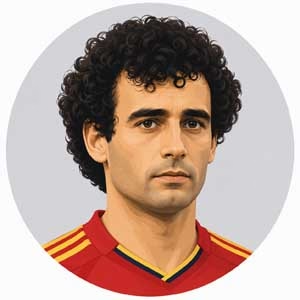
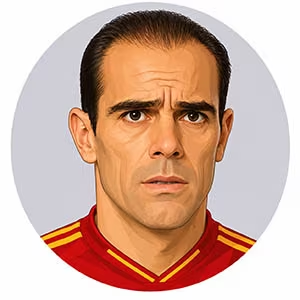
Spain - Defensive MidfielderGallego, Ricardo
A Spanish sports journalist writing about a group of gifted teenagers breaking into Real Madrid's first team in the early 1980s needed a title for his article, and initially thought a piece devoted entirely to a bunch of kids would be too much — so he added a veteran's name to soften it. Ricardo Gallego wasn't one of the kids in question, the Quinta del Buitre generation that would go on to define Spanish football for a decade. He was the older teammate who had already been through the club's youth system, already establishing himself in the first team, and who effectively godfathered that celebrated group into stardom without ever becoming its most famous member.
Born in Madrid in 1959, Gallego grew up attending matches at the Bernabéu with his father, a club member, from the age of three, and came through Real Madrid's academy idolizing the club's own number 10, Manuel Velázquez, whom he imitated at school the day after every match. He developed into a genuinely elegant, technically refined midfielder — praised specifically for his vision, his composure in possession, and what teammates and observers described as an almost magical pause, the ability to slow the game down at will — combined with enough physical range to operate equally well as a deep-lying playmaker, a defensive pivot, or a sweeper organizing the defense from behind. He was part of the Castilla side that reached the 1980 Copa del Rey final, an unprecedented achievement for a reserve team, before establishing himself permanently in Real Madrid's first team that same year. Across nine seasons and 372 official matches, he won four league titles, two Copas del Rey and consecutive UEFA Cups, becoming a central figure alongside Camacho and Stielike as the club transitioned toward the Quinta del Buitre era. For Spain he won 42 caps, playing at the 1982 and 1986 World Cups and the 1984 and 1988 European Championships, before closing his career with brief spells at Udinese and Rayo Vallecano.
His limitations were modest relative to his standing, connected mainly to a lack of explosive pace that limited him against the fastest attacking players of his era, a gap he compensated for through reading of the game and positioning rather than raw athleticism. His versatility, while valuable to his coaches, also meant he rarely occupied a single fixed role long enough to build the kind of singular individual reputation that more specialized teammates enjoyed.
Temperamentally he was defined by a discretion that has become almost impossible to find in a modern footballer of comparable achievement. Gallego was nicknamed El Soso — roughly, the bland one — by a coach during his Castilla years, a label that stuck precisely because it captured his complete lack of interest in self-promotion: he never asked the club for more money, was by his own admission poor at the public relations side of the profession, and would leave the stadium after matches on foot with his own family rather than cultivate any public persona around his considerable achievements. He led by example rather than by voice, and the young players who would go on to form the Quinta del Buitre — Butragueño, Sanchís, Míchel, Martín Vázquez, Pardeza — came up through the same academy system he had, with Gallego as the experienced professional already established in the role they were fighting to claim, a mentorship position he occupied without evident ego about it. He spoke about the Barcelona rivalry of Maradona's era with the same understated tone he applied to everything else, treating extraordinary matches as simply part of the job. Away from football his life remained genuinely private, a footballer of an era, as one retrospective put it, that will not return — raised playing outdoors rather than through structured academies, and entirely uninterested in the visibility that later generations of Real Madrid players would come to expect as a matter of course. Elegant on the pitch, deliberately invisible off it, and central to a decade of Real Madrid success without ever seeking credit for it, Gallego built a career on being exactly the kind of player his own nickname suggested he wasn't.