We use Google Analytics to understand how visitors use this site. Analytics cookies are only activated with your consent. For details, read our Privacy Policy.
Profile lensThe same player, read from a different angle.
Athletic79
Acceleration
73
Pace
77
Agility
73
Strength
85
Balance
77
Jumping
79
Stamina
86
Fitness
84
Technical74
Dribbling
73
Short Passing
75
Long Passing
76
Finishing
64
Shot Accuracy
63
Shot Power
84
Shooting Technique
68
Heading
62
Tackling
77
Crossing
85
Free Kick
69
Penalties
70
First Touch
76
Mental82
Composure
82
Aggression
83
Consistency
80
Creativity
70
Leadership
85
Work Rate
87
Tactical74
Vision
73
Off the Ball
66
Defensive Positioning
76
Teamwork
80
Anticipation
76
Marking
73
Attacking68
Crossing
85
Finishing
64
Heading Accuracy
62
Shot Accuracy
63
Off the Ball
66
Technique73
Dribbling
73
Free Kick
69
Short Passing
75
Long Passing
76
First Touch
76
Shot Technique
68
Movement75
Acceleration
73
Pace
77
Agility
73
Balance
77
Physicality84
Shot Power
84
Jumping
79
Stamina
86
Strength
85
Fitness
84
Defending75
Marking
73
Tackling
77
Def. Positioning
76
Mentality & Game Reading79
Aggression
83
Composure
82
Penalties
70
Vision
73
Leadership
85
Work Rate
87
Teamwork
80
Anticipation
76
Consistency
80
Creativity
70
Uruguay - Right BackForlán, Pablo
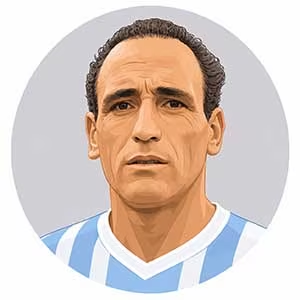
Pablo Justo Forlán Lamarque was the dynamic, iron-willed right-back from Mercedes whose thunderous overlapping runs and fierce tactical bite laid the foundation of a legendary footballing dynasty that would span three generations of South American royalty. Known across the continent as El Boniato, Forlán represented the ideal fusion of traditional Uruguayan garra and modern, lung-bursting two-way wing-back play: a relentless wide defender endowed with limitless stamina, heavy tackling mechanics, and a dangerous, driven delivery from the touchline.
Operating down the right flank, Forlán was an offensive catalyst who attacked space with aggression without sacrificing defensive rigidity. He used his explosive acceleration and low-slung, sturdy frame to muscle wingers off the ball in one-on-one duels, timing sliding challenges before immediately initiating transitions with powerful forward surges and whipped crosses into the penalty box. A centerpiece of CA Peñarol's golden era between 1963 and 1970, he lifted four Uruguayan Primera División titles (1964, 1965, 1967, 1968), the 1966 Copa Libertadores over River Plate, and the 1966 Intercontinental Cup over Real Madrid. In 1970, he completed a high-profile move to São Paulo FC, becoming an adored idol at the Morumbi across 243 matches, sweeping three Campeonato Paulista titles (1970, 1971, 1975) and reaching the 1974 Copa Libertadores final, before subsequent stints with Cruzeiro, Nacional, and Defensor. For Uruguay, across 17 official caps, he was a key figure across three World Cups (1966 in England, 1970 in Mexico—where Uruguay finished fourth—and 1974 in West Germany), alongside lifting the 1967 South American Championship (Copa América) on home soil.
That high-intensity, physical style, however, lived within clear structural and technical boundaries. Forlán was a direct, linear flank runner rather than an elusive, tight-space dribbler who manipulated the ball with intricate sole-rolls or reverse flicks; his offensive effectiveness depended on having open running lanes ahead of him. When caught high up the pitch during broken transitional phases, his aggressive forward positioning could leave the wide channel behind him vulnerable to lightning counter-attacks if his right-sided center-half was slow to cover. Furthermore, his fiercely competitive, fiery disposition occasionally drew unnecessary fouls and bookings in high-friction derby clashes when opposing wingers looked to provoke him.
Psychologically, Forlán was a natural-born competitor governed by an unyielding warrior ethos and a profound sense of family and sporting honor. He brought an uncompromising intensity to every training session and match, demanding absolute commitment from teammates and relishing the hostility of away cauldrons in continental competitions. On the pitch, his body language was a masterclass in kinetic defiance: chest thrust forward, contesting every 50-50 challenge with ferocious determination, and relentlessly driving his squad forward with sharp, authoritative gestures. Inside the Peñarol, São Paulo, and Uruguayan locker rooms, his voice carried immense weight—an adored, fearless pillar of South American football whose relentless energy, competitive fire, and iconic silverware haul established the gold standard for Uruguayan full-backs.