We use Google Analytics to understand how visitors use this site. Analytics cookies are only activated with your consent. For details, read our Privacy Policy.
Profile lensThe same player, read from a different angle.
Athletic80
Acceleration
76
Pace
78
Agility
78
Strength
82
Balance
78
Jumping
78
Stamina
85
Fitness
86
Technical76
Dribbling
76
Short Passing
75
Long Passing
75
Finishing
65
Shot Accuracy
68
Shot Power
82
Shooting Technique
68
Heading
75
Tackling
76
Crossing
79
Free Kick
65
Penalties
66
First Touch
77
Mental77
Composure
78
Aggression
75
Consistency
77
Creativity
72
Leadership
76
Work Rate
78
Tactical77
Vision
75
Off the Ball
69
Defensive Positioning
76
Teamwork
87
Anticipation
78
Marking
76
Attacking71
Crossing
79
Finishing
65
Heading Accuracy
75
Shot Accuracy
68
Off the Ball
69
Technique73
Dribbling
76
Free Kick
65
Short Passing
75
Long Passing
75
First Touch
77
Shot Technique
68
Movement78
Acceleration
76
Pace
78
Agility
78
Balance
78
Physicality83
Shot Power
82
Jumping
78
Stamina
85
Strength
82
Fitness
86
Defending76
Marking
76
Tackling
76
Def. Positioning
76
Mentality & Game Reading76
Aggression
75
Composure
78
Penalties
66
Vision
75
Leadership
76
Work Rate
78
Teamwork
87
Anticipation
78
Consistency
77
Creativity
72
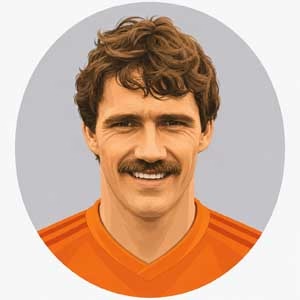
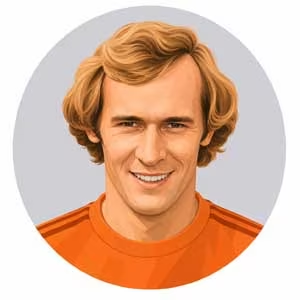
Netherlands - Right Backvan Aerle, Berry
Antonius Henricus "Berry" van Aerle was the ultimate blue-collar workhorse of Dutch football's golden year: an uncompromising, hyper-disciplined right-back and defensive utility man whose tactical reliability, lung-bursting recovery pace, and selfless containment provided the defensive foundation for PSV Eindhoven’s 1988 Treble and the Netherlands’ historic European Championship triumph.
Van Aerle built his reputation on pure defensive pragmatism and physical stamina. Operating primarily as an orthodox, defense-first right-back—though equally capable of slotting into central midfield as a destructive ball-winner or covering the left flank—he excelled at close-contact containment: staying on his feet, tracking runners step-for-step across ninety minutes, and executing clean, no-nonsense tackles before cycling possession with low-risk ground passes to playmakers like Søren Lerby, Gerald Vanenburg, or Ronald Koeman. Across thirteen seasons at PSV Eindhoven spanning 315 league matches and 12 goals between 1981 and 1994 (interrupted only by a brief loan at Royal Antwerp), he was the silent, indispensable engine of Guus Hiddink’s squad, collecting five Eredivisie championships, three KNVB Cups, and the 1987–88 European Cup against Benfica in Stuttgart. In the summer of 1988, he completed the ultimate domestic-continental sweep as an ever-present starting right-back for the Netherlands at Euro '88 in West Germany, famously neutralizing the opposing wide threats across all five matches to lift the Henri Delaunay Trophy. For the Oranje, across 35 caps between 1987 and 1992, he featured in two major tournaments, including the 1990 World Cup in Italy and Euro 1992 in Sweden.
That specialized, containment-first approach came with stark creative boundaries. Van Aerle was deliberately stripped of attacking flamboyance: he was not a modern, high-output overlapping wing-back who ventured deep into the final third to deliver whipping crosses or score from distance, and his contribution to positional build-up against deep low blocks was purely functional. When his team required intricate combination play or individual dribbling to unpick packed defenses, his lack of refined technical variety on the ball became apparent. Furthermore, while his linear recovery sprint was rapid, his crossing on the dead run was often direct and hurried rather than delicately curved.
Deeply unpretentious, modest, and completely allergic to the glamour and self-promotion of modern football, Van Aerle approached his profession with the quiet dignity of a factory worker clocking into a shift. He had zero ego, never demanded headlines, and took immense pride in performing the exhausting, invisible defensive duties that allowed artists like Ruud Gullit and Marco van Basten to thrive unburdened. On the pitch, his presence was steady, alert, and relentless: marking wide forwards with suffocating physical proximity, tracking long diagonals with total concentration, and getting straight back up from bruising collisions without theatrical complaints. Inside the PSV and Oranje dressing rooms, he was an adored, low-maintenance teammate whose humility, unshakeable work ethic, and ironclad reliability made him the definitive, beloved symbol of Dutch football's greatest summer.