We use Google Analytics to understand how visitors use this site. Analytics cookies are only activated with your consent. For details, read our Privacy Policy.
Profile lensThe same player, read from a different angle.
Athletic81
Acceleration
86
Pace
85
Agility
80
Strength
81
Balance
78
Jumping
82
Stamina
79
Fitness
80
Technical83
Dribbling
83
Short Passing
77
Long Passing
75
Finishing
86
Shot Accuracy
84
Shot Power
83
Shooting Technique
75
Heading
83
Tackling
41
Crossing
71
Free Kick
80
Penalties
85
First Touch
83
Mental76
Composure
83
Aggression
82
Consistency
76
Creativity
79
Leadership
69
Work Rate
73
Tactical81
Vision
75
Off the Ball
87
Defensive Positioning
38
Teamwork
74
Anticipation
87
Marking
37
Attacking82
Crossing
71
Finishing
86
Heading Accuracy
83
Shot Accuracy
84
Off the Ball
87
Technique79
Dribbling
83
Free Kick
80
Short Passing
77
Long Passing
75
First Touch
83
Shot Technique
75
Movement82
Acceleration
86
Pace
85
Agility
80
Balance
78
Physicality81
Shot Power
83
Jumping
82
Stamina
79
Strength
81
Fitness
80
Defending39
Marking
37
Tackling
41
Def. Positioning
38
Mentality & Game Reading78
Aggression
82
Composure
83
Penalties
85
Vision
75
Leadership
69
Work Rate
73
Teamwork
74
Anticipation
87
Consistency
76
Creativity
79
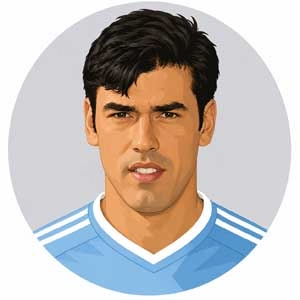
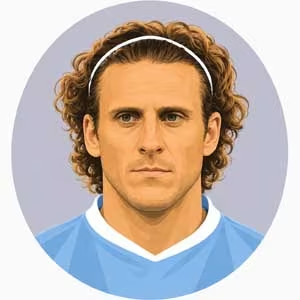
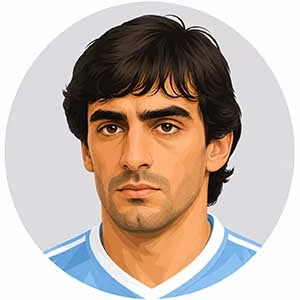
Uruguay - StrikerFonseca, Daniel
At Mestalla on 16 September 1992, Napoli were playing their first European match of the season when Daniel Fonseca scored after twenty-one minutes. Valencia equalised early in the second half, but Fonseca then scored four more times, completing a five-goal performance in a 5–1 away victory. It was his European debut for Napoli. The match showed the extreme end of a forward whose influence could arrive in concentrated bursts rather than through continuous domination of possession. Fonseca could attack the penalty area, move away from it to create an angle and then return quickly enough to finish the same attack. The five goals also arrived shortly after a major career transition: he had moved from Cagliari to a Napoli still reorganising after the end of its previous era and immediately accepted the burden of becoming one of its principal attacking references. Contemporary reporting treated the performance almost as an instantaneous transfer of responsibility onto the young Uruguayan.
Fonseca was a mobile forward rather than a fixed penalty-box number nine. At Cagliari he often started from the left, using acceleration and diagonal movement to reach central finishing zones, while at Napoli he increasingly operated closer to goal. He combined a powerful left foot with strong heading, quick finishing and enough technical mobility to work around another striker rather than demanding exclusive occupation of the centre. Claudio Ranieri, whom Fonseca later called his “football father”, gave him considerable patience during a difficult first six months in Italy, when Fonseca admitted that almost nothing he attempted worked. The eventual response was substantial: 17 league goals across two seasons with Cagliari, followed by 31 Serie A goals in two seasons at Napoli. At Roma he shared attacking responsibility effectively with Abel Balbo before moving to Juventus, where injuries and greater competition increasingly turned him into a secondary option. His career therefore moved repeatedly between centrality and support rather than following one stable striker hierarchy.
The limitations were partly technical and increasingly physical. Fonseca had enough pace to separate over short and medium distances but was not a dribbler capable of generating elite attacking volume through prolonged one-against-one play. His movement away from the centre could create combinations, yet when frustration or lack of service drew him too far from the scoring zone, the team could lose the penalty-area presence that made him most dangerous. He was also more effective when physically sharp enough to attack space repeatedly. By his final Roma season, and especially after joining Juventus, recurrent injuries increasingly reduced availability; in 1999–2000 he failed to make a single Serie A appearance. His later career should therefore not be explained simply through reduced confidence or selection. The athletic platform itself became unreliable. Nor was Fonseca a high-volume creative organiser who could compensate completely by dropping deeper once acceleration and movement declined.
Psychologically, Fonseca is best defined by **reciprocal trust mobilisation**. He later stated unusually directly that to give his maximum he needed a coach who believed in him; when he found the right manager, he was prepared to “throw himself into the fire” and difficult tasks became easier. Ranieri provides the positive model: patience during an initially disastrous adaptation produced loyalty strong enough that Fonseca still described him decades later as a formative figure. Conflict appeared when he perceived the opposite mechanism. At Roma, Fonseca said his relationship with Carlos Bianchi deteriorated quickly and that he spent roughly eight months without playing; when he asked to leave, he believed Bianchi had agreed to tell the president he was unnecessary, only to discover that the coach had described him instead as a useful late substitute. Fonseca remembered the episode as a breach of straightforward dealing rather than merely resentment at being benched. His reaction to transfer rumours at Napoli shows the same sensitivity from another direction: when newspapers suggested he would leave for Juventus, he responded angrily because he did not want supporters to consider him a traitor and insisted that he would announce any departure himself. This was not generic status dependence. Fonseca could accept tactical variation and competition, but engagement was strongest when trust felt reciprocal and communication direct. Evidence for systematic referee conflict, retaliatory aggression or performance collapse under major-event pressure is insufficient. His sharper pattern is that **trust received from authority could be converted into unusually high commitment, while perceived duplicity or withdrawal of trust could convert disagreement into open confrontation**.