We use Google Analytics to understand how visitors use this site. Analytics cookies are only activated with your consent. For details, read our Privacy Policy.
Profile lensThe same player, read from a different angle.
Athletic80
Acceleration
74
Pace
78
Agility
76
Strength
83
Balance
83
Jumping
78
Stamina
90
Fitness
78
Technical79
Dribbling
77
Short Passing
80
Long Passing
81
Finishing
64
Shot Accuracy
66
Shot Power
85
Shooting Technique
71
Heading
74
Tackling
84
Crossing
75
Free Kick
66
Penalties
66
First Touch
79
Mental79
Composure
82
Aggression
80
Consistency
77
Creativity
73
Leadership
70
Work Rate
92
Tactical81
Vision
80
Off the Ball
66
Defensive Positioning
79
Teamwork
85
Anticipation
85
Marking
79
Attacking69
Crossing
75
Finishing
64
Heading Accuracy
74
Shot Accuracy
66
Off the Ball
66
Technique76
Dribbling
77
Free Kick
66
Short Passing
80
Long Passing
81
First Touch
79
Shot Technique
71
Movement78
Acceleration
74
Pace
78
Agility
76
Balance
83
Physicality83
Shot Power
85
Jumping
78
Stamina
90
Strength
83
Fitness
78
Defending81
Marking
79
Tackling
84
Def. Positioning
79
Mentality & Game Reading79
Aggression
80
Composure
82
Penalties
66
Vision
80
Leadership
70
Work Rate
92
Teamwork
85
Anticipation
85
Consistency
77
Creativity
73
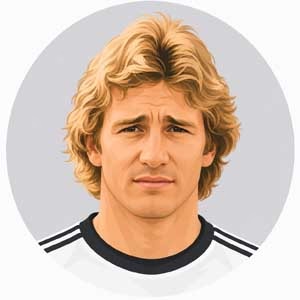
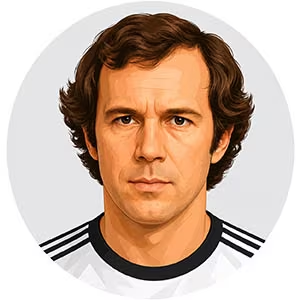
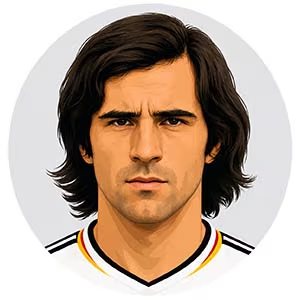
Germany - Defensive MidfielderDremmler, Wolfgang
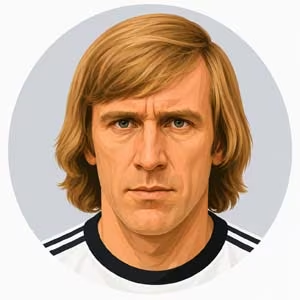
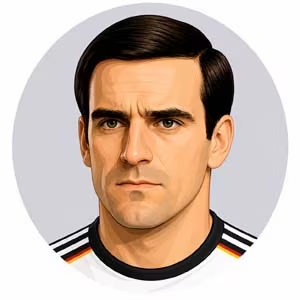
The tireless engine room that powered Paul Breitner and Karl-Heinz Rummenigge’s dominant Bayern Munich side of the early 1980s was anchored by a relentless physical workhorse from Salzgitter. Wolfgang Dremmler was the ultimate tactical utility weapon and defensive destroyer for both club and country. Operating primarily as an aggressive, man-marking defensive midfielder or a lung-busting right-back, Dremmler combined boundless cardiovascular stamina with ferocious ball-winning tenacity, tracking opposing playmakers across every blade of grass and shutting down transitions through sheer physical friction. After lifting the 1976–77 DFB-Pokal and reaching the 1978 UEFA Cup semi-finals with Eintracht Braunschweig, he joined Bayern Munich in 1979 under Pál Csernai. Over seven seasons in Bavaria, he won four Bundesliga championships, three DFB-Pokals, and started the 1982 European Cup final against Aston Villa in Rotterdam. For West Germany, across 27 caps and three goals, he was an indispensable starting midfielder in Jupp Derwall’s squad at the 1982 World Cup in Spain, starting the final against Italy in Madrid.
Nevertheless, Dremmler’s game was strictly utilitarian and destructive in nature. He possessed limited creative vision when tasked with building possession against deep low blocks; his passing range was basic and risk-averse, his crossing from wide areas lacked precision, and his dribbling in tight channels was rudimentary. If his team was forced to chase a game without space on the break, his offensive utility dropped sharply. Severe, recurring knee cartilage injuries ultimately took a heavy physical toll, forcing his retirement from top-flight football in 1986.
Disciplined, unyielding, and driven by an intense German blue-collar work ethic, Dremmler was the quintessential team-first enforcer who embraced the unglamorous dirty work without complaint. He had zero interest in media fanfare or personal accolades, measuring his success entirely by the total neutralization of his direct opponent. On the pitch, his body language was aggressive and relentless: charging into 50-50 duels with absolute commitment, maintaining tight physical contact on opposing number tens, and contesting every loose ball. Inside the Bayern and West German dressing rooms, he was an essential, highly respected balancer who earned the trust of commanding leaders like Breitner and Rummenigge. Match officials found him a combative, tough competitor who pushed physical marking to the absolute legal limit, leaving a lasting legacy as one of the most dedicated, durable, and effective German midfielders of the 1980s.