We use Google Analytics to understand how visitors use this site. Analytics cookies are only activated with your consent. For details, read our Privacy Policy.
Profile lensThe same player, read from a different angle.
Athletic82
Acceleration
77
Pace
76
Agility
72
Strength
85
Balance
85
Jumping
84
Stamina
88
Fitness
85
Technical79
Dribbling
75
Short Passing
80
Long Passing
79
Finishing
70
Shot Accuracy
72
Shot Power
87
Shooting Technique
70
Heading
82
Tackling
82
Crossing
70
Free Kick
72
Penalties
71
First Touch
79
Mental81
Composure
82
Aggression
86
Consistency
82
Creativity
72
Leadership
79
Work Rate
84
Tactical81
Vision
82
Off the Ball
70
Defensive Positioning
81
Teamwork
83
Anticipation
84
Marking
77
Player Traits
Attacking73
Crossing
70
Finishing
70
Heading Accuracy
82
Shot Accuracy
72
Off the Ball
70
Technique76
Dribbling
75
Free Kick
72
Short Passing
80
Long Passing
79
First Touch
79
Shot Technique
70
Movement78
Acceleration
77
Pace
76
Agility
72
Balance
85
Physicality86
Shot Power
87
Jumping
84
Stamina
88
Strength
85
Fitness
85
Defending80
Marking
77
Tackling
82
Def. Positioning
81
Mentality & Game Reading81
Aggression
86
Composure
82
Penalties
71
Vision
82
Leadership
79
Work Rate
84
Teamwork
83
Anticipation
84
Consistency
82
Creativity
72
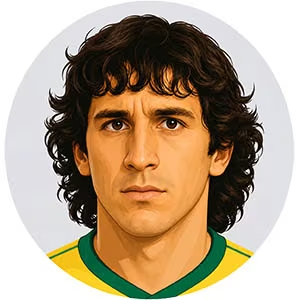
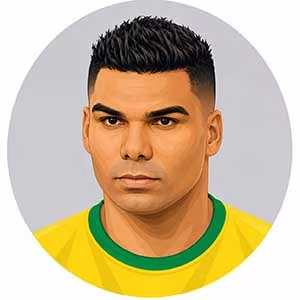
Brazil - Defensive MidfielderCasemiro
Casemiro rarely defended the space directly in front of him as though it were the only problem that mattered. When a full-back advanced, a midfielder lost possession or a centre-back stepped towards the ball, he immediately adjusted towards the space that teammate had abandoned. Sometimes the intervention was an interception, sometimes a tackle, sometimes simply occupying the passing lane long enough for the structure to recover. At Real Madrid this became so familiar that his role could appear almost entirely reactive, but the sequence usually began before the emergency existed. Casemiro understood that playing behind adventurous midfielders and full-backs meant accepting responsibility for actions initiated by somebody else. When the recovery could not be made cleanly, he was also willing to stop the transition with a foul and accept the disciplinary consequence. The important distinction was functional: contact was a tool for restoring structure, not automatically evidence that the duel had become personal.
Casemiro developed into a holding midfielder whose defensive range combined anticipation, physical strength and an unusually strong instinct for second balls. He could protect the centre-backs, move laterally to cover wide advances and step forward aggressively when an opponent received with a poor body orientation. His aerial ability added another layer, both defensively and in the opposing penalty area, while powerful long-range shooting produced important goals beyond what his role normally required. In possession he was considerably more competent than the destroyer stereotype suggests. Casemiro could switch play, pass vertically when the lane opened and circulate securely, although he was not the primary tempo controller. At Real Madrid that division of labour became exceptionally productive: he supplied defensive balance while more creative midfielders assumed greater responsibility for progression. The arrangement contributed to five Champions League titles during his period at the club. With Brazil he occupied a similarly structural position, becoming the midfielder whose presence allowed more attacking players to operate ahead of the ball without leaving central transitions completely unprotected.
The limitations follow directly from that specialisation. Casemiro was not press-resistant through close control at the level of an elite possession regista, and opponents capable of forcing him to receive facing his own goal could disrupt circulation. His turning radius and acceleration over longer distances were functional rather than exceptional; once bypassed in an open transition, he could not always recover through speed alone. Aggressive stepping also carried disciplinary cost. Tactical fouls could be rational when they prevented a dangerous transition, but repeated interventions accumulated bookings and eventually reduced how freely he could defend later in matches. His forward contribution was dangerous through shooting and aerial arrival rather than sustained creative construction. At Manchester United, environments with less stable spacing around him sometimes exposed these limitations more severely: when several structural problems developed simultaneously, Casemiro could be forced into larger spaces and later interventions, making the same aggressive instincts look more reckless because the original defensive distances were already compromised. Context therefore altered both the frequency and apparent quality of his aggression.
Psychologically, Casemiro is best defined by **protective role ownership**. He has repeatedly described defensive work not as an unpleasant obligation but as the function through which he understands his contribution to the team. That matters because low-glamour responsibility did not appear to create status resentment even while he played beside more celebrated creators. His behaviour instead suggests pride in becoming the player expected to repair imbalance: cover the teammate who advances, contest the second ball, stop the counterattack or absorb the booking when allowing play to continue would be more damaging. This should not be confused with emotional aggression. Casemiro can tackle extremely hard and has accumulated red cards, particularly later in his career, but the psychological interpretation has to remain action-specific: many interventions are tactical attempts to regain or terminate possession, while individual incidents can cross into excessive force without proving retaliation or anger. His move from Madrid to Manchester United offers another useful signal. Leaving an established championship hierarchy for a less stable project did not protect his status competitively; he accepted a context in which his responsibility quickly expanded and became one of the side’s vocal senior figures. Evidence for systematic referee obsession, teammate-directed blame or provocation-driven retaliation is insufficient for a defining score. The stronger pattern is that **Casemiro does not merely tolerate being responsible for other players’ risk: he appears to treat the protection of that risk as a specialist domain of his own, and his engagement increases when the collective structure gives that responsibility clear meaning**.


 All Time Real MadridClub