We use Google Analytics to understand how visitors use this site. Analytics cookies are only activated with your consent. For details, read our Privacy Policy.
Profile lensThe same player, read from a different angle.
Athletic80
Acceleration
75
Pace
76
Agility
79
Strength
78
Balance
77
Jumping
79
Stamina
87
Fitness
85
Technical75
Dribbling
76
Short Passing
75
Long Passing
74
Finishing
59
Shot Accuracy
60
Shot Power
80
Shooting Technique
65
Heading
72
Tackling
78
Crossing
60
Free Kick
65
Penalties
65
First Touch
78
Mental80
Composure
78
Aggression
86
Consistency
80
Creativity
66
Leadership
80
Work Rate
87
Tactical78
Vision
75
Off the Ball
64
Defensive Positioning
78
Teamwork
82
Anticipation
83
Marking
81
Player Traits
Attacking63
Crossing
60
Finishing
59
Heading Accuracy
72
Shot Accuracy
60
Off the Ball
64
Technique72
Dribbling
76
Free Kick
65
Short Passing
75
Long Passing
74
First Touch
78
Shot Technique
65
Movement77
Acceleration
75
Pace
76
Agility
79
Balance
77
Physicality82
Shot Power
80
Jumping
79
Stamina
87
Strength
78
Fitness
85
Defending79
Marking
81
Tackling
78
Def. Positioning
78
Mentality & Game Reading78
Aggression
86
Composure
78
Penalties
65
Vision
75
Leadership
80
Work Rate
87
Teamwork
82
Anticipation
83
Consistency
80
Creativity
66
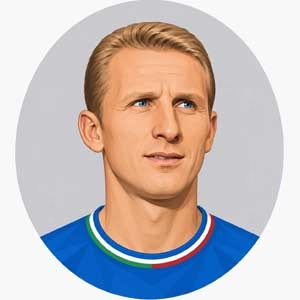
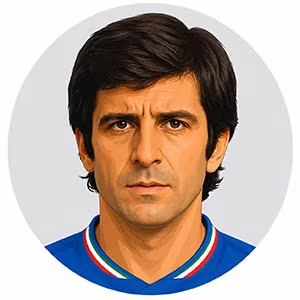
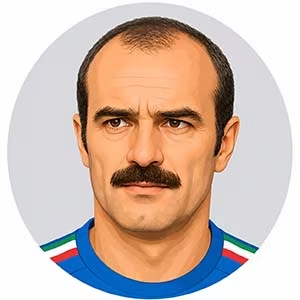
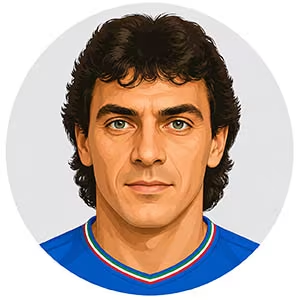
Italy - Defensive MidfielderTrapattoni, Giovanni
A rolled-up pair of sleeves and a shadow-like stride that erased the greatest number tens in world football from the match sheet turned a modest son of Cusano Milanino into the ultimate tactical conscience of Nereo Rocco’s Catenaccio. Long before he became the whistling, arm-waving master strategist of European management, Giovanni Trapattoni was an uncompromising, hyper-disciplined defensive midfielder and stopper whose relentless man-marking, spatial anticipation, and gladiatorial stamina provided the protective armor behind AC Milan's first golden continental era.
Deployed as an orthodox mediano metodista, a man-marking shadow, or a central sweeper, Trapattoni excelled at close-contact containment: stepping into the hip pocket of playmakers, disrupting their passing cadence through clean standing tackles, and immediately recycling possession with pragmatic, low-risk ground passes to Gianni Rivera. Over twelve seasons with AC Milan between 1959 and 1971 spanning 351 appearances and six goals, he cemented his status as the indispensable defensive cornerstone of the Rossoneri, lifting two Scudetti (1961–62, 1967–68), the 1966–67 Coppa Italia, two European Cups (1962–63 against Eusébio's Benfica at Wembley and 1968–69 over Cruyff's Ajax in Madrid), the 1967–68 Cup Winners' Cup, and the 1969 Intercontinental Cup over Estudiantes. His defining individual masterpiece remains the 1963 Wembley final, where his suffocating, sixty-minute neutralization of Eusébio turned the tide of European football history, before repeating the feat against Pelé in Milan's historic triumph over Santos. For Italy, across 17 caps and one goal, he served as a dependable defensive anchor, featuring at the 1962 World Cup in Chile.
That relentless defensive focus, however, came with strict offensive limitations. Trapattoni was not a progressive orchestrator who dictated attacking tempo with forty-yard switches of play or split defenses with intricate through-balls; his passing repertoire was deliberately safe, horizontal, and functional, designed entirely to offload the ball to elite playmakers as quickly as possible. Furthermore, his hyper-focused, man-to-man duties occasionally meant that if an elite opponent drifted wide to drag him into deep defensive channels, large pockets of space could open in the central midfield corridor if his partners failed to shift in tandem.
Deeply grounded, monastic, and carrying the tireless work ethic of Brianza's working-class roots, Trapattoni approached football as a sacred duty of self-sacrifice. He possessed zero vanity or desire for individual spotlight, taking immense professional pride in doing the exhausting, invisible dirty work that allowed artists like Rivera to shine unburdened. On the pitch, his body language was all watchful, unyielding concentration: tracking opposing creators step-for-step across ninety minutes, contesting 50-50 balls with fierce determination, and setting a standard of immaculate sportsmanship that saw him avoid cynical brutality despite his physical role. Inside the Milan and Azzurri dressing rooms, his quiet humility, tactical loyalty, and unwavering reliability made him an adored, foundational leader whose playing career laid the indestructible mental foundation for his later managerial dynasty.