We use Google Analytics to understand how visitors use this site. Analytics cookies are only activated with your consent. For details, read our Privacy Policy.
Profile lensThe same player, read from a different angle.
Athletic78
Acceleration
78
Pace
74
Agility
83
Strength
76
Balance
77
Jumping
85
Stamina
68
Fitness
85
Technical44
Dribbling
54
Short Passing
54
Long Passing
57
Shot Accuracy
44
Shot Power
76
Shooting Technique
44
Heading
47
Free Kick
44
Penalties
44
First Touch
59
Mental83
Composure
83
Consistency
85
Leadership
79
Goalkeeping89
Reflexes
95
Positioning
87
Handling
87
Kicking
87
Goalkeeping89
Reflexes
95
Positioning
87
Handling
87
Kicking
87
Attacking46
Heading Accuracy
47
Shot Accuracy
44
Technique52
Dribbling
54
Free Kick
44
Short Passing
54
Long Passing
57
First Touch
59
Shot Technique
44
Physicality78
Shot Power
76
Jumping
85
Stamina
68
Strength
76
Fitness
85
Movement78
Acceleration
78
Pace
74
Agility
83
Balance
77
Mentality & Game Reading73
Composure
83
Penalties
44
Leadership
79
Consistency
85
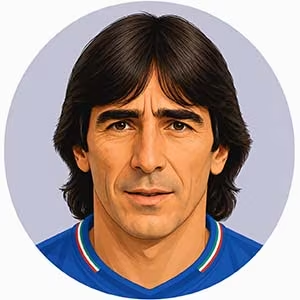
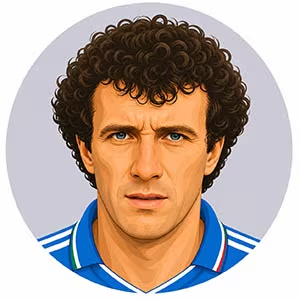
Italy - GoalkeeperTancredi, Franco
Tancredi was a relatively small goalkeeper, under 1.80 metres, who compensated through explosive reflexes, spring and exceptional speed off his line. He was particularly strong in close-range situations, reacting rapidly to deflections and attacking through balls before forwards could settle themselves. His courage in leaving the goal was important to Roma’s defensive structure because Nils Liedholm’s teams often committed numbers forward and trusted Tancredi to protect the space behind them. Penalties became another speciality. He combined lower-body explosiveness with repeated practice and observation of takers, while Liedholm encouraged him to remain upright as long as possible rather than commit early. His four consecutive saves in the 1980 Coppa Italia final shoot-out against Torino established that reputation, and Roma again defeated Torino on penalties in the following season’s final. Tancredi arrived at Roma in 1977 after earlier spells with Giulianova, Milan and Rimini, became the established starter during 1979–80 and remained first choice for more than a decade. He made 289 Serie A appearances for Roma, including 258 consecutively between April 1980 and January 1989, and won the 1982–83 Scudetto and four Coppe Italia. He also reached the 1984 European Cup final. Italy gave him 12 senior caps between 1984 and 1986; despite being strongly considered for the 1986 World Cup, Giovanni Galli was ultimately preferred. Tancredi left Roma in 1990 and finished his playing career with Torino.
His physical profile imposed real limitations. Height reduced his margin on high balls in crowded areas, and the aggressive starting positions that made him effective also required precise timing: a late decision could leave him exposed outside the goal. His style depended heavily on reflexes and explosiveness, so athletic decline inevitably removed more from his game than it would from a goalkeeper built primarily around reach and static positioning. The European Cup final also exposed the limits of preparation. Tancredi had studied Liverpool’s penalty takers, but they changed their usual choices, leaving his anticipation without the expected information advantage. His emotional investment in Roma was another potential vulnerability. Defeats associated with the club did not simply disappear once the match ended; the 1984 final remained personally painful decades later. That attachment strengthened commitment, but it also meant that some failures accumulated rather than being processed with complete detachment.
Psychologically, Tancredi combined high competitive activation with unusually little need to turn emotion outward. His penalty technique itself shows the pattern. He described saving penalties as requiring intuition, study and the mental refusal to consider oneself beaten, but he rejected the idea of distracting opponents theatrically, saying that a goalkeeper should remain concentrated on his own task. That distinction is important: pressure activated him, but he preferred procedural control to provocation. The 1984 final shows the cost when control was insufficient. Tancredi did not blame teammates publicly afterward; he later rejected stories of dressing-room arguments and recalled the players sitting silently for an extended period after defeat. The event remained painful for years, suggesting strong emotional retention rather than rapid detachment, yet the following seasons show no corresponding professional collapse. His most extreme test came on 13 December 1987 at San Siro. Returning for the second half against Milan, Tancredi was struck by explosions from fireworks thrown from the stands, lost consciousness and required immediate treatment. The incident caused lasting physical consequences, including hearing damage, yet he returned to competition and continued the remarkable sequence of consecutive league appearances that lasted until 1989. The reaction toward Milan’s hierarchy was different from his reaction to ordinary sporting defeat: he later expressed disappointment that club representatives had suggested he had exaggerated the incident. That suggests a clear sensitivity to perceived delegitimisation. Physical danger itself did not produce public retaliation against supporters or opponents, but having the seriousness of what happened questioned remained a grievance. Tancredi’s relationship with Roma operated in the opposite direction. When he returned to the Olimpico as a Torino player, the Curva Sud welcomed him back and repeatedly called him toward the supporters; he later described the reception as the best day of his life. His environmental sensitivity was therefore high in both directions: rejection and recognition penetrated deeply. Yet inside matches he was not a volatile goalkeeper. His courage in exits, penalty confrontations and long sequence of uninterrupted appearances indicate low avoidance and high reliability. Emotion mattered enormously to him, but it usually remained behind the action rather than controlling it.


 All Time RomaClub