We use Google Analytics to understand how visitors use this site. Analytics cookies are only activated with your consent. For details, read our Privacy Policy.
Profile lensThe same player, read from a different angle.
Athletic81
Acceleration
77
Pace
82
Agility
76
Strength
83
Balance
87
Jumping
74
Stamina
86
Fitness
79
Technical80
Dribbling
81
Short Passing
80
Long Passing
83
Finishing
73
Shot Accuracy
74
Shot Power
92
Shooting Technique
74
Heading
72
Tackling
81
Crossing
78
Free Kick
84
Penalties
85
First Touch
80
Mental84
Composure
84
Aggression
90
Consistency
82
Creativity
74
Leadership
85
Work Rate
86
Tactical79
Vision
84
Off the Ball
77
Defensive Positioning
73
Teamwork
82
Anticipation
75
Marking
73
Player Traits
Attacking75
Crossing
78
Finishing
73
Heading Accuracy
72
Shot Accuracy
74
Off the Ball
77
Technique80
Dribbling
81
Free Kick
84
Short Passing
80
Long Passing
83
First Touch
80
Shot Technique
74
Movement81
Acceleration
77
Pace
82
Agility
76
Balance
87
Physicality83
Shot Power
92
Jumping
74
Stamina
86
Strength
83
Fitness
79
Defending76
Marking
73
Tackling
81
Def. Positioning
73
Mentality & Game Reading83
Aggression
90
Composure
84
Penalties
85
Vision
84
Leadership
85
Work Rate
86
Teamwork
82
Anticipation
75
Consistency
82
Creativity
74
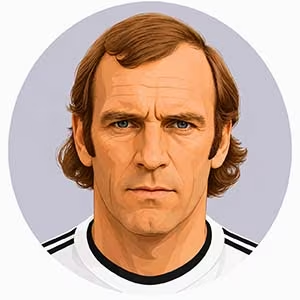
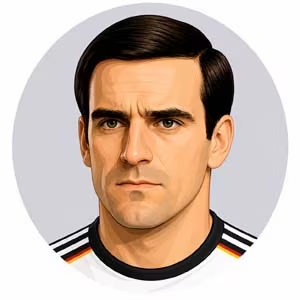
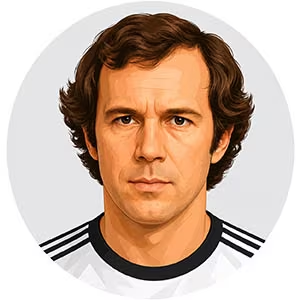
Germany - Centre MidfielderRoth, Franz
Big-game European finals in the late 1960s and 1970s had a habit of finding their decisive spark off the laces of a Bavarian blacksmith's son known across the continent as Bulle (The Bull). Franz Roth was the ultimate destructive midfield enforcer and clutch goalscorer for the historic Bayern Munich side that conquered Europe three times in a row. Stationed as a deep-lying defensive anchor or man-marking wing-half, he combined an imposing six-foot frame with a sledgehammer shooting technique from extreme distance. His entire legacy is etched in championship gold: scoring the extra-time winner against Rangers in the 1967 European Cup Winners' Cup final, drilling the opening goal against Leeds United in the 1975 European Cup final, and unleashing a vicious 30-yard free-kick past AS Saint-Étienne to seal the 1976 European Cup in Glasgow. Across 322 Bundesliga appearances for Bayern, he lifted four league titles, three European Cups, and three DFB-Pokals. For West Germany, his international career was limited to just four caps, crowded out by a midfield generation featuring Wolfgang Overath, Günter Netzer, and Uli Hoeneß.
Tactically and mechanically, Roth’s game was rigid and heavily specialized. He was entirely a linear force of containment and power: his short-passing range lacked disguise, his turning circle in tight spaces was slow, and his game was ineffective when tasked with intricate, creative orchestrations against structured defensive low blocks. Furthermore, his heavy reliance on raw physical contact left him vulnerable to agile, elusive dribblers who played between the lines.
Monastic, unselfish, and utterly indifferent to the celebrity spotlight of Munich, Roth took pride in the unglamorous dirty work required to free Franz Beckenbauer and Gerd Müller. He was an immovable rock on the pitch: unblinking when absorbing heavy physical challenges, disciplined in his marking assignments against Europe's top playmakers, and ruthlessly composed when striking loose balls on continental nights. Inside the Bayern locker room, he was a universally beloved and indispensable cultural pillar—the blue-collar backbone of FC Hollywood whose quiet reliability held the locker room together. Opponents dreaded his bone-jarring shoulder charges, while match officials respected his honest, uncompromising style, leaving behind an immortal legacy as the most clutch, powerful, and understated European Cup hero in Bayern Munich history.