We use Google Analytics to understand how visitors use this site. Analytics cookies are only activated with your consent. For details, read our Privacy Policy.
Profile lensThe same player, read from a different angle.
Athletic80
Acceleration
69
Pace
72
Agility
70
Strength
91
Balance
85
Jumping
82
Stamina
87
Fitness
85
Technical75
Dribbling
68
Short Passing
75
Long Passing
74
Finishing
58
Shot Accuracy
61
Shot Power
82
Shooting Technique
66
Heading
83
Tackling
86
Crossing
68
Free Kick
71
Penalties
68
First Touch
77
Mental83
Composure
82
Aggression
85
Consistency
86
Creativity
68
Leadership
84
Work Rate
85
Tactical79
Vision
77
Off the Ball
68
Defensive Positioning
78
Teamwork
86
Anticipation
80
Marking
77
Player Traits
Attacking68
Crossing
68
Finishing
58
Heading Accuracy
83
Shot Accuracy
61
Off the Ball
68
Technique72
Dribbling
68
Free Kick
71
Short Passing
75
Long Passing
74
First Touch
77
Shot Technique
66
Movement74
Acceleration
69
Pace
72
Agility
70
Balance
85
Physicality85
Shot Power
82
Jumping
82
Stamina
87
Strength
91
Fitness
85
Defending80
Marking
77
Tackling
86
Def. Positioning
78
Mentality & Game Reading80
Aggression
85
Composure
82
Penalties
68
Vision
77
Leadership
84
Work Rate
85
Teamwork
86
Anticipation
80
Consistency
86
Creativity
68
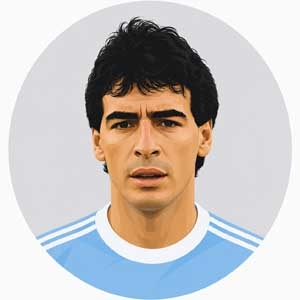
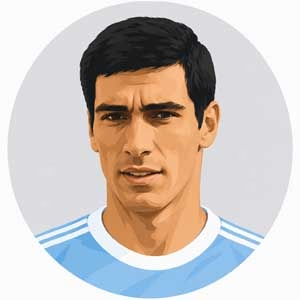
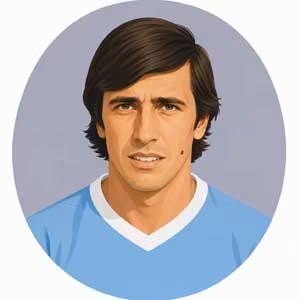
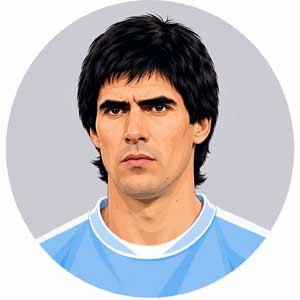
Uruguay - Defensive MidfielderOstolaza, Santiago
When the freezing Tokyo rain battered the National Stadium on December 11, 1988, it was a colossal, indefatigable midfielder from Dolores who rose twice above the Dutch champions—first nodding home in normal time, then bulleting an equalizer in the dying seconds of extra time—before coolly converting the decisive spot-kick to crown his club champions of the world. Santiago Javier Ostolaza Sosa—revered across South American football simply as El Vasco—was the ultimate modern embodiment of the traditional Uruguayan volante de contención: a gladiatorial pivot whose game fused immense physical endurance, punishing aerial superiority, and a rare, clutch goalscoring instinct on the grandest international stages.
Operating primarily as a central defensive screen, combative cinco, or occasional marking center-back, Ostolaza established a suffocating perimeter in front of his back four. He was a master of second-ball anticipation, utilizing his broad, powerful frame and long stride to break up counter-attacks with clean, crunching standing tackles before cycling possession to creative outlets. His defining club zenith came with Club Nacional de Football in 1988: under Roberto Fleitas, he served as the tactical heartbeat of the side that captured both the 1988 Copa Libertadores (scoring in the semi-final) and the 1988 Intercontinental Cup against Guus Hiddink's PSV Eindhoven, earning the Man of the Match award and the Toyota car for his legendary brace in Tokyo. He followed with the 1989 Copa Interamericana and Recopa Sudamericana before embarking on a nomadic international journey that included productive spells in Mexico with Cruz Azul and Querétaro, in Spain with Albacete Balompié, and across various Argentine and Uruguayan sides like Gimnasia La Plata, Defensor Sporting, and Montevideo Wanderers. For Uruguay, across 43 caps and six goals between 1988 and 1993, he was a key lieutenant under Óscar Washington Tabárez, starring at the 1989 Copa América (finishing as runners-up) and emerging as La Celeste's top scorer at the 1990 World Cup in Italy with three goals, including a memorable strike against South Korea that propelled Uruguay into the knockout rounds.
That bruising, combat-heavy profile, however, lived within clear creative and structural constraints. Ostolaza was an enforcer and a vertical finisher rather than an elusive, nimble playmaker capable of unraveling deep low blocks with delicate dribbling in congested channels; his passing under pressure was strictly direct, pragmatic, and designed to minimize risk rather than orchestrate intricate attacking sequences. When deployed in fast, fluid transition matches against low-gravity, agile number tens who operated between lines and avoided physical contact altogether, his recovery turn over ten yards could be tested if his interior partners failed to squeeze the surrounding space.
Psychologically, Ostolaza was an unshakeable monument of mental fortitude, competitive pride, and battlefield composure. He belonged to that rare breed of footballers whose performance levels escalated in direct proportion to the hostility and magnitude of the occasion—a true big-game specialist who felt zero apprehension when stepping up to take high-stakes penalties or contesting aerial duels against towering European center-halves. On the pitch, his body language was all quiet, imposing gravity: head held high, chest thrust out, directing midfield positioning with authoritative arm sweeps, and attacking set-pieces with a terrifying, single-minded conviction. Inside the locker rooms of Montevideo, Tokyo, and the Uruguayan national team, his leadership was absolute—an adored, fearless warrior whose aerial heroics and iconic 1988 world title cemented his status among the most legendary central midfielders in South American history.


 All Time UruguayNT