We use Google Analytics to understand how visitors use this site. Analytics cookies are only activated with your consent. For details, read our Privacy Policy.
Profile lensThe same player, read from a different angle.
Athletic80
Acceleration
72
Pace
76
Agility
73
Strength
79
Balance
87
Jumping
86
Stamina
87
Fitness
80
Technical76
Dribbling
74
Short Passing
77
Long Passing
75
Finishing
63
Shot Accuracy
66
Shot Power
84
Shooting Technique
72
Heading
84
Tackling
81
Crossing
70
Free Kick
63
Penalties
60
First Touch
78
Mental78
Composure
77
Aggression
88
Consistency
78
Creativity
68
Leadership
70
Work Rate
91
Tactical78
Vision
77
Off the Ball
64
Defensive Positioning
80
Teamwork
82
Anticipation
79
Marking
80
Player Traits
Attacking69
Crossing
70
Finishing
63
Heading Accuracy
84
Shot Accuracy
66
Off the Ball
64
Technique73
Dribbling
74
Free Kick
63
Short Passing
77
Long Passing
75
First Touch
78
Shot Technique
72
Movement77
Acceleration
72
Pace
76
Agility
73
Balance
87
Physicality83
Shot Power
84
Jumping
86
Stamina
87
Strength
79
Fitness
80
Defending80
Marking
80
Tackling
81
Def. Positioning
80
Mentality & Game Reading77
Aggression
88
Composure
77
Penalties
60
Vision
77
Leadership
70
Work Rate
91
Teamwork
82
Anticipation
79
Consistency
78
Creativity
68
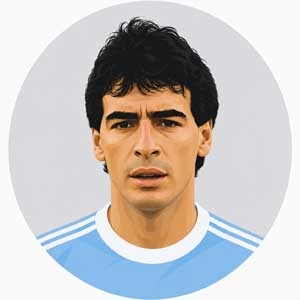
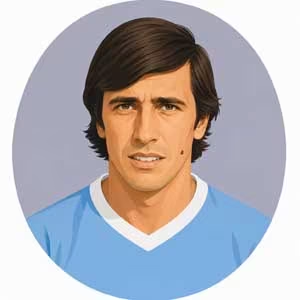
Uruguay - Defensive MidfielderCastillo, Julio Montero
Montero Castillo was primarily a defensive midfielder, although he had begun as a centre-back and retained the physical instincts of one. Strong, tireless and positionally alert, he protected the defensive line, covered more creative midfielders and attacked loose balls aggressively. He did not try to dominate possession through elaborate passing; his own description of the role was brutally simple: recover the ball, give it to the players who could create, then prepare to cover them again. That division of labour made him central to Nacional’s most successful period. After beginning with Liverpool Montevideo, he joined Nacional in 1966 and gradually moved into midfield. The club credits him with 462 appearances, six Uruguayan championships, the 1971 Copa Libertadores, Intercontinental Cup and Interamerican Cup. The 1971 Libertadores final against Estudiantes suited him perfectly: a match built around territorial struggle, second balls and repeated contact rather than sustained creative freedom. Montero Castillo later remembered those encounters as games in which both teams hit hard and accepted that the opponent would do the same. He later played for Independiente, Granada and Tenerife before returning to Nacional. For Uruguay he earned 42 official caps and scored once, won the 1967 South American Championship, reached the 1970 World Cup semi-final and also appeared at the 1974 tournament.
His limitations were inseparable from the qualities that made him useful. Montero Castillo defended aggressively enough that referees could begin matches already alert to his reputation; he later complained that in Uruguay officials sometimes warned him before play even settled. Against technically superior teams capable of circulating the ball rapidly, repeated attempts to close space could turn into fouls when he arrived late. The Netherlands match in 1974 was the clearest example: rather than becoming less involved as Dutch movement pulled Uruguay apart, he continued contesting situations until dismissal removed him completely. His contribution in possession was also functional rather than creative. If a team required its holding midfielder to dictate rhythm, break lines repeatedly or carry possession through pressure, others offered more. His value increased when the surrounding structure supplied creators he could protect; it decreased when he had to become one himself. High emotional and physical activation could therefore be both solution and failure condition.
Psychologically, Montero Castillo appears to have understood football as work performed under confrontation. He later called himself an “obrero” and described central midfield as the heart of the side because somebody had to run, mark and cover the players given greater creative freedom. Teammate Ildo Maneiro remembered that support directly: Montero Castillo would tell him to ask for the ball and reassured him that defensive cover existed behind his attacking decisions. Roberto Matosas similarly remembered an inexhaustible player who recovered possession constantly. His leadership therefore operated through protection and workload rather than elegant instruction. Physical hostility rarely frightened him. Recalling trips to play Estudiantes in La Plata, he spoke almost fondly about supporters insulting, spitting and throwing objects while the players simply had to continue forward. He described those encounters as good matches rather than traumatic ones. That tolerance should not be confused with emotional immunity. Montero Castillo was perfectly capable of escalation. In the violent 1971 Copa Montevideo derby, he was one of several Nacional players dismissed as the match disintegrated into repeated confrontations. The 1974 red card provides a second example under very different circumstances. When frustration accumulated and his team lost territorial control, his answer could become increasingly physical rather than more conservative. Yet this was not simply indiscriminate aggression. He later noted that while playing in Spain he was never sent off, suggesting that context and competitive temperature mattered greatly. He also showed little tendency to romanticise failure. Speaking about the 1970 World Cup semi-final defeat to Brazil, he acknowledged the opponent’s quality but immediately added that he was never satisfied by losing; returning home after finishing fourth to find no celebration reinforced that hard competitive standard. Montero Castillo therefore belongs in a very specific category: highly confrontational without requiring personal hatred, collectively protective without being gentle, and normally able to make aggression serve structure until frustration or rivalry pushed activation beyond its useful threshold.



 All Time UruguayNT