We use Google Analytics to understand how visitors use this site. Analytics cookies are only activated with your consent. For details, read our Privacy Policy.
Profile lensThe same player, read from a different angle.
Athletic80
Acceleration
92
Pace
82
Agility
87
Strength
72
Balance
76
Jumping
68
Stamina
80
Fitness
80
Technical87
Dribbling
87
Short Passing
87
Long Passing
84
Finishing
85
Shot Accuracy
83
Shot Power
88
Shooting Technique
87
Heading
84
Tackling
32
Crossing
85
Free Kick
85
Penalties
82
First Touch
90
Mental77
Composure
80
Aggression
76
Consistency
75
Creativity
88
Leadership
72
Work Rate
76
Tactical80
Vision
84
Off the Ball
84
Defensive Positioning
40
Teamwork
75
Anticipation
75
Marking
41
Player Traits
Attacking84
Crossing
85
Finishing
85
Heading Accuracy
84
Shot Accuracy
83
Off the Ball
84
Technique87
Dribbling
87
Free Kick
85
Short Passing
87
Long Passing
84
First Touch
90
Shot Technique
87
Movement84
Acceleration
92
Pace
82
Agility
87
Balance
76
Physicality78
Shot Power
88
Jumping
68
Stamina
80
Strength
72
Fitness
80
Defending38
Marking
41
Tackling
32
Def. Positioning
40
Mentality & Game Reading78
Aggression
76
Composure
80
Penalties
82
Vision
84
Leadership
72
Work Rate
76
Teamwork
75
Anticipation
75
Consistency
75
Creativity
88
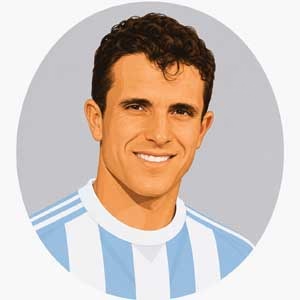
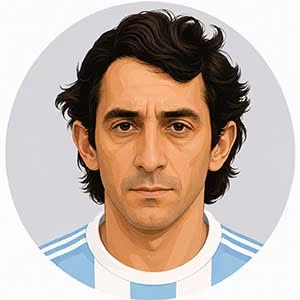
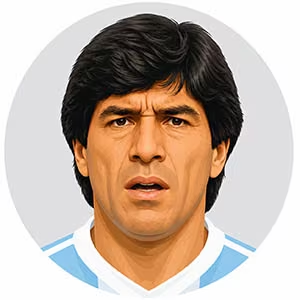
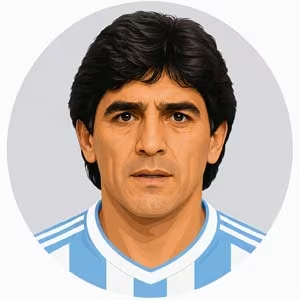
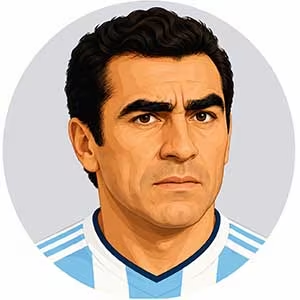
Argentina - Attacking MidfielderOnega, Ermindo
The delicate, visionary reverse ball slipped between two sliding defenders to release an overlapping forward inside a packed Monumental stood as the tactical signature of a maestro from Las Parejas who bridged two golden eras of River Plate. Ermindo Ángel Onega—revered simply across Argentine football as El Ronco for his famously raspy voice—was one of the most complete, cerebral inside-forwards and attacking playmakers in South American history, combining panoramic passing vision with the lethal, double-digit scoring instincts of a pure center-forward.
Operating as an inside-right, roving number eight, or advanced conductor, Onega possessed immaculate close control, a low center of gravity, and an exceptional ability to strike the ball cleanly off both feet from distance. He excelled at dictating the tempo of the final third: dropping deep into midfield to collect possession, accelerating past challenges with sudden shoulder feints, and arriving late in the penalty box to finish moves with clinical placement. Across a storied decade at River Plate between 1957 and 1968 spanning 222 matches and 98 goals, he was the indisputable technical brain and talisman of the team, later forming an iconic, telepathic attacking tandem with his younger brother Daniel Onega and driving River to the 1966 Copa Libertadores final. He later brought his cultured game to Peñarol in Uruguay—winning the 1969 Uruguayan Primera División—and Vélez Sarsfield, before concluding his career in Chile with Deportes La Serena. For Argentina, across 30 caps and 11 goals, he was the creative fulcrum of their mid-1960s generation: lifting the 1964 Taça das Nações in Brazil and starring at the 1966 World Cup in England, where he was widely praised by the international press for his majestic playmaking.
His refined, intellectual style, however, belonged to an era of pure technical expression that faced growing friction from the rise of hyper-physical, destructive marking systems in the late 1960s. Onega was not a combative ball-winner who relished tracking back into his own penalty box to slide into muddy challenges, nor did he possess the raw linear sprinting speed to outpace defenders in wide-open forty-yard footraces. When isolated against cynical, suffocating man-markers who were permitted to foul him before he could turn and survey passing lanes, his creative rhythm could be disrupted if his teammates failed to provide dynamic off-the-ball movement.
Passionate, fiercely articulate, and carrying an unbending sense of tactical pride, Onega was a natural commander whose booming, hoarse instructions directed matches like an on-field general. He had zero tolerance for sloppy distribution or tactical indiscipline, demanding perfection from his attacking partners while shouldering the immense, suffocating pressure of River Plate's painful domestic title drought with courageous leadership. On the pitch, his body language radiated pure authority: surveying the pitch with his head held high, dictating transitions with decisive arm gestures, and striking long-range efforts with effortless power. Inside the River Plate, Peñarol, and Argentine locker rooms, his tactical wisdom was revered—an adored patriarch whose vision, immense goalscoring output, and technical elegance cemented an immortal legacy as one of the greatest attacking midfielders in Argentine football history.