We use Google Analytics to understand how visitors use this site. Analytics cookies are only activated with your consent. For details, read our Privacy Policy.
Profile lensThe same player, read from a different angle.
Athletic82
Acceleration
81
Pace
83
Agility
77
Strength
81
Balance
85
Jumping
83
Stamina
87
Fitness
80
Technical77
Dribbling
78
Short Passing
73
Long Passing
77
Finishing
64
Shot Accuracy
66
Shot Power
87
Shooting Technique
71
Heading
81
Tackling
81
Crossing
76
Free Kick
68
Penalties
66
First Touch
77
Mental79
Composure
78
Aggression
85
Consistency
76
Creativity
68
Leadership
81
Work Rate
84
Tactical78
Vision
75
Off the Ball
74
Defensive Positioning
76
Teamwork
84
Anticipation
82
Marking
79
Attacking72
Crossing
76
Finishing
64
Heading Accuracy
81
Shot Accuracy
66
Off the Ball
74
Technique74
Dribbling
78
Free Kick
68
Short Passing
73
Long Passing
77
First Touch
77
Shot Technique
71
Movement82
Acceleration
81
Pace
83
Agility
77
Balance
85
Physicality84
Shot Power
87
Jumping
83
Stamina
87
Strength
81
Fitness
80
Defending79
Marking
79
Tackling
81
Def. Positioning
76
Mentality & Game Reading78
Aggression
85
Composure
78
Penalties
66
Vision
75
Leadership
81
Work Rate
84
Teamwork
84
Anticipation
82
Consistency
76
Creativity
68
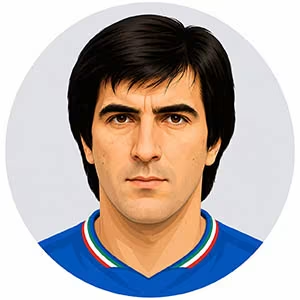
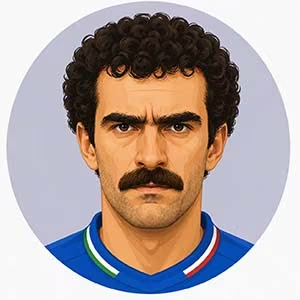
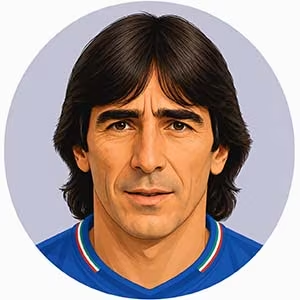
Italy - Left BackNela, Sebastiano
Sebino Nela was a full-back capable of playing naturally on either side, an important distinction in an era when such interchangeability was considerably less common. Around 1.77 metres tall, lean and quick, he defended through acceleration, anticipation and an appetite for direct confrontation rather than physical size. He could close aggressively on a winger, tackle with force and immediately turn recovery into forward movement. In possession he was more technically accomplished than the image of a purely combative defender suggests. His left foot was particularly useful, but he could operate on the right without merely surviving there, and his willingness to advance gave Roma width when their attacking players moved inside. Under Nils Liedholm he learned to function within a sophisticated zonal structure that required defenders to read space rather than simply follow opponents. Nela developed at Genoa, making his Serie A debut while still a teenager, before Roma signed him in 1981. He became an immediate regular and remained with the club for eleven seasons, making 397 competitive appearances. He won the 1982–83 Scudetto and three Coppe Italia, and started the 1984 European Cup final against Liverpool at the Olimpico. A serious knee injury in 1987 removed him for an extended period, but he returned and continued playing for Roma until 1992 before spending his final two seasons with Napoli. Italy used him less extensively than his club prominence might suggest: he earned five senior caps, was selected for the victorious 1982 World Cup squad without appearing and played at the 1986 tournament in Mexico.
Nela’s aggression had genuine costs. He defended close to opponents and enjoyed the physical duel, which meant that mistimed challenges could become fouls and that emotional temperature was more relevant to his game than for defenders based primarily on containment. His forward commitment could also expose space behind him, particularly when Roma lost possession before the defensive structure had reset. Technically competent though he was, he was not a playmaking full-back capable of controlling matches through distribution, and against opponents who forced him into sustained positional possession his attacking influence diminished. The major knee injury of 1987 was the clearest physical limitation: it interrupted his prime and required a long recovery, inevitably reducing some of the explosiveness on which his two-way game depended. His combative temperament was similarly double-edged. It could raise his intensity when matches became hostile, but also made detachment from confrontation harder.
Nela’s behaviour makes clear that his aggression was emotional as well as functional, although it should not be confused with indiscriminate loss of control. He has repeatedly described the Roma of his era through belonging, friendship and collective identity, and his attachment to the club remained unusually strong long after retirement. On the pitch that investment appeared as visible confrontation: he was not a defender who treated every provocation as irrelevant, and heated exchanges with opponents belonged naturally to his competitive vocabulary. Yet the same player operated for years inside Liedholm’s tactically demanding defensive system, showing that emotional intensity did not prevent positional discipline or acceptance of sophisticated coaching. Nela has spoken of Liedholm with enduring respect and affection, recalling a coach who could correct players through irony rather than constant authoritarian intervention. Authority therefore appears to have worked best on him when accompanied by trust and personal credibility rather than fear. The 1984 European Cup final provides the clearest test of emotional attachment. Losing the trophy to Liverpool in Roma’s own stadium became a lasting wound for the group, and Nela has continued to speak about the match decades later without pretending that time converted it into an ordinary defeat. Like several teammates, he experienced the occasion intensely rather than distancing himself from it. Crucially, however, the defeat did not produce withdrawal from responsibility: he remained a central Roma player through the following seasons. The knee injury in 1987 created another form of frustration. Recovery required months away from the competitive environment on which much of his identity depended, yet he returned to play several more seasons at the highest level rather than allowing lost explosiveness to end his career immediately. His leadership was predominantly emotional and affiliative rather than organisational. He was capable of transmitting urgency, defending teammates and embodying the group’s antagonism toward an opponent, but was less naturally the detached tactical commander directing everyone around him. Hostile environments were therefore unlikely to suppress him; confrontation more often increased his activation. That carried an obvious disciplinary cost, but it also explains why his best football fitted matches in which technical structure and emotional commitment had to coexist. Nela did not become competitive by eliminating emotion. He competed by using it.


 All Time RomaClub