We use Google Analytics to understand how visitors use this site. Analytics cookies are only activated with your consent. For details, read our Privacy Policy.
Profile lensThe same player, read from a different angle.
Athletic83
Acceleration
77
Pace
78
Agility
71
Strength
91
Balance
84
Jumping
86
Stamina
89
Fitness
88
Technical78
Dribbling
72
Short Passing
77
Long Passing
78
Finishing
72
Shot Accuracy
66
Shot Power
88
Shooting Technique
70
Heading
90
Tackling
88
Crossing
74
Free Kick
61
Penalties
66
First Touch
76
Mental82
Composure
80
Aggression
87
Consistency
80
Creativity
64
Leadership
86
Work Rate
87
Tactical81
Vision
76
Off the Ball
65
Defensive Positioning
85
Teamwork
85
Anticipation
83
Marking
87
Player Traits
Attacking73
Crossing
74
Finishing
72
Heading Accuracy
90
Shot Accuracy
66
Off the Ball
65
Technique72
Dribbling
72
Free Kick
61
Short Passing
77
Long Passing
78
First Touch
76
Shot Technique
70
Movement78
Acceleration
77
Pace
78
Agility
71
Balance
84
Physicality88
Shot Power
88
Jumping
86
Stamina
89
Strength
91
Fitness
88
Defending87
Marking
87
Tackling
88
Def. Positioning
85
Mentality & Game Reading79
Aggression
87
Composure
80
Penalties
66
Vision
76
Leadership
86
Work Rate
87
Teamwork
85
Anticipation
83
Consistency
80
Creativity
64
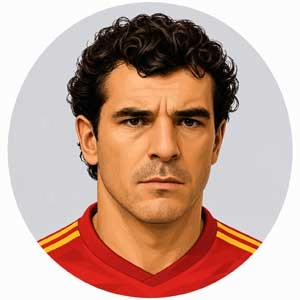
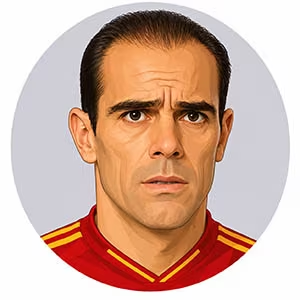
Spain - Defensive MidfielderNadal, Miguel Ángel
The booming crunch of a six-foot-two frame wiping out a counter-attack on the edge of the center circle followed by a crisp, fifty-yard raking ball to the opposite flank encapsulated the formidable dual identity of a Manacor native who anchored European football’s most revolutionary collective. Miguel Ángel Nadal Homar—feared across the continent as The Beast of Manacor—was the physical powerhouse and tactical hybrid of Johan Cruyff’s legendary Barcelona Dream Team, alternating seamlessly between an unyielding, destructive central defender and an authoritative, deep-lying defensive midfielder.
Blessed with immense upper-body strength, towering aerial dominance, and clean, low-risk distribution, Nadal provided the muscular steel and positional insurance that allowed Cruyff’s fluid playmakers to take risks without defensive fear. Forged at RCD Mallorca, his decade at FC Barcelona between 1991 and 1999 yielded over 300 official appearances and a glittering trophy haul: five La Liga championships, two Copas del Rey, the 1991–92 European Cup at Wembley, the 1996–97 European Cup Winners' Cup, and two UEFA Super Cups, before returning to Mallorca to captain them to the historic 2002–03 Copa del Rey. For Spain, across 62 caps and three goals, he was an indispensable defensive rock across three World Cups (1994, 1998, 2002) and Euro '96, earning a place in the Euro '96 Team of the Tournament.
Nadal’s game, however, was fundamentally built on power, containment, and anticipatory positioning rather than lightning agility. His heavy, muscular frame meant a wide turning radius; when isolated in wide-open forty-yard footraces against dynamic, low-center-of-gravity forwards who turned sharply in the half-spaces, his recovery speed could be tested. Furthermore, despite his clean passing range, his technical execution under suffocating, modern forward pressing was pragmatic rather than intricate, preferring immediate long-range switches over high-risk short combinations inside his own box.
Quiet, resilient, and forged in the same family ethos of athletic discipline that would later produce his nephew Rafael, Nadal approached professional football with the blue-collar seriousness of an island artisan. He had zero vanity, willingly embracing the unglamorous defensive destruction so that flair players like Romário, Stoichkov, and Laudrup could dominate the headlines. He handled high-profile setbacks—such as missing the decisive penalty in the Euro '96 quarter-final against England—with stoic dignity, returning to the training ground the next morning without excuses. On the pitch, his presence was imposing, vocal, and vigilant: commanding aerial space on set pieces, organizing the defensive line with measured authority, and putting his body into every duel. Inside the Camp Nou and Spanish national team dressing rooms, he was an adored, zero-maintenance professional whose physical courage, tactical loyalty, and mental toughness made him one of the most reliable pillars in modern Spanish football history.