We use Google Analytics to understand how visitors use this site. Analytics cookies are only activated with your consent. For details, read our Privacy Policy.
Profile lensThe same player, read from a different angle.
Athletic79
Acceleration
77
Pace
75
Agility
76
Strength
79
Balance
77
Jumping
75
Stamina
90
Fitness
83
Technical81
Dribbling
80
Short Passing
82
Long Passing
84
Finishing
76
Shot Accuracy
74
Shot Power
92
Shooting Technique
76
Heading
73
Tackling
68
Crossing
81
Free Kick
77
Penalties
74
First Touch
82
Mental79
Composure
81
Aggression
78
Consistency
76
Creativity
74
Leadership
77
Work Rate
83
Tactical81
Vision
84
Off the Ball
77
Defensive Positioning
73
Teamwork
86
Anticipation
81
Marking
69
Player Traits
Attacking76
Crossing
81
Finishing
76
Heading Accuracy
73
Shot Accuracy
74
Off the Ball
77
Technique80
Dribbling
80
Free Kick
77
Short Passing
82
Long Passing
84
First Touch
82
Shot Technique
76
Movement76
Acceleration
77
Pace
75
Agility
76
Balance
77
Physicality84
Shot Power
92
Jumping
75
Stamina
90
Strength
79
Fitness
83
Defending70
Marking
69
Tackling
68
Def. Positioning
73
Mentality & Game Reading79
Aggression
78
Composure
81
Penalties
74
Vision
84
Leadership
77
Work Rate
83
Teamwork
86
Anticipation
81
Consistency
76
Creativity
74
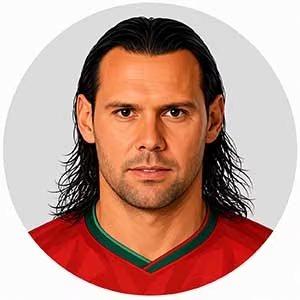
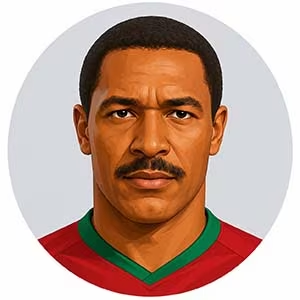
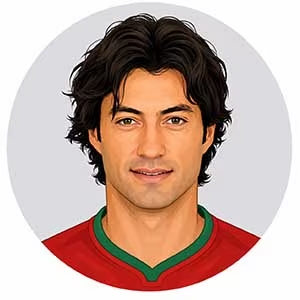
Portugal - Centre MidfielderManiche
Maniche was a dynamic central midfielder whose value came from connecting phases rather than specialising in only one of them. Usually operating alongside a more positionally conservative midfielder, he covered large distances, pressed opponents, recovered second balls and then accelerated forward to support attacks. His low centre of gravity and strong legs allowed him to protect possession under contact, while his stamina gave him the freedom to appear repeatedly around the opposition penalty area without abandoning his defensive responsibilities altogether. He passed quickly when the forward option was available rather than carrying possession unnecessarily, but he was also an unusually dangerous long-range shooter for a midfielder. José Mourinho’s Porto gave those qualities their ideal structure. After developing at Benfica and spending formative seasons with Alverca, Maniche left Benfica following a dispute with the club’s directors and joined Porto in 2002. He immediately became central to a side that won the UEFA Cup in 2003 and the Champions League in 2004, as well as consecutive Portuguese league titles. That period established him internationally. At Euro 2004 he scored against Russia, converted in the shoot-out against England and produced the semi-final winner against the Netherlands, earning selection in UEFA’s Team of the Tournament. He remained decisive for Portugal at the 2006 World Cup, scoring against Mexico and the Netherlands as the team reached the semi-finals. His club career became far less stable after Porto: Dinamo Moscow, a loan to Chelsea, Atlético Madrid, another loan to Inter, Köln and Sporting followed. He retired with 52 Portugal appearances and seven goals, his peak compressed into a few seasons in which his physical intensity and willingness to attack from midfield made him one of Portugal’s most effective tournament players.
That intensity had costs. Maniche was not a naturally controlling midfielder who slowed matches through constant positional discipline, and his instinct to leave his zone and attack space could expose teammates if possession was lost behind him. He was most effective beside a holding player capable of protecting those forward movements. His shooting ambition also produced waste: the spectacular goals survive in memory, but attempting difficult shots necessarily surrendered possession when the execution failed. As his athletic level declined, the balance became harder to maintain because much of his influence depended on repeatedly travelling between both penalty areas. His post-Porto career exposed another limitation. He contributed at several major clubs but rarely recreated the combination of tactical trust, physical peak and defined responsibility that Mourinho had given him. In less settled environments his influence became inconsistent, and disagreements over role or club direction sometimes ended in separation rather than adaptation.
Maniche’s behaviour suggests a player whose emotional stability depended less on the size of an occasion than on his relationship with the environment around him. Major matches repeatedly raised his involvement. Within a few months in 2004 he played decisive roles in a Champions League-winning campaign and a European Championship run, and two years later he again scored in knockout football at the World Cup. He did not approach those moments conservatively: against the Netherlands in 2004, the rationally safer choice from the corner of the box was to recycle or cross, yet he chose the difficult shot and executed it without apparent hesitation. Afterward he redirected attention toward Portugal’s victory rather than presenting the goal as personal validation. Before the final he spoke about patience and mental strength against Greece’s defensive structure, suggesting that competitive tension was acknowledged rather than denied. His relationship with Mourinho provides another behavioural signal. Maniche described him not merely as the best coach he had worked with but as someone who had become closer to a friend than a boss. Under a coach whose demands were extremely explicit, Maniche accepted heavy tactical and physical responsibility and produced his most consistent football. Authority itself therefore did not appear to provoke resistance; trust mattered. By contrast, his departure from Benfica followed conflict with the board, while at Dinamo Moscow he publicly admitted dissatisfaction and later said that money was not everything and that he would think twice before leaving Porto if given the decision again. When the environment felt wrong, he did not simply absorb the discomfort indefinitely. This gives his career a different signal from generic volatility: he could submit willingly to rigorous coaching when he trusted the coach, yet institutional attachment weakened rapidly when he felt disconnected from the project. There is little evidence that physical provocation routinely made him lose emotional control. The famously violent 2006 World Cup match against the Netherlands produced sixteen yellow cards and four dismissals, yet Maniche remained on the field and scored the winning goal. Aggression around him did not require retaliation from him. His competitive activation was already high enough. Maniche functioned best when that energy had a trusted tactical structure; without one, the same restless drive was less easily converted into sustained influence.