We use Google Analytics to understand how visitors use this site. Analytics cookies are only activated with your consent. For details, read our Privacy Policy.
Profile lensThe same player, read from a different angle.
Athletic82
Acceleration
87
Pace
86
Agility
82
Strength
80
Balance
76
Jumping
77
Stamina
90
Fitness
76
Technical80
Dribbling
83
Short Passing
75
Long Passing
82
Finishing
76
Shot Accuracy
74
Shot Power
86
Shooting Technique
79
Heading
74
Tackling
70
Crossing
85
Free Kick
82
Penalties
78
First Touch
84
Mental80
Composure
77
Aggression
85
Consistency
80
Creativity
77
Leadership
81
Work Rate
82
Tactical77
Vision
81
Off the Ball
78
Defensive Positioning
67
Teamwork
85
Anticipation
81
Marking
66
Player Traits
Attacking77
Crossing
85
Finishing
76
Heading Accuracy
74
Shot Accuracy
74
Off the Ball
78
Technique81
Dribbling
83
Free Kick
82
Short Passing
75
Long Passing
82
First Touch
84
Shot Technique
79
Movement83
Acceleration
87
Pace
86
Agility
82
Balance
76
Physicality82
Shot Power
86
Jumping
77
Stamina
90
Strength
80
Fitness
76
Defending68
Marking
66
Tackling
70
Def. Positioning
67
Mentality & Game Reading81
Aggression
85
Composure
77
Penalties
78
Vision
81
Leadership
81
Work Rate
82
Teamwork
85
Anticipation
81
Consistency
80
Creativity
77
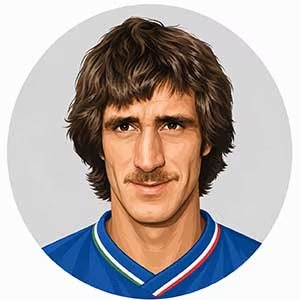
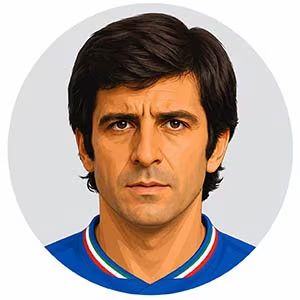
Italy - Left BackMaldera, Aldo
Nereo Rocco handed a nineteen-year-old the number 10 shirt before his Serie A debut — Gianni Rivera's shirt, unavailable that day after a suspension — and said only, in his blunt Triestine manner, take it, mule, and honor it. Aldo Maldera's first match, against Mantova in March 1972, was unremarkable by his own later admission. What followed was not: within a few seasons he had become one of the first genuinely attacking full-backs in Italian football, a defender opposing coaches specifically game-planned around containing.
Born in Milan in 1953 to a family that had emigrated from Corato, in Puglia, where his father worked as a fruit vendor, Maldera was the youngest of three footballing brothers — known for a period as Maldera III — and came through Milan's academy alongside future national teammate Gabriele Oriali. He was left-footed, fast, and possessed a genuinely powerful shot from distance, qualities that turned the left flank, in an era when full-backs were expected to do little beyond defend, into a real attacking channel. His finest season came in 1978–79, Milan's Scudetto della Stella, in which he scored nine goals from full-back — a total that nearly broke Giacinto Facchetti's record for a defender in a sixteen-team league and earned him the nickname il terzino goleador, the goal-scoring full-back. A contemporary account described the mechanism plainly: Rivera provided the vision, Maldera provided the arm, and the goal followed the same pattern often enough that rival managers built specific plans around stopping him. When Milan were caught up in the Totonero betting scandal and relegated to Serie B in 1980, Maldera stayed rather than seeking an easier path elsewhere, captained the club through its lowest period in decades, and contributed directly to the side's promotion back to Serie A with decisive late goals against Genoa and Avellino. He later played for Roma, Fiorentina and Lucchese before retiring in 1988. For Italy he won 10 caps, played at the 1978 World Cup — including the third-place match against Brazil — and Euro 1980, before his international place was eventually taken by Antonio Cabrini.
His limitations were the standard trade-off of his pioneering role: an attacking full-back committing forward as often as Maldera did occasionally left his own flank exposed in transition, a risk his coaches accepted in exchange for the goals and attacking width he otherwise provided. His technical range in possession, while good, depended more on physical power and shooting quality than on close control, meaning his contribution in build-up play was more direct than orchestrated.
Temperamentally he was defined by a loyalty to Milan that persisted through the club's most difficult years rather than only its triumphant ones, staying and captaining the side through relegation rather than using his individual reputation to leave for a stronger team. He came from a modest, close-knit family — his father a man of few words, his mother, by all accounts, considerably more voluble — and carried that grounded, unglamorous quality into a career that made him a genuine on-field pioneer without any accompanying reputation for controversy or self-promotion. He was, by wide consensus, a widely respected figure within Italian football throughout his career and after it, moving into youth coaching at Roma for nearly two decades after retiring, then into grassroots football education, and finally into a technical director role in Greece. He died in 2012, at fifty-eight, of a pulmonary embolism. Innovative on the pitch without ever appearing to seek credit for the innovation, loyal to a fault during the club's darkest chapter, and quietly influential in developing younger players for decades after his own career ended, Maldera built a legacy defined less by any single dramatic moment than by a consistency of character that outlasted every club he represented.