We use Google Analytics to understand how visitors use this site. Analytics cookies are only activated with your consent. For details, read our Privacy Policy.
Profile lensThe same player, read from a different angle.
Athletic77
Acceleration
74
Pace
76
Agility
77
Strength
75
Balance
80
Jumping
70
Stamina
85
Fitness
78
Technical89
Dribbling
85
Short Passing
91
Long Passing
93
Finishing
83
Shot Accuracy
83
Shot Power
91
Shooting Technique
84
Heading
64
Tackling
49
Crossing
88
Free Kick
99
Penalties
91
First Touch
89
Mental79
Composure
92
Aggression
74
Consistency
74
Creativity
86
Leadership
70
Work Rate
77
Tactical85
Vision
90
Off the Ball
85
Defensive Positioning
63
Teamwork
91
Anticipation
74
Marking
47
Player Traits
Attacking81
Crossing
88
Finishing
83
Heading Accuracy
64
Shot Accuracy
83
Off the Ball
85
Technique90
Dribbling
85
Free Kick
99
Short Passing
91
Long Passing
93
First Touch
89
Shot Technique
84
Movement77
Acceleration
74
Pace
76
Agility
77
Balance
80
Physicality80
Shot Power
91
Jumping
70
Stamina
85
Strength
75
Fitness
78
Defending53
Marking
47
Tackling
49
Def. Positioning
63
Mentality & Game Reading82
Aggression
74
Composure
92
Penalties
91
Vision
90
Leadership
70
Work Rate
77
Teamwork
91
Anticipation
74
Consistency
74
Creativity
86
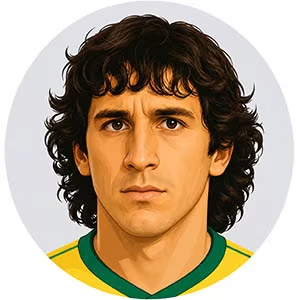
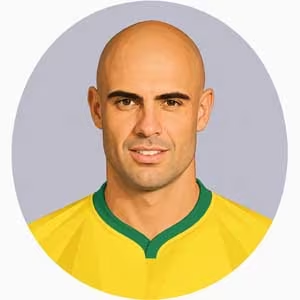
Brazil - Attacking MidfielderJuninho Pernambucano
A dead ball thirty-five yards out from goal at the Stade de Gerland in the mid-2000s provoked a level of terror in world-class goalkeepers that borders on the mythical. Antônio Augusto Ribeiro Reis Junior, immortalized globally as Juninho Pernambucano, was the undisputed master and visionary pioneer of the knuckleball free-kick technique, redefining the physical laws of ball striking. Stationed as an advanced playmaker, central orchestrator, or wide set-piece architect, Juninho possessed an extraordinary passing range, exquisite vision, and a venomous, unpredictable strike that dipped, swerved, and changed direction violently in mid-air with zero rotational spin. Across eight legendary seasons at Olympique Lyonnais between 2001 and 2009, he scored an astonishing 100 goals in 343 appearances—netting 44 direct free-kicks—as the absolute captain and tactical brain behind Lyon’s unprecedented seven consecutive Ligue 1 championships. For Brazil, across 40 caps and six goals, he won the 2005 FIFA Confederations Cup and featured at the 2006 World Cup in Germany, scoring a trademark long-range screamer against Japan.
Yet Juninho’s hyper-specialized profile required structural insulation in open-field transitions. He lacked blistering straight-line speed or dynamic recovery pace over long expanses; when isolated against hyper-athletic, transitional midfields without dedicated enforcers like Mahamadou Diarra or Michael Essien to cover the defensive ground around him, his midfield could be bypassed through direct running. Furthermore, his aerial output was minimal, and his game suffered whenever opposing teams successfully denied him space to turn and face forward in the middle third.
Monastic, intensely driven, and governed by an unyielding professional perfectionism, Juninho approached his craft with scientific obsession, spending hours after training refining the exact contact point between his instep and the ball's valve. He led Lyon not through loud bravado, but through pristine technical execution and demanding tactical standards that transformed a regional club into a European heavyweight. On the pitch, his body language was focused and commanding, marshaling set pieces with icy precision and directing attacking transitions with sharp pointing gestures. Inside the Lyon and Brazilian locker rooms, he was an untouchable patriarch and revered mentor to younger stars like Karim Benzema and Fred, setting an immaculate standard of humility and discipline. Goalkeepers from Oliver Kahn to Iker Casillas were left utterly helpless by his dipping trajectories, cementing an immortal legacy as the greatest, most devastating free-kick taker the sport of football has ever seen.