We use Google Analytics to understand how visitors use this site. Analytics cookies are only activated with your consent. For details, read our Privacy Policy.
Profile lensThe same player, read from a different angle.
Athletic83
Acceleration
84
Pace
85
Agility
79
Strength
80
Balance
78
Jumping
81
Stamina
85
Fitness
91
Technical79
Dribbling
77
Short Passing
78
Long Passing
83
Finishing
76
Shot Accuracy
75
Shot Power
82
Shooting Technique
72
Heading
75
Tackling
74
Crossing
80
Free Kick
74
Penalties
86
First Touch
80
Mental85
Composure
86
Aggression
80
Consistency
87
Creativity
72
Leadership
82
Work Rate
84
Tactical77
Vision
77
Off the Ball
76
Defensive Positioning
73
Teamwork
82
Anticipation
81
Marking
73
Player Traits
Attacking76
Crossing
80
Finishing
76
Heading Accuracy
75
Shot Accuracy
75
Off the Ball
76
Technique77
Dribbling
77
Free Kick
74
Short Passing
78
Long Passing
83
First Touch
80
Shot Technique
72
Movement82
Acceleration
84
Pace
85
Agility
79
Balance
78
Physicality84
Shot Power
82
Jumping
81
Stamina
85
Strength
80
Fitness
91
Defending73
Marking
73
Tackling
74
Def. Positioning
73
Mentality & Game Reading82
Aggression
80
Composure
86
Penalties
86
Vision
77
Leadership
82
Work Rate
84
Teamwork
82
Anticipation
81
Consistency
87
Creativity
72
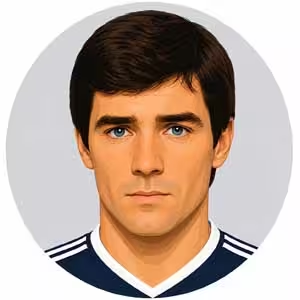
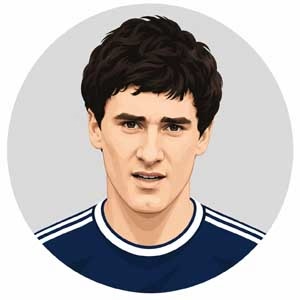
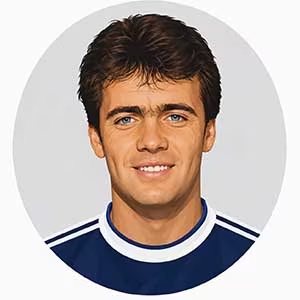
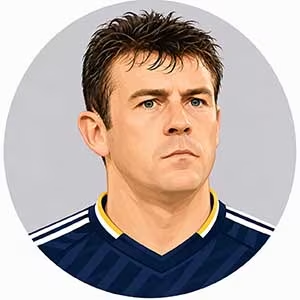
Scotland - Right BackJardine, Sandy
Two Rangers full-backs of the same golden generation, and neither Eric Caldow nor Sandy Jardine was ever once cautioned at international level across their combined careers — a statistic that says as much about the particular discipline the club demanded of that defensive lineage as it does about either man individually. Jardine made his debut against the very club he had supported as a boy, showed his own boyhood idols no mercy, and spent the following fifteen years building a reputation for exactly the composure that statistic implies.
Born William Pullar Jardine in Edinburgh in 1948, close enough to Hearts' Tynecastle Park that he grew up following the club, Jardine signed for Rangers as a teenager and made his first-team debut in 1967, days after a shock Scottish Cup defeat to lower-league Berwick Rangers had shaken the club into change. He was remarkably versatile early on, filling in as an inside forward, a left-back and even, briefly, at centre-forward, before manager Willie Waddell identified right-back as his ideal position from 1970 onward — a role he made almost entirely his own for the rest of a fifteen-year Rangers career. He combined defensive reliability with a genuine attacking instinct, running forward to support the play with a fitness that once carried him through 171 consecutive appearances, and played in two European finals a full five years apart: the 1967 Cup Winners' Cup defeat to Bayern Munich, and the club's greatest triumph, the 1972 victory over Dynamo Moscow in Barcelona. He won three league titles, five Scottish Cups and five League Cups, was part of two domestic Treble-winning sides, and made nearly 800 appearances for the club before returning to boyhood club Hearts in 1982, where he later became player-assistant manager and eventually joint manager. For Scotland he won 38 caps across nine years, playing at the 1974 and 1978 World Cups, and at the 1974 tournament he and Celtic's Danny McGrain were spoken of as the finest full-back pairing in the competition.
His limitations were modest relative to his standing, tied mainly to a career unfolding, like Greig's, during a period when Celtic's dominance under Jock Stein made sustained Rangers success considerably harder to come by than the club's history had suggested it should be. His attacking instincts, valuable as they were, occasionally left gaps behind him that a more purely defensive full-back would not have created.
Temperamentally he was defined, by every tribute offered at his death, in terms of dignity, class and integrity — words that appeared independently across multiple obituaries without evident coordination. That character extended well beyond his playing career: after returning to Rangers in various off-field roles, he became one of the club's most visible defenders during its genuine institutional crisis in 2012, helping organize a supporters' fighting fund and leading a protest march against decisions he believed were unfair to the club — activism undertaken not for personal gain but out of the same loyalty that had defined his playing days. He was diagnosed with liver cancer that same year and died eighteen months later, in 2014, at sixty-five. Rangers renamed the Govan Stand in his honor that summer, and Alex Ferguson, who had worked alongside him at Ibrox, called him a noble and courageous man held in immense respect at the club. Composed on the pitch, quietly principled in institutional crisis, and honored in death with the same seriousness his colleagues had shown him in life, Jardine belonged to a specific tradition of Rangers full-backs whose authority rested on conduct rather than confrontation.