We use Google Analytics to understand how visitors use this site. Analytics cookies are only activated with your consent. For details, read our Privacy Policy.
Profile lensThe same player, read from a different angle.
Athletic79
Acceleration
72
Pace
77
Agility
68
Strength
95
Balance
90
Jumping
76
Stamina
78
Fitness
78
Technical79
Dribbling
74
Short Passing
73
Long Passing
68
Finishing
84
Shot Accuracy
79
Shot Power
86
Shooting Technique
79
Heading
81
Tackling
44
Crossing
66
Free Kick
62
Penalties
68
First Touch
78
Mental78
Composure
76
Aggression
80
Consistency
78
Creativity
66
Leadership
80
Work Rate
80
Tactical79
Vision
73
Off the Ball
85
Defensive Positioning
40
Teamwork
77
Anticipation
82
Marking
38
Player Traits
Attacking79
Crossing
66
Finishing
84
Heading Accuracy
81
Shot Accuracy
79
Off the Ball
85
Technique72
Dribbling
74
Free Kick
62
Short Passing
73
Long Passing
68
First Touch
78
Shot Technique
79
Movement77
Acceleration
72
Pace
77
Agility
68
Balance
90
Physicality83
Shot Power
86
Jumping
76
Stamina
78
Strength
95
Fitness
78
Defending41
Marking
38
Tackling
44
Def. Positioning
40
Mentality & Game Reading76
Aggression
80
Composure
76
Penalties
68
Vision
73
Leadership
80
Work Rate
80
Teamwork
77
Anticipation
82
Consistency
78
Creativity
66
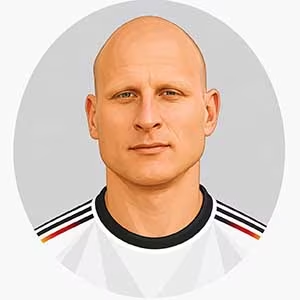
Germany - StrikerJancker, Carsten
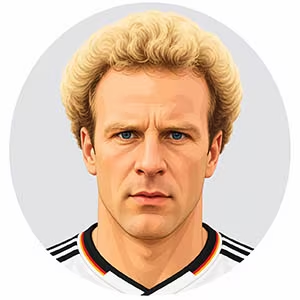
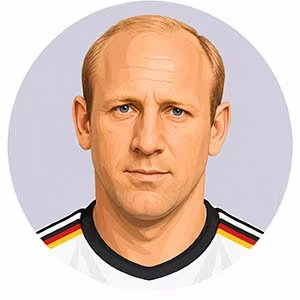
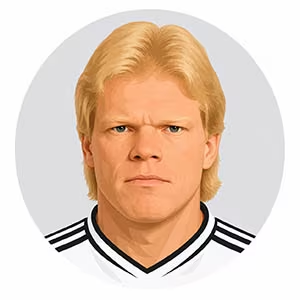
The sheer physical mass of a shaved-headed, six-foot-four target man became the primary battering ram of Ottmar Hitzfeld’s late-1990s Bayern Munich in the form of Carsten Jancker. Developed in the Hansa Rostock academy and refined through a pivotal Austrian stint with Rapid Wien—where he netted seven goals during their run to the 1996 UEFA Cup Winners' Cup final—Jancker was an unapologetic specialist in low-block demolition. He was not signed for aesthetic dribbling or delicate perimeter play; his entire tactical value resided in pinning central defenders, absorbing ferocious contact with his back to goal, and executing crisp, first-time aerial flick-ons or chest lay-offs for dynamic runners like Giovane Élber and Stefan Effenberg. At the Olympiastadion, Jancker's punishing physical presence anchored Bayern to four Bundesliga titles (1999, 2000, 2001, 2003), two DFB-Pokals, and the 2000–01 UEFA Champions League title against Valencia, alongside starting in the infamous 1999 final against Manchester United where his overhead kick rattled the crossbar. For Germany, across 33 caps and 10 goals, he served as Rudi Völler’s starting spearhead during the run to the 2002 World Cup final in Japan and South Korea, famously scoring in the 8–0 rout of Saudi Arabia.
Yet this hyper-specialized profile came with unforgiving tactical ceilings. Once stripped of overlapping wing service, Jancker’s offensive threat evaporated: his turning circle was notoriously wide, his linear acceleration over twenty yards was sluggish, and his shooting mechanics were stiff and heavily right-footed outside the six-yard box. His subsequent transfer to Udinese in Serie A ruthlessly exposed these limitations, resulting in a miserable two-year spell where Italian man-markers neutralized his physical hold-up play without breaking sweat, leading to subsequent journeyman years at Kaiserslautern, Shanghai Shenhua, and SV Mattersburg.
Stoic, uncomplaining, and built for self-sacrifice, Jancker accepted his role as an unglamorous tactical distraction without seeking personal limelight. He knew his job was to absorb bruising punishment from stoppers so others could score, and he performed it with monastic discipline. On the pitch, his body language was stoic and impassive; he treated violent shirt-pulling and forearm checks to the spine as routine occupational hazards rather than reasons to protest. Inside the Bayern and German locker rooms, he was an understated, quiet giant who avoided the tabloid drama of the FC Hollywood era, earning the genuine respect of combustible leaders like Oliver Kahn and Effenberg through his unselfish work rate. When marked by aggressive center-halves, Jancker leaned his heavy frame into the duel, wearing down opponents over ninety minutes through pure attrition. Match officials found him remarkably easy to referee because of his honest physical play, leaving behind a legacy as one of the most imposing, selfless, and functionally effective classic target men in modern German football history.