We use Google Analytics to understand how visitors use this site. Analytics cookies are only activated with your consent. For details, read our Privacy Policy.
Profile lensThe same player, read from a different angle.
Athletic77
Acceleration
74
Pace
75
Agility
71
Strength
91
Balance
78
Jumping
78
Stamina
77
Fitness
74
Technical84
Dribbling
81
Short Passing
74
Long Passing
75
Finishing
90
Shot Accuracy
85
Shot Power
89
Shooting Technique
78
Heading
87
Tackling
44
Crossing
71
Free Kick
95
Penalties
82
First Touch
85
Mental76
Composure
83
Aggression
81
Consistency
75
Creativity
74
Leadership
70
Work Rate
72
Tactical79
Vision
74
Off the Ball
87
Defensive Positioning
40
Teamwork
72
Anticipation
80
Marking
38
Player Traits
Attacking84
Crossing
71
Finishing
90
Heading Accuracy
87
Shot Accuracy
85
Off the Ball
87
Technique81
Dribbling
81
Free Kick
95
Short Passing
74
Long Passing
75
First Touch
85
Shot Technique
78
Movement75
Acceleration
74
Pace
75
Agility
71
Balance
78
Physicality82
Shot Power
89
Jumping
78
Stamina
77
Strength
91
Fitness
74
Defending41
Marking
38
Tackling
44
Def. Positioning
40
Mentality & Game Reading76
Aggression
81
Composure
83
Penalties
82
Vision
74
Leadership
70
Work Rate
72
Teamwork
72
Anticipation
80
Consistency
75
Creativity
74
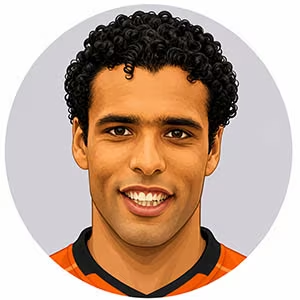
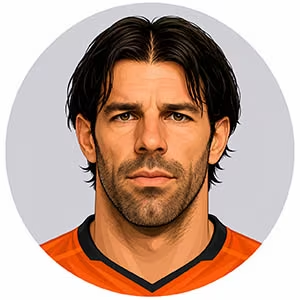
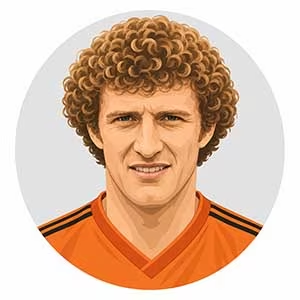
Netherlands - StrikerVan Hooijdonk, Pierre
Defying the laws of ballistics with dipping, vicious free-kicks that cleared the wall before plummeting like stones into the bottom corner turned a towering native of Steenbergen into one of the most feared set-piece executioners in European history. Petrus Ferdinandus Johannes van Hooijdonk was a powerhouse target-forward who married an imposing physical frame with the delicate, surgical ball-striking technique of a classic number ten.
Stationed as a traditional focal point, Van Hooijdonk combined exceptional back-to-goal hold-up play, dominant aerial heading, and a lethal scoring record across every league he touched: netting 52 goals for Celtic (winning the 1995 Scottish Cup), 34 league goals to fire Nottingham Forest into the Premier League, and becoming a cult idol at Benfica. His undisputed career peak unfolded at Feyenoord between 2001 and 2003, where he scored 52 goals in 61 matches, famously netting two free-kicks in the final to lift the 2001–02 UEFA Cup as the tournament's top scorer, before claiming back-to-back Süper Lig titles with Fenerbahçe. For the Netherlands, across 46 caps and 14 goals, he was a trusted clutch weapon across two European Championships (2000, 2004) and the 1998 World Cup.
His heavy, upright running style, however, carried distinct mechanical limitations. Van Hooijdonk lacked top-end sprint speed and agile lateral mobility; he could not run the channels over thirty yards or lead an intense, high-pressing frontline. When isolated against swift, modern center-backs who refused to engage in physical wrestling duels and successfully cut off deliveries into his chest, his contribution to open build-up play could become static and peripheral.
Outspoken, fiercely independent, and carrying an uncompromising sense of professional self-worth, Van Hooijdonk never shied away from high-voltage conflict. He famously went on strike at Nottingham Forest in 1998 after club directors sold his key teammates without consultation, enduring relentless media vitriol with head held high. On the pitch, his body language was commanding and demanding: organizing attacking setups, calling for deliveries, and celebrating free-kicks with outstretched arms. Inside the Celtic, Feyenoord, and Fenerbahçe dressing rooms, he was an untouchable, charismatic leader whose absolute reliability in high-pressure moments earned the lifelong adoration of supporters, leaving behind an enduring legacy as the ultimate clutch dead-ball specialist and target-man of his era.