We use Google Analytics to understand how visitors use this site. Analytics cookies are only activated with your consent. For details, read our Privacy Policy.
Profile lensThe same player, read from a different angle.
Athletic83
Acceleration
83
Pace
87
Agility
81
Strength
91
Balance
85
Jumping
82
Stamina
80
Fitness
75
Technical84
Dribbling
86
Short Passing
78
Long Passing
75
Finishing
86
Shot Accuracy
83
Shot Power
87
Shooting Technique
89
Heading
84
Tackling
51
Crossing
68
Free Kick
75
Penalties
77
First Touch
86
Mental76
Composure
76
Aggression
80
Consistency
75
Creativity
88
Leadership
71
Work Rate
80
Tactical82
Vision
78
Off the Ball
87
Defensive Positioning
44
Teamwork
77
Anticipation
85
Marking
38
Player Traits
Attacking82
Crossing
68
Finishing
86
Heading Accuracy
84
Shot Accuracy
83
Off the Ball
87
Technique82
Dribbling
86
Free Kick
75
Short Passing
78
Long Passing
75
First Touch
86
Shot Technique
89
Movement84
Acceleration
83
Pace
87
Agility
81
Balance
85
Physicality83
Shot Power
87
Jumping
82
Stamina
80
Strength
91
Fitness
75
Defending44
Marking
38
Tackling
51
Def. Positioning
44
Mentality & Game Reading79
Aggression
80
Composure
76
Penalties
77
Vision
78
Leadership
71
Work Rate
80
Teamwork
77
Anticipation
85
Consistency
75
Creativity
88
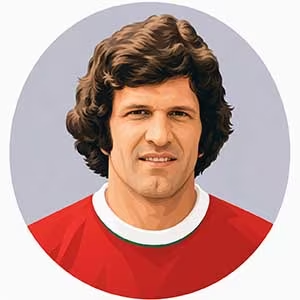
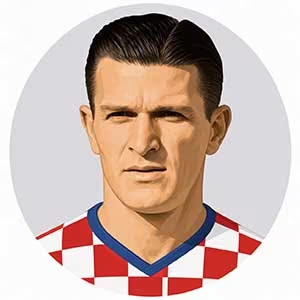
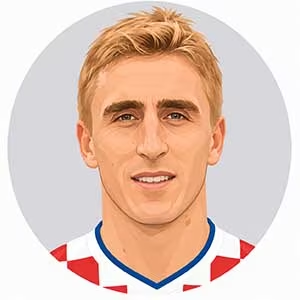
Croatia - StrikerBokšic, Alen
Raw physical power, a long stride capable of chewing up open ground, and devastating linear dribbling made Alen Bokšić one of the most unplayable, complete forward specimens of 1990s European football. Emerging from Hajduk Split—where he scored the famous winner in the 1991 Yugoslav Cup final against Red Star Belgrade—the Dalmatian powerhouse exploded onto the global stage with Olympique de Marseille during the 1992–93 campaign. Operating as an imposing six-foot-two center-forward with rare acceleration and broad-shouldered balance, he led Ligue 1 with 23 goals, won the inaugural UEFA Champions League against AC Milan, and finished runner-up to Roberto Baggio for the 1993 Ballon d'Or. His subsequent move to Serie A saw him terrorize Italian defenses for Lazio and Juventus: he possessed the rare ability to receive the ball 40 yards from goal, drop his shoulder, and barge through two central defenders at full sprint. Across his stints in Rome and Turin, he lifted two Scudetti (1996–97 with Juve, 1999–2000 with Lazio), the 1996 Intercontinental Cup, the 1998–99 European Cup Winners' Cup, and two Coppa Italia trophies before concluding his career in the Premier League with Middlesbrough. For Croatia, he collected 40 caps and ten goals, forming a terrifying attacking tandem with Davor Šuker, though chronic muscle and knee injuries cruelly ruled him out of Croatia’s historic 1998 World Cup bronze run.
Aloof, fiercely private, and driven by pure athletic instinct, Bokšić played the game with an unpredictable, moody brilliance that left managers alternately awed and exasperated. He was completely uninterested in penalty-box poaching or padding his scoring statistics against weaker opposition; he drew genuine motivation almost exclusively from high-friction, heavyweight fixtures against elite defenders like Franco Baresi or Paolo Maldini, whom he regularly dismantled with sheer power. On the pitch, his body language could swing from languid disinterest to sudden, terrifying ferocity in the space of three strides. Inside the dressing room, he was a quiet, self-contained figure who maintained an independent circle, respected by teammates for his unselfish hold-up play and willingness to create space for secondary runners rather than obsessing over personal tallies. When opposing stoppers attempted to intimidate him with cynical physical contact, Bokšić met force with overwhelming force, shrugging off shirt-pulls and tactical fouls without going down. Referees found him hard to read but fundamentally honest, leaving an enduring legacy as an athletic juggernaut whose terrifying technical and physical ceiling was matched only by the fragile muscles that limited his full consistency.


 All Time CroatiaNT