We use Google Analytics to understand how visitors use this site. Analytics cookies are only activated with your consent. For details, read our Privacy Policy.
Profile lensThe same player, read from a different angle.
Athletic80
Acceleration
73
Pace
76
Agility
71
Strength
86
Balance
82
Jumping
81
Stamina
81
Fitness
91
Technical78
Dribbling
72
Short Passing
75
Long Passing
78
Finishing
64
Shot Accuracy
64
Shot Power
82
Shooting Technique
66
Heading
84
Tackling
86
Crossing
70
Free Kick
65
Penalties
64
First Touch
75
Mental84
Composure
80
Aggression
91
Consistency
92
Creativity
64
Leadership
83
Work Rate
81
Tactical79
Vision
72
Off the Ball
64
Defensive Positioning
85
Teamwork
76
Anticipation
82
Marking
84
Player Traits
Attacking69
Crossing
70
Finishing
64
Heading Accuracy
84
Shot Accuracy
64
Off the Ball
64
Technique72
Dribbling
72
Free Kick
65
Short Passing
75
Long Passing
78
First Touch
75
Shot Technique
66
Movement76
Acceleration
73
Pace
76
Agility
71
Balance
82
Physicality84
Shot Power
82
Jumping
81
Stamina
81
Strength
86
Fitness
91
Defending85
Marking
84
Tackling
86
Def. Positioning
85
Mentality & Game Reading79
Aggression
91
Composure
80
Penalties
64
Vision
72
Leadership
83
Work Rate
81
Teamwork
76
Anticipation
82
Consistency
92
Creativity
64
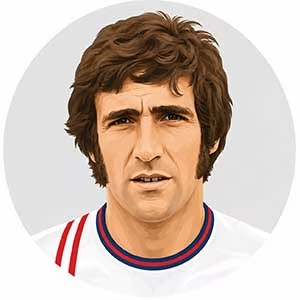
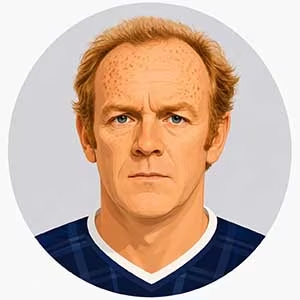
England - Centre-backHunter, Norman
Hunter was a left-footed centre-back and occasional defensive midfielder whose game combined ferocious tackling with anticipation and considerably better distribution than his image suggested. He was not especially tall for a central defender, but compensated through strength, timing and a willingness to engage attackers before they could establish control. Don Revie considered his reading of danger exceptional: Hunter stepped forward to intercept, covered teammates when the defensive line was disturbed and often stopped attacks before they developed into obvious emergencies. Once possession was recovered, his powerful left foot allowed him to find midfielders quickly rather than merely clear the ball. Alongside the more aerially dominant Jack Charlton, he became the aggressive mobile component of one of England’s strongest defences. Hunter joined Leeds as a teenager, made his first-team debut in 1962 and accumulated 726 appearances for the club. He won two First Division titles, the FA Cup, League Cup and two Inter-Cities Fairs Cups, while repeatedly finishing runner-up in domestic and European competitions. In 1973–74, as Leeds won another league championship, Hunter became the inaugural winner of the PFA Players’ Player of the Year award. He left for Bristol City in 1976 and later played for Barnsley. England gave him 28 caps. He belonged to the 1966 World Cup-winning squad but could not displace the established central-defensive partnership, and he remained part of the national setup through the unsuccessful qualification campaign for the 1974 tournament.
His aggression imposed costs that cannot be softened into “competitive spirit”. Hunter fouled deliberately when he believed the situation required it and later admitted as much. His disciplinary file was substantial even by the standards of an era in which defenders were allowed far greater physical latitude. Against quick attackers, stepping forward aggressively could leave him exposed if the challenge failed, while his relatively modest height made the partnership with a dominant aerial defender especially useful. More importantly, emotional escalation could override tactical judgement. In 1975, after repeated confrontation with Derby County’s Francis Lee, Hunter exchanged punches with him in a prolonged fight and both players were sent off. He also maintained antagonistic relationships with opponents such as Peter Osgood. Hunter himself described occasions when the desire to win became so intense that a “red mist” descended. His physical aggression was normally purposeful; under sufficient provocation it could cease to be.
Psychologically, Hunter is unusually valuable because he openly distinguished intention from escalation. He insisted that he never began matches wanting to injure opponents, but also admitted that competitive intensity could wind him up until control deteriorated. This was not retrospective sanitisation: he joked about the FA maintaining a thick disciplinary file on him and acknowledged that, if the laws still allowed certain methods, he would use them. The “Bites Yer Legs” identity therefore did not merely come from hostile mythology. Hunter accepted much of the underlying truth, even if he disliked occasions when the nickname caused people to ignore his technical ability. Provocation was consequently a genuine performance variable. Ordinary physical confrontation did not intimidate him; it increased his engagement and suited his preferred game. Personal antagonism was different. Against opponents with whom rivalry accumulated, such as Osgood or Lee, the contest could become interpersonal, raising retaliation risk beyond what the tactical situation justified. Yet Hunter was not generally an anxious or socially hostile personality. Away from the immediate confrontation he was remembered for humour, warmth and self-deprecation, and he could recount his own excesses without constructing elaborate excuses. Even the famous nickname was eventually treated as a joke with supporters. His relationship with authority was similarly revealing. Revie trusted him enormously and Hunter accepted a highly structured collective culture in which preparation, tactical assignments and responsibility to teammates were non-negotiable. Alf Ramsey’s repeated preference for other centre-backs did not produce a documented public campaign for selection; Hunter remained within the England squad despite possessing the status of one of the best defenders in domestic football. His strongest grievances emerged instead when he believed competition itself had become unfair. In the controversial 1973 Cup Winners’ Cup final against Milan, frustration with refereeing contributed to his late dismissal. Hunter’s leadership was protective and confrontational rather than calming. He covered teammates, imposed physical boundaries around dangerous areas and accepted responsibility for stopping attacks even when the solution risked punishment. Major occasions did not make him cautious: decades of finals, title races and European ties generally intensified the same behaviour. The essential contradiction is therefore that Hunter possessed excellent tactical intelligence while occasionally allowing emotion to override it. He could see danger earlier than most defenders, yet when anger became personal he could knowingly create danger for himself.