We use Google Analytics to understand how visitors use this site. Analytics cookies are only activated with your consent. For details, read our Privacy Policy.
Profile lensThe same player, read from a different angle.
Athletic81
Acceleration
82
Pace
85
Agility
83
Strength
81
Balance
77
Jumping
85
Stamina
79
Fitness
78
Technical83
Dribbling
80
Short Passing
75
Long Passing
72
Finishing
92
Shot Accuracy
91
Shot Power
79
Shooting Technique
71
Heading
92
Tackling
41
Crossing
67
Free Kick
66
Penalties
76
First Touch
78
Mental77
Composure
84
Aggression
76
Consistency
75
Creativity
71
Leadership
74
Work Rate
74
Tactical81
Vision
73
Off the Ball
89
Defensive Positioning
33
Teamwork
72
Anticipation
88
Marking
38
Player Traits
Attacking86
Crossing
67
Finishing
92
Heading Accuracy
92
Shot Accuracy
91
Off the Ball
89
Technique74
Dribbling
80
Free Kick
66
Short Passing
75
Long Passing
72
First Touch
78
Shot Technique
71
Movement82
Acceleration
82
Pace
85
Agility
83
Balance
77
Physicality80
Shot Power
79
Jumping
85
Stamina
79
Strength
81
Fitness
78
Defending37
Marking
38
Tackling
41
Def. Positioning
33
Mentality & Game Reading76
Aggression
76
Composure
84
Penalties
76
Vision
73
Leadership
74
Work Rate
74
Teamwork
72
Anticipation
88
Consistency
75
Creativity
71
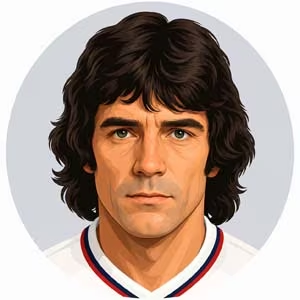
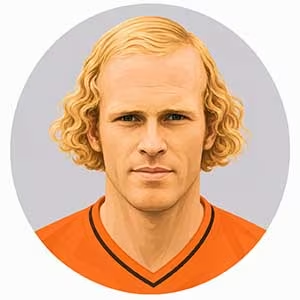
Netherlands - StrikerGeels, Ruud
Geels was a centre-forward whose game was built around movement inside the box rather than sustained participation outside it. Around 1.80 metres tall, he possessed an exceptional leap and heading technique that allowed him to dominate defenders considerably taller than himself. He attacked crosses rather than waiting underneath them, adjusting his run late and generating power through timing and elevation. With the ball on the ground he was efficient rather than elaborate: quick finishes, rebounds, short combinations and instinctive shots mattered more than dribbling or extended construction. His career was remarkably itinerant for a player of such consistent productivity. After emerging with Telstar, he joined Feyenoord in 1966 and was part of the squad that won the European Cup in 1970, although he had already lost his regular place by then. He moved to Go Ahead Eagles and then Club Brugge, where his scoring brought him back into the Netherlands setup. Ajax signed him in 1974, and there he reached his statistical peak. Geels became Eredivisie top scorer in four consecutive seasons from 1974–75 through 1977–78, scoring 123 league goals in 131 appearances for Ajax. He later played for Anderlecht, Sparta Rotterdam and PSV, becoming the rare footballer to represent Feyenoord, Ajax and PSV during the same career. He finished as Eredivisie top scorer for a fifth time with Sparta in 1980–81. For the Netherlands he scored 11 goals in 20 appearances and was selected for the 1974 World Cup, although he did not play during the tournament.
The narrowness of his specialisation was also his principal limitation. Geels could disappear from matches when opponents denied crosses, defended the penalty area deeply and prevented him establishing the positions from which his heading and finishing became dangerous. He was not a forward who naturally dropped into midfield to dictate combinations, carried attacks over long distances or created repeated chances through one-on-one dribbling. His value therefore depended heavily on supply and territorial presence. Coaches seeking constant pressing, positional interchange or extensive contribution to construction could prefer a less prolific but more multifunctional forward. This mattered at the highest level. Geels could score at extraordinary rates in domestic football without becoming indispensable for the Netherlands, and his complete lack of minutes at the 1974 World Cup demonstrated how tactical hierarchy could override individual productivity. When the structure did not require his particular finishing profile, he had fewer alternative ways of forcing himself into it.
Psychologically, Geels was more sensitive to that hierarchy than his long scoring record might suggest. Selection for the 1974 World Cup initially represented recognition, but his role quickly became marginal. Geels later recalled the tournament without romanticising the experience: he had expected some opportunity, found himself repeatedly unused and became increasingly frustrated as the competition progressed. He did not disrupt the squad publicly during its run to the final, but the exclusion clearly mattered to him and remained part of how he remembered the tournament. That distinction is useful. Geels could contain frustration behaviourally without being emotionally indifferent to status. His club career repeatedly tested the same issue. At Feyenoord he lost his place despite scoring heavily earlier in his spell and chose movement rather than indefinite acceptance of reserve status. Later transfers followed a similar practical logic: he went where his finishing could remain central to the team rather than attaching his identity permanently to one institution. That mobility should not be confused with weak commitment. At Ajax he produced four consecutive top-scoring seasons and functioned reliably despite managerial and tactical changes. His relationship with physical confrontation was comparatively straightforward. Geels expected centre-backs to challenge him aggressively because his game required repeated aerial contact, but there is little evidence of a habitual pattern of retaliation, referee disputes or emotional destabilisation after fouls. The more important trigger was usefulness. When selected and supplied, his confidence appears remarkably stable: misses did not stop him returning to the same spaces, and his scoring record across unrelated clubs indicates little dependence on one supportive environment. When deprived of a role altogether, however, frustration accumulated. He was therefore neither status-indifferent like a purely functional squad player nor theatrically demanding. His behaviour suggests a strong professional belief that goals justified participation, accompanied by genuine difficulty accepting situations in which coaches reached a different conclusion. Major occasions themselves did not produce obvious inhibition; rather, the problem was whether he was allowed into them. Geels’s competitive identity rested on repetition and proof. He kept entering the penalty area, kept scoring, and expected that production to earn another opportunity. When it did not, he generally moved somewhere that would give him one.


 All Time AjaxClub