We use Google Analytics to understand how visitors use this site. Analytics cookies are only activated with your consent. For details, read our Privacy Policy.
Profile lensThe same player, read from a different angle.
Athletic77
Acceleration
84
Pace
83
Agility
83
Strength
66
Balance
76
Jumping
63
Stamina
85
Fitness
78
Technical80
Dribbling
82
Short Passing
82
Long Passing
86
Finishing
66
Shot Accuracy
74
Shot Power
84
Shooting Technique
77
Heading
61
Tackling
59
Crossing
85
Free Kick
85
Penalties
76
First Touch
83
Mental80
Composure
84
Aggression
76
Consistency
81
Creativity
73
Leadership
72
Work Rate
83
Tactical80
Vision
82
Off the Ball
78
Defensive Positioning
68
Teamwork
86
Anticipation
76
Marking
62
Attacking73
Crossing
85
Finishing
66
Heading Accuracy
61
Shot Accuracy
74
Off the Ball
78
Technique83
Dribbling
82
Free Kick
85
Short Passing
82
Long Passing
86
First Touch
83
Shot Technique
77
Movement82
Acceleration
84
Pace
83
Agility
83
Balance
76
Physicality75
Shot Power
84
Jumping
63
Stamina
85
Strength
66
Fitness
78
Defending63
Marking
62
Tackling
59
Def. Positioning
68
Mentality & Game Reading79
Aggression
76
Composure
84
Penalties
76
Vision
82
Leadership
72
Work Rate
83
Teamwork
86
Anticipation
76
Consistency
81
Creativity
73
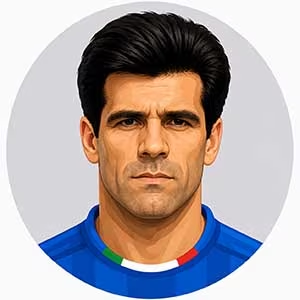
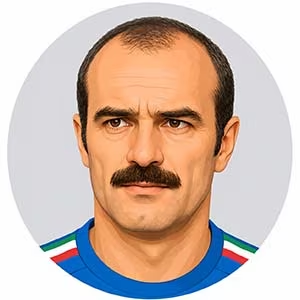
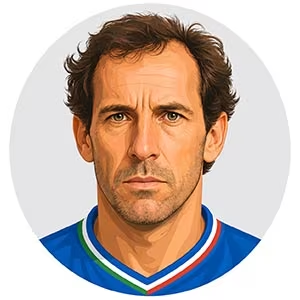
Italy - Left MidfielderEvani, Alberico
Ten days in December 1989, two finals, two free kicks, two decisive goals — the European Super Cup against Barcelona and the Intercontinental Cup against Atlético Nacional, both resolved by the same unassuming left-sided player nobody outside Milan's own dressing room would have picked as the team's most reliable man in a crisis. Alberico Evani spoke little, was noticed less, and was, by the consistent account of everyone who played with him, simply and indisputably effective.
Born in Massa, Tuscany, in 1963, Evani came through Milan's academy and stayed with the club for thirteen seasons, developing from a left-back into a genuinely versatile midfielder capable of filling nearly any position across the left side of the pitch. He was not the fastest or most technically dazzling player in a squad that eventually contained Gullit, Van Basten and Rijkaard, but Arrigo Sacchi specifically valued him for tactical discipline and tireless movement, qualities that kept him a fixture even as the club assembled one of the greatest sides in football history around him. He won three Serie A titles, two European Cups, two European Super Cups and two Intercontinental Cups at Milan, scoring the winner in the 1989 Intercontinental Cup final and being named man of the match, before a 1993 move to Sampdoria added a Coppa Italia alongside teammates including Roberto Mancini. He closed his playing career in the lower divisions at Reggiana and Carrarese. For Italy he won 15 caps under his former Milan manager Sacchi and was part of the 1994 World Cup squad that reached the final, where he converted his penalty in the shootout defeat to Brazil — one of only two Italian players to do so that day, alongside Demetrio Albertini.
His limitations were the modest ones of a genuine utility player rather than a headline talent. Evani was never going to be the man defining a Milan team's attacking identity, and his value lay almost entirely in reliability and adaptability rather than in individual brilliance; against opponents who could isolate and outclass him technically in one-on-one situations, his contribution remained functional rather than decisive. His path to a regular first-team place was also complicated by the sheer depth of the squad around him, meaning even a genuinely important player spent portions of his prime competing for a place rather than guaranteed one.
Temperamentally he was defined by quiet loyalty and understated composure under pressure. During Milan's difficult early-1980s period, which included two relegations to Serie B, Evani chose to stay with the club alongside Franco Baresi and Mauro Tassotti rather than leave for an easier path elsewhere, a decision that positioned all three players at the heart of the extraordinary success that followed once the club recovered. He earned the affectionate nickname Bubu, after Yogi Bear's melancholic-looking sidekick Boo-Boo, a label that captured both his physical resemblance and a personality colleagues described as unassuming rather than demonstrative. He was trusted repeatedly with the responsibility of the decisive free kick and the decisive penalty precisely because his composure did not visibly fluctuate with the size of the occasion — the two finals resolved within ten days of each other in 1989 were not aberrations but a pattern that continued into the 1994 World Cup shootout. Away from the pitch he moved seamlessly into a long coaching career within Italian football's youth system, eventually becoming an assistant to the senior national team, a natural continuation of a career built on reliability rather than visibility. Quiet, versatile and consistently entrusted with the moments that mattered most precisely because he never seemed rattled by them, Evani built a career on being exactly the player a great team needs and rarely celebrates.