We use Google Analytics to understand how visitors use this site. Analytics cookies are only activated with your consent. For details, read our Privacy Policy.
Profile lensThe same player, read from a different angle.
Athletic80
Acceleration
76
Pace
82
Agility
76
Strength
79
Balance
83
Jumping
78
Stamina
87
Fitness
76
Technical80
Dribbling
77
Short Passing
82
Long Passing
82
Finishing
77
Shot Accuracy
77
Shot Power
89
Shooting Technique
73
Heading
76
Tackling
72
Crossing
74
Free Kick
74
Penalties
73
First Touch
78
Mental76
Composure
78
Aggression
82
Consistency
77
Creativity
73
Leadership
70
Work Rate
82
Tactical79
Vision
82
Off the Ball
75
Defensive Positioning
69
Teamwork
84
Anticipation
77
Marking
66
Player Traits
Attacking76
Crossing
74
Finishing
77
Heading Accuracy
76
Shot Accuracy
77
Off the Ball
75
Technique78
Dribbling
77
Free Kick
74
Short Passing
82
Long Passing
82
First Touch
78
Shot Technique
73
Movement79
Acceleration
76
Pace
82
Agility
76
Balance
83
Physicality82
Shot Power
89
Jumping
78
Stamina
87
Strength
79
Fitness
76
Defending69
Marking
66
Tackling
72
Def. Positioning
69
Mentality & Game Reading78
Aggression
82
Composure
78
Penalties
73
Vision
82
Leadership
70
Work Rate
82
Teamwork
84
Anticipation
77
Consistency
77
Creativity
73
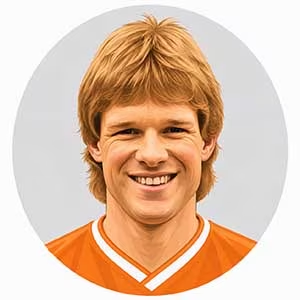
Netherlands - Left MidfielderKoeman, Erwin
There is a photograph from the 1988 European Championship final, seconds before the Netherlands' opening goal, of a corner curling in from the right — Erwin Koeman's delivery, headed out, crossed back in by the same player toward the far post, where Marco van Basten craned his neck to square it for Ruud Gullit's header. Koeman's younger brother Ronald orchestrated that Dutch side from the back as its sweeper and most celebrated figure. Erwin, on the opposite flank, remains part of the answer to a trivia question almost nobody gets right: he and Ronald are still the only siblings to have played together in a European Championship final.
Born in Zaandam in 1961, eighteen months before Ronald, Erwin Koeman came through Groningen, the club their father Martin had also represented at international level, before both brothers made their national team debuts in the same match in 1983. He was a conventional, technically capable left-sided midfielder, valued for accurate crossing and intelligent positioning rather than the goal-scoring range that made his brother a defender who behaved like an attacker. He spent three seasons at PSV without ever fully establishing himself, then moved to Belgium's KV Mechelen, where he became central to the club's finest period — a Belgian championship, the 1988 Cup Winners' Cup, and a European Super Cup win in 1989 that, in an unusual family footnote, came against Ronald's PSV. He returned to PSV for a second spell and won two further league titles before closing his career back at Groningen at thirty-seven. He appeared in four of the Netherlands' five matches at Euro 1988, including the final, and played at the 1990 World Cup as the country defended its title.
His limitations were tied to a career spent almost entirely inside the Dutch and Belgian leagues rather than in the more visible competitions that built his brother's wider reputation. Koeman never played in Spain, Italy or England, the markets that magnified contemporaries into international stars, and his more conventional attacking profile lacked the singular quality — Ronald's shooting range from deep positions — that made a career-defining highlight reel possible. Squad rotation limited his minutes even during the Netherlands' greatest tournament, and his overall international recognition never matched his tangible contribution to the team's biggest moment.
Temperamentally the available record describes a player defined by quiet effectiveness and family loyalty rather than by any singular personality trait of his own. He remained closely associated with Groningen throughout his life, played alongside his brother at multiple stages of both their careers, and moved into coaching immediately after retiring — six years at PSV across youth and first-team assistant roles, then later joining Ronald's staff at both Southampton and Everton, a professional partnership that outlasted their playing careers by decades. He went on to hold head coaching positions himself, including spells with Hungary, Utrecht and Fenerbahçe, suggesting an independent coaching identity even within a career frequently described in relation to his more famous sibling. In 2021 a statue of all three Koemans — father and both sons — was erected outside Groningen's stadium, a monument to a genuinely three-generation football family rather than to any single member of it. Understated, loyal to both family and hometown club, and a genuine contributor to Dutch football's greatest tournament triumph despite being consistently overshadowed by his own brother, Erwin Koeman built a career whose quieter contributions were real even when they went largely unrecorded outside football history.