We use Google Analytics to understand how visitors use this site. Analytics cookies are only activated with your consent. For details, read our Privacy Policy.
Profile lensThe same player, read from a different angle.
Athletic79
Acceleration
84
Pace
81
Agility
87
Strength
74
Balance
83
Jumping
75
Stamina
78
Fitness
73
Technical85
Dribbling
91
Short Passing
86
Long Passing
82
Finishing
85
Shot Accuracy
84
Shot Power
83
Shooting Technique
78
Heading
77
Tackling
45
Crossing
77
Free Kick
75
Penalties
86
First Touch
86
Mental76
Composure
82
Aggression
74
Consistency
74
Creativity
87
Leadership
70
Work Rate
74
Tactical80
Vision
82
Off the Ball
85
Defensive Positioning
45
Teamwork
78
Anticipation
78
Marking
38
Player Traits
Attacking82
Crossing
77
Finishing
85
Heading Accuracy
77
Shot Accuracy
84
Off the Ball
85
Technique83
Dribbling
91
Free Kick
75
Short Passing
86
Long Passing
82
First Touch
86
Shot Technique
78
Movement84
Acceleration
84
Pace
81
Agility
87
Balance
83
Physicality77
Shot Power
83
Jumping
75
Stamina
78
Strength
74
Fitness
73
Defending43
Marking
38
Tackling
45
Def. Positioning
45
Mentality & Game Reading79
Aggression
74
Composure
82
Penalties
86
Vision
82
Leadership
70
Work Rate
74
Teamwork
78
Anticipation
78
Consistency
74
Creativity
87
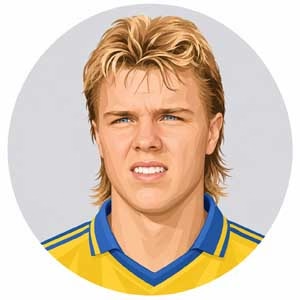
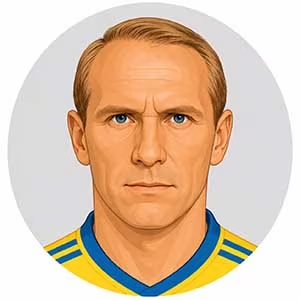
Sweden - ForwardBrolin, Tomas
Brolin at his peak was neither a conventional striker nor a pure midfielder. He could play behind the forwards, as a second striker, from the right, or as a central attacking connector, combining short passing, powerful carrying, acceleration and unusually direct goal threat. His best football at Parma and with Sweden depended on that hybridity. He could drop to participate in construction, attack the box late, exchange positions with forwards and exploit spaces before defenders had assigned responsibility for him. At USA 1994, Sweden initially used him in attack before shifting him towards the right; Kennet Andersson later recalled that Brolin was unhappy with the change until Roland Nilsson assured him that defensive duties would be covered, after which the arrangement worked extremely well. That anecdote matters tactically: Brolin could accept positional displacement if the new role preserved attacking interpretation. His capacity to improvise within structure made him central to Parma’s rise and Sweden’s 1994 bronze medal, while two Guldbollen awards, in 1990 and 1994, mark how high his peak was regarded domestically.
The limitations became far more visible once injury and environment removed that functional freedom. In November 1994 Brolin suffered a serious foot fracture against Hungary. He returned earlier than expected and later rejected the idea that the injury alone ended his career, but it undeniably interrupted the physical continuity of a player whose game depended on mobility and rapid changes of direction. At Leeds, the more important degradation mechanism was tactical and institutional. Brolin says Howard Wilkinson recruited him after explicitly promising a central creative role, “the spider in the web,” only to use him differently once circumstances changed. He could still technically perform other positions, but a role that reduced him to functions he did not believe suited his game progressively detached him from the project. This distinction matters. Brolin was not incapable of tactical compromise—the Swedish national team had already disproved that. He degraded when compromise became, in his perception, misrepresentation: when the role no longer matched the footballing agreement under which he had entered the environment. Physically, reduced sharpness compounded the problem, but loss of trust appears at least as important as loss of explosiveness.
Psychologically, Brolin is best defined by high competitive self-direction combined with low tolerance for imposed role incongruence. Under tournament pressure, his instinct was often to take ownership rather than defer. Against Romania he changed the rehearsed free kick because he read the situation differently and scored; in the same match he advised the far more experienced Ravelli before the shoot-out. After Sweden lost the 1994 semi-final to Brazil, Brolin later recalled being among the first players to push the group towards treating the third-place match as meaningful rather than surrendering emotionally after elimination. None of this supports the stereotype of a carefree improviser. He was intensely invested in how the game should be solved. That same trait became corrosive at Leeds. Brolin’s later account describes broken promises, marginalisation and eventually deliberate underperformance in one episode because he believed the club was mishandling him; whether every detail of that retrospective account is accepted or not, the behavioural conflict itself is well documented. He also later said that what ultimately exhausted him was not the old injury but the football establishment and the mechanisms surrounding selection and treatment. This is not simple authority rebellion: with Sweden and Parma he functioned inside demanding structures when he believed the role made footballing sense. Nor is it low resilience: acute competitive pressure repeatedly produced strong performance. The more precise distinction is agency dependence. Brolin could tolerate difficulty, tactical change and high stakes; he struggled far more when he felt that his interpretation of his own function had been stripped of legitimacy.