We use Google Analytics to understand how visitors use this site. Analytics cookies are only activated with your consent. For details, read our Privacy Policy.
Profile lensThe same player, read from a different angle.
Athletic79
Acceleration
77
Pace
75
Agility
74
Strength
85
Balance
76
Jumping
82
Stamina
88
Fitness
77
Technical80
Dribbling
79
Short Passing
82
Long Passing
79
Finishing
80
Shot Accuracy
71
Shot Power
84
Shooting Technique
76
Heading
83
Tackling
79
Crossing
74
Free Kick
63
Penalties
66
First Touch
80
Mental78
Composure
82
Aggression
76
Consistency
77
Creativity
74
Leadership
79
Work Rate
75
Tactical81
Vision
82
Off the Ball
74
Defensive Positioning
77
Teamwork
83
Anticipation
83
Marking
73
Player Traits
Attacking76
Crossing
74
Finishing
80
Heading Accuracy
83
Shot Accuracy
71
Off the Ball
74
Technique77
Dribbling
79
Free Kick
63
Short Passing
82
Long Passing
79
First Touch
80
Shot Technique
76
Movement76
Acceleration
77
Pace
75
Agility
74
Balance
76
Physicality83
Shot Power
84
Jumping
82
Stamina
88
Strength
85
Fitness
77
Defending76
Marking
73
Tackling
79
Def. Positioning
77
Mentality & Game Reading78
Aggression
76
Composure
82
Penalties
66
Vision
82
Leadership
79
Work Rate
75
Teamwork
83
Anticipation
83
Consistency
77
Creativity
74
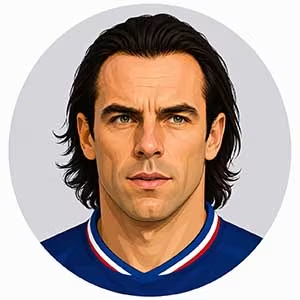
France - Centre MidfielderBoghossian, Alain
Born in Marseille in 1970 to a family of Armenian descent, Boghossian was a box-to-box and holding midfielder built on work rate, positional intelligence and defensive solidity rather than technical flair. He read the game well enough to break up opposition attacks early, covered ground constantly across ninety minutes, and passed simply and reliably rather than ambitiously, favouring the correct option over the spectacular one. He emerged in French football before moving to Italy, where he spent the bulk of his career: five seasons at Sampdoria from 1993, where he won the 1994 Coppa Italia, then Napoli, then Parma from 2000, where he added further Italian silverware in a squad built around more heralded names. He won the 1998 World Cup with France, featuring as a rotation and impact midfielder across the tournament behind the first-choice trio of Deschamps, Petit and Vieira, and collected a modest number of senior caps for a champion of that stature.
His limitations were exactly what his role implied. Boghossian was never a creative outlet and offered little going forward beyond the simple pass, which meant his teams needed genuine playmakers elsewhere to generate chances. He was not physically dominant and depended on positioning and anticipation rather than power to win the ball, making him less effective against midfields that combined size with technical quality. In the biggest matches of his career he was frequently a squad option rather than an automatic starter, and his influence on any given game was proportional to how much defensive disorder needed correcting rather than to any individual moment he could manufacture alone.
Temperamentally he was the model of quiet acceptance. Boghossian never publicly contested his role in a France squad containing better-known midfielders, worked without complaint in the shadow of teammates who received the credit for performances he had helped enable, and built a career-long reputation as a reliable, low-maintenance professional inside every dressing room he occupied. He did not seek confrontation with coaches or officials, argued rarely, and fouled at a functional rather than aggressive rate — enough to break up play, not enough to accumulate cards. His discipline in training was consistent and unremarkable in the best sense: he simply did the work. Away from football his connection to his Armenian heritage was not incidental; he later became actively involved in developing football in Armenia, working with the national federation in a technical capacity, a commitment that suggested his sense of duty extended well beyond any single dressing room. Unassuming, dependable and entirely without ego about his own visibility, Boghossian belonged to the category of footballer that champion teams require and rarely celebrate.